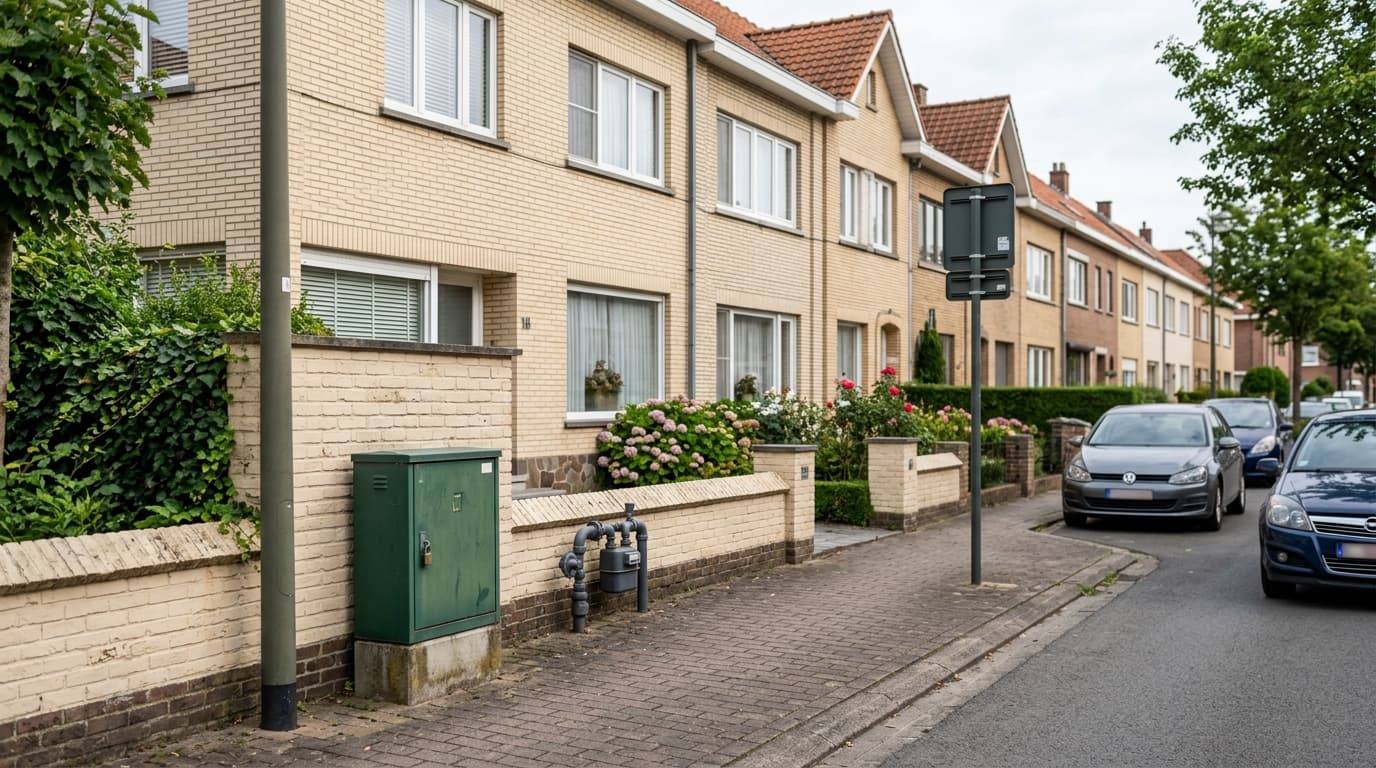
Two companies share the amount on a Belgian energy bill. You picked one of them, the supplier. The other came with your address, without anyone asking your opinion: the distribution system operator, known here by its French abbreviation GRD. Knowing who does what saves you from calling the wrong number, and from believing that switching supplier will move a line that never moves.
What is the difference between a supplier and a grid operator?
The supplier sells the energy and issues the bill. The grid operator owns the cables, the gas pipes and the meter.
This split dates from market liberalisation and it is strict. Synergrid, the federation of Belgian grid operators, sums up their mission as building, maintaining and managing the network, physically distributing electricity and gas to end customers, and carrying out public service obligations. The supplier buys its energy from producers, importers or exchanges, then resells it with its own margin and commercial service.
One example makes the boundary obvious. If you leave Engie for Mega or Luminus, your electricity keeps arriving through exactly the same cables, read by exactly the same meter, maintained by exactly the same technical crew. Only the company that bills you changes, along with the price it applies to the energy component.

Who is my distribution network operator?
Your municipality decides, and you cannot change it.
Synergrid is explicit on this point: a single distribution system operator is appointed for a defined territory, so the customer cannot choose their own. Precisely because it operates as a monopoly, its tariffs are capped and approved by the competent regional regulator: CWaPE in Wallonia, Brugel in Brussels, VREG in Flanders.
Three ways to identify yours, from fastest to most reliable:
- Your energy bill. The operator's name appears in the network costs block, often in small print, sometimes with two different names if you are connected to both energies.
- Synergrid's municipal lookup. The federation publishes a search tool returning the grid operator for your municipality, separately for electricity and gas.
- Your regional regulator's website. The slowest route, but the official reference if the territory is ever disputed.
Sibelga, Fluvius and the five Walloon operators
The Belgian landscape is asymmetrical, and that is the first source of confusion.
Brussels has one player: Sibelga distributes both electricity and gas across the nineteen municipalities. In Flanders, Fluvius operates the network on behalf of all Flemish operators, which for the end user also amounts to a single contact. Wallonia has five, very unequal in size.
| Region | Operators | Energies | Coverage |
|---|---|---|---|
| Brussels | Sibelga | Electricity and gas | 19 municipalities |
| Flanders | Fluvius | Electricity and gas | Whole region |
| Wallonia | ORES | Electricity and gas | About three quarters of Walloon municipalities |
| Wallonia | RESA | Electricity and gas | Liège area |
| Wallonia | AIEG | Electricity only | Andenne, Gesves, Ohey, Viroinval, Rumes |
| Wallonia | AIESH | Electricity only | Beaumont, Chimay, Couvin, Erquelinnes, Froidchapelle, Momignies, Sivry-Rance |
| Wallonia | REW | Electricity only | Wavre, Limal, Bierges |
Three of those five operators handle electricity alone. A consequence rarely spelled out: a household in Andenne or Chimay connected to natural gas does not have the same technical contact for its two energies. One number for a power cut, another one for a gas smell.
How much does the network you did not choose cost?
Far more than most people assume, and the gap between two Belgian addresses is more than twofold.
According to the CREG, the federal energy regulator, network tariffs account on average for something like a third of a residential electricity bill. That makes them the second component of the total, behind the energy share and ahead of levies. Unlike the price per kWh, they are not negotiable: the regional regulator sets them for an entire zone and they apply identically to every customer in it, whatever their supplier.
The table below shows annual network tariffs recorded by Test Achats for an average household in 2026. The consumption assumptions used by that source are 3,500 kWh for electricity and 17,000 kWh for natural gas.
| Zone | Electricity network 2026 | Gas network 2026 | Year-on-year change |
|---|---|---|---|
| Flanders (average) | 463 € | 276 € | Electricity down 20 €, gas up 16 € |
| Brussels (Sibelga) | 493 € | 342 € | Electricity +27 €, gas +16 € |
| Wallonia ORES | 454 € | 544 € | Gas up 35 € region-wide |
| Wallonia RESA | 442 € | 580 € | Lower electricity, higher gas than ORES |
| Antwerp | 429 € | 256 € | Cheapest Flemish example quoted |
| Kortrijk | 511 € | 299 € | 82 € and 43 € more than Antwerp |
The number worth remembering is a subtraction. For gas, between the 256 € paid by an Antwerp household and the 580 € paid by a Liège household at identical consumption, the gap reaches 324 € a year, more than double, on a line neither of them can move by switching supplier. The comparison runs the other way too: electricity network costs are lower at RESA than in Brussels, while gas there costs 238 € more.
Switching supplier acts on the energy component of your bill. On network tariffs, no contract, no promotion and no negotiation changes anything at all.
That finding does not make supplier comparison pointless, quite the opposite. It simply narrows the scope: the only fraction of the bill you still control deserves serious optimisation, which is what our energy supplier ranking does by reasoning in total annual cost rather than headline price.
The EAN code, your connection's identity card
Eighteen digits starting with 54, one per energy.
The EAN code uniquely identifies your supply point, not your contract and not your physical meter. It stays attached to the address when you move out, when you switch supplier and when the meter is replaced. The Belgian market uses it to know where to send energy and whom to bill, which is why every switching or opening procedure asks for it.
It sits on the first or second page of the bill, in the block describing the supply point. If you are connected to both gas and electricity you have two of them, one per energy, and mixing them up is the single most common mistake when switching. Our guide to understanding your energy bill locates the relevant block precisely.
Should you call the supplier or the grid operator?
One sentence covers it: anything physical belongs to the grid operator, anything contractual belongs to the supplier.
| Situation | Who to contact |
|---|---|
| Power cut in the neighbourhood | Grid operator |
| Gas smell | Grid operator, emergency number, immediately |
| Faulty meter or meter replacement | Grid operator |
| New connection, capacity increase | Grid operator |
| Opening a meter after moving in | Supplier, which passes it on to the operator |
| Bill unclear or disputed | Supplier |
| Advance payment too high | Supplier |
| Contract change or switching supplier | New supplier |
| Budget meter, payment plan | Supplier, then operator for the technical execution |
Elia and Fluxys distribute nothing
Two more names sometimes show up on the bill, and neither is a distribution operator.
Elia runs the high-voltage electricity transmission grid above 30 kV and keeps national supply and demand in balance. Fluxys handles high-pressure gas transmission, storage and the Zeebrugge LNG terminal. Both deliver to distribution networks, never to your home.
Why can't you choose your grid operator?
Duplicating a network makes no economic sense.
Laying a second set of cables and pipes in every street to create competition would cost far more than that competition could ever save. So the regulator replaces the market: instead of letting several operators fight over a territory, it caps the single operator's allowed revenue and controls its tariffs. On 26 June 2025 CWaPE approved the periodic electricity distribution tariffs for ORES, RESA, AIEG and AIESH covering 2026 to 2029, based on allowed revenue proposals filed by those operators.
Consolidation, on the other hand, remains an open subject. A merger of the Walloon operators comes up regularly in public debate, with economies of scale argued on one side and local anchoring on the other. No such decision would make the operator choosable anyway: it would reduce the number of monopolies, not their nature.
The next decision is about the supplier
Once the operator's role is clear, the useful question goes back to the contract. Our method for choosing an energy supplier sets out the criteria that genuinely drive annual cost, and the file on energy supplier bankruptcy explains what happens to your connection when the company billing you disappears. Good news in that particular scenario: the network itself keeps running exactly as before.
Sources. Synergrid, "Market players": missions of distribution system operators, one operator appointed per territory, tariffs approved by the regional regulator, role of Elia (electricity transmission above 30 kV) and Fluxys (high-pressure gas transmission, storage, Zeebrugge LNG), Fluvius operating on behalf of all Flemish operators (accessed 29 August 2026). CWaPE, press release on the periodic electricity distribution tariffs for ORES, RESA, AIEG and AIESH covering 2026 to 2029, approved on 26 June 2025. CREG: share of network tariffs in a residential electricity bill, around one third on average (accessed 29 August 2026). Test Achats, 2026 tariff evolution file: annual network tariffs by region and by energy for an average household, assuming 3,500 kWh of electricity with a 4.26 kW average monthly peak and 17,000 kWh of natural gas (accessed 29 August 2026). EAN code format, 18 digits starting with 54, one per energy: documentation from suppliers active on the Belgian market and from grid operators (accessed 29 August 2026). Municipal coverage of AIEG, AIESH and REW: electricity-only perimeters, recorded in August 2026, to be re-checked against Synergrid's municipal lookup before any procedure. Network tariffs are revised at the start of each calendar year and variable contracts are re-indexed monthly: every figure quoted is a 2026 value to be refreshed.
Fournisseurs comparator
Compare all fournisseurs side by side.
Compare now →
Frequently asked questions
Camille suit le marché belge de l'énergie depuis une dizaine d'années. Elle a d'abord travaillé côté gestion de contrats B2B, puis est passée à l'analyse indépendante : elle éplucha les grilles tarifaires de Mega, Bolt, Engie, Luminus, TotalEnergies, Eneco ou Ecopower, recoupe chaque prix avec le CREG Scan, la CWaPE, le VREG et Brugel, et refait les calculs de facture à la main quand un fournisseur communique un chiffre trop rond. Sa conviction : la plupart des ménages belges ne changent jamais de fournisseur et paient chaque année quelques centaines d'euros de trop — pas par paresse, mais parce que les offres sont volontairement illisibles. Ici, elle traduit les conditions tarifaires en euros par an, et dit clairement quand une « promo » n'en est pas une.