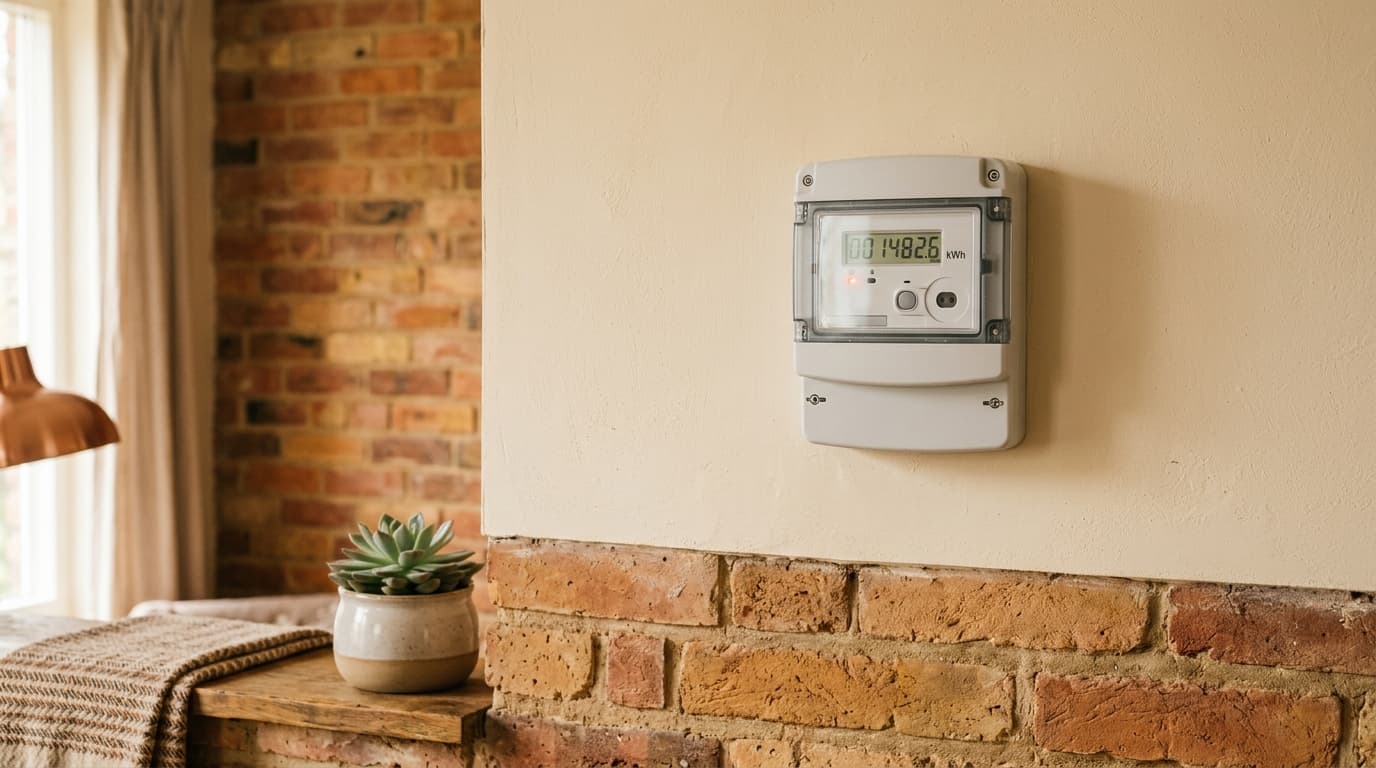
A digital meter changes neither your supplier nor the price per kWh you pay: it changes how your consumption is measured, and therefore which tariff structures you can access. That is the whole nuance — and it also explains why some households gain from it and others do not. Here is, region by region, what the device actually changes on your bill in 2026.
What exactly is a digital meter?
It is a meter that records your consumption continuously and transmits it remotely to your grid operator, with no manual reading required.
Where the old disc meter simply held a cumulative index read once a year, the digital meter — also called a smart meter or communicating meter — measures consumption in fifteen-minute slices and reports it automatically. No more annual self-readings, no more estimated indexes distorting the settlement bill, and above all: the appearance of a data point that did not exist before, peak power.
That new data point is what changes everything. It makes possible network tariffs that no longer depend solely on the volume consumed, but also on when and how intensely you consume.
Where does the Belgian rollout stand in 2026?
Very unevenly, depending on the region: Flanders is well ahead, Wallonia is accelerating, Brussels is just starting.
≈ 80%
Coverage in Flanders (100% target by mid-2029)
1.5M
Meters targeted in Wallonia by 2029
2030
Full deployment targeted in Brussels
In Flanders, Fluvius has reached roughly 80% coverage, with a 100% target by mid-2029 (Selectra / Voltea, 2026). In Wallonia, grid operators are aiming for 300,000 installations in 2026 to reach 1.5 million meters by 2029, with full deployment due by 31 December 2029 (CWaPE, 2026). In Brussels, large-scale rollout only began in October 2023 and is meeting considerable resistance — refusals to install, refusals to consent to data transmission — with full deployment targeted around 2030 (Brugel, 2026).
| Region | Progress in 2026 | Full deployment targeted |
|---|---|---|
| Flanders | ≈ 80% coverage (Fluvius) | 100% by mid-2029 |
| Wallonia | 300,000 installations targeted in 2026, 1.5 million by 2029 | 31 December 2029 |
| Brussels | Large-scale rollout started in October 2023 | Around 2030 |
Is a digital meter compulsory?
Not everywhere and not for everyone, but it already is in three specific situations, since 2024.
Replacement is required in three cases (Test-Achats / TotalEnergies, 2026):
- every new connection;
- the replacement of a faulty or end-of-life meter;
- every new photovoltaic installation.
Outside those cases, you are affected according to your grid operator's rollout schedule — Fluvius, ORES, RESA or Sibelga depending on your municipality.
Can you refuse installation or data transmission?
Yes in some cases, but refusal has a price: giving up tariff options.
In Brussels, outside the cases set out in the Ordinance, you can object to your meter being replaced, provided you explicitly notify Sibelga of your refusal — no reply is treated as tacit consent (SocialEnergie, 2026). In Flanders, installation goes ahead but you can refuse remote data transmission; you then have to read your meter manually once a year, and access to dynamic tariffs is lost.
One point few comparison sites mention: the data does not always arrive where it should. Brugel sanctioned Sibelga for failing to communicate metering data to the market, the operator having only activated the functionality on 1 June 2025 when the obligation had applied since 1 January 2025 (Brugel, 2026). Having the meter therefore does not yet guarantee, everywhere, that you get the uses that come with it.
How does a digital meter change the bill in Flanders?
It is what makes the capacity tariff possible: your network costs depend on your peak power, not only on your kWh.
This is the most concrete change of the three regions. In Flanders, distribution costs are calculated from two elements: total consumption in kWh, and peak power — the highest average power reached over a quarter-hour during the calendar month, expressed in kW. Billing does not use a single month: it relies on the average of the monthly peaks over the past twelve months (Eneco / Engie, 2026).
Two households consuming exactly the same number of kWh can pay different network costs, depending on whether they spread their consumption or concentrate it into a few quarter-hours.
You can read your current monthly peak directly on the meter's display under code 1.6.0, and find the history on the my.fluvius.be portal. Without a digital meter, a flat rate based on a 2.5 kW peak applies — the minimum contribution to network costs (Test-Achats, 2026).
In practice, this rewards one simple behaviour: not running the washing machine, the oven, the tumble dryer and the EV charger at the same time. It is not about overall frugality, but about simultaneity.
What is the IMPACT tariff in Wallonia?
An incentive distribution tariff available since 1 January 2026, reserved for digital meters with active communication.
Wallonia introduced, in its 2026-2029 electricity withdrawal tariff grids, a new option called the IMPACT tariff (CWaPE, 2026). It sits alongside automatic dual-hourly billing and remains optional. Its principle: modulate the distribution cost to encourage shifting consumption towards periods when the grid is less strained. Access condition: having a digital meter with its communication function switched on — which automatically excludes anyone who refused data transmission.
The Walloon reasoning mirrors the Flemish one, with a different method: Flanders acts on peak power, Wallonia on time slots. In both cases, the logic is to stop billing the network on volume alone.
| Region | What the meter unlocks | Basis of calculation | Without a digital meter |
|---|---|---|---|
| Flanders | Capacity tariff | Average peak power over 15 minutes, averaged over 12 months (code 1.6.0) | Flat rate based on a 2.5 kW peak |
| Wallonia | IMPACT tariff (since 1 January 2026) | Time slots; communication function must be switched on | n/a |
How does this relate to dual-hourly and dynamic contracts?
The digital meter widens your choice: it makes dual-hourly billing easier to activate and unlocks contracts indexed to hourly prices.
With a digital meter, switching to dual-hourly billing is generally done without any technical intervention, and free of charge in Flanders (Test-Achats, 2026). If you are still weighing the two options, our comparison of dual-hourly versus single-hourly meters sets out which profiles come out ahead.
Above all, quarter-hourly metering is the technical precondition for a dynamic contract: a formula whose price tracks hourly wholesale market quotations. It can be attractive for anyone genuinely able to shift their usage, and risky for anyone who cannot — we work through that trade-off in our guide to fixed, variable and dynamic contracts. Not every supplier offers this type of contract: that is precisely the kind of criterion that separates offers in the energy supplier ranking.
Will a digital meter increase my bill?
Not by itself: it measures, it does not price. What moves is the structure of network costs.
✓ Pros
- No more manual readings or estimated indexes, so fairer annual settlements
- Detailed consumption tracking through the grid operator's portal
- Access to dynamic contracts and incentive tariffs (IMPACT in Wallonia)
- Simplified switch to dual-hourly billing, with no technical intervention
- Free installation for the consumer
✗ Cons
- In Flanders, highly concentrated consumption can raise the network share via peak power
- Refusing remote communication closes off dynamic and incentive tariffs
- Manual annual reading required if you opt out in Flanders
- A more complex bill, harder to check line by line
- Rollout and data transmission still uneven across grid operators
The real risk is not the device — it is accepting the new structure without adapting to it. A Flemish household running four large appliances simultaneously sees its peak climb and its network share with it; the same household, shifting two appliances by an hour, returns to its previous level. The room for manoeuvre is real, but it requires knowing where to look — hence the usefulness of code 1.6.0.
What should you do once it is installed?
Three checks that take less than an hour and prevent nasty surprises at settlement time.
- Note the indexes at the moment of replacement: they are your reference point for the next settlement bill. Our guide to understanding your energy bill explains how to cross-check those figures.
- Activate your access to the grid operator's portal to track your consumption — and, in Flanders, your monthly peak.
- Reopen the contract file: the digital meter changes the options available, so the deal that suited you yesterday is not necessarily the best one today.
Key takeaways
The figures quoted here — roughly 80% coverage in Flanders with a 100% target by mid-2029 (Selectra / Voltea, 2026), 1.5 million Walloon meters targeted by the end of 2029 (CWaPE, 2026), Brussels-wide deployment around 2030 (Brugel, 2026), a Flemish flat rate based on a 2.5 kW peak without a digital meter (Test-Achats, 2026) — evolve with the pace of the rollout and regulators' decisions. Network tariff grids are revised periodically, and prices on variable or dynamic contracts move every month: always re-check the grid in force before committing. To compare what suppliers actually offer in terms of dynamic contracts and consumption tracking, start with the energy supplier ranking.
Sources — CWaPE (2026-2029 withdrawal tariff grids and the IMPACT tariff), Brugel (Brussels rollout and metering data), Fluvius, ORES, RESA and Sibelga (regional rollout schedules), together with the Test-Achats, TotalEnergies, Selectra, Voltea, Eneco, Engie, CallMePower and SocialEnergie publications cited in the article. Pages accessed 18 August 2026. Network tariff grids are revised periodically and variable or dynamic offers are reindexed every month.
Électricité comparator
Compare all électricité side by side.
Compare now →
Frequently asked questions
Camille suit le marché belge de l'énergie depuis une dizaine d'années. Elle a d'abord travaillé côté gestion de contrats B2B, puis est passée à l'analyse indépendante : elle éplucha les grilles tarifaires de Mega, Bolt, Engie, Luminus, TotalEnergies, Eneco ou Ecopower, recoupe chaque prix avec le CREG Scan, la CWaPE, le VREG et Brugel, et refait les calculs de facture à la main quand un fournisseur communique un chiffre trop rond. Sa conviction : la plupart des ménages belges ne changent jamais de fournisseur et paient chaque année quelques centaines d'euros de trop — pas par paresse, mais parce que les offres sont volontairement illisibles. Ici, elle traduit les conditions tarifaires en euros par an, et dit clairement quand une « promo » n'en est pas une.