Choosing between a dual-hourly and a single-hourly meter does not hinge on a universal rule, but on a simple question: what share of your electricity do you use during off-peak hours? If it is at least a quarter, and especially 40% or more, the dual-hourly meter usually saves you money. Below that, the single meter on a single rate is often the better deal — all the more so as, in 2026, the time slots changed in Wallonia and differ from one region to another. Here is how to decide for your own case.
Dual-hourly or single-hourly: what is the difference?
The single-hourly meter applies one price per kWh, the dual-hourly meter applies two depending on the time.
On a single-hourly meter, you pay the same kWh rate whatever the hour: one dial, one price, what is called the "single rate". On a dual-hourly meter, consumption is split between peak hours (daytime, more expensive) and off-peak hours (at night and, depending on the region, part of the day, cheaper). The idea is an old one: to encourage shifting heavy usage — washing machine, tumble dryer, water heater, charging a vehicle — to the moments when the grid is under less strain.
Is a dual-hourly meter still worth it in 2026?
Yes, but only if a large enough share of your consumption falls in off-peak hours.
The commonly accepted rule in Belgium is a threshold of about a quarter of consumption in off-peak hours to start gaining, with the benefit becoming clear beyond 40%. Below that, the higher daytime rate — and, on some offers, a slightly higher standing charge — erases the night-time advantage. In other words, the dual-hourly meter rewards households able to genuinely shift their usage, not those who hope to without changing their habits.
The dual-hourly meter does not reward those who have a double meter, but those who really move their consumption to night-time.
This calculation has been reshaped by a deeper shift: in Flanders, the network share of the bill no longer distinguishes peak from off-peak hours since the capacity tariff was introduced, rolled out from 2023 and fully in force in 2026. In practice, the distribution cost there now depends mainly on your peak power (the highest point measured over 15 minutes), not the time of day. The day/night split then survives only on the energy component set by the supplier.
What are the off-peak hours in 2026 by region?
They differ from one region to another, and Wallonia changed them on 1 January 2026.
10pm-7am + 11am-5pm
Wallonia (every day)
10pm-7am + weekend
Brussels (weekdays)
No network distinction
Flanders (capacity tariff)
In Wallonia (ORES, RESA), since 1 January 2026, off-peak hours cover 10 p.m.-7 a.m. and 11 a.m.-5 p.m. every day, weekends and public holidays included. Peak hours are therefore 7 a.m.-11 a.m. and 5 p.m.-10 p.m. That brings the total to around 105 off-peak hours a week, versus 93 before (ORES, 2026). The switch was automatic, with no action from the customer.
In Brussels (Sibelga), the slots remain unchanged in 2026: off-peak from 10 p.m. to 7 a.m. on weekdays, plus the entire weekend (Friday 10 p.m. to Monday 7 a.m.). In Flanders (Fluvius), as noted, the network share no longer makes the distinction.
| Region | Operator | Off-peak hours 2026 | Weekly total |
|---|---|---|---|
| Wallonia | ORES, RESA | 10 p.m.-7 a.m. and 11 a.m.-5 p.m., every day | ≈ 105 h (93 before) |
| Brussels | Sibelga | 10 p.m.-7 a.m. on weekdays + the whole weekend | n/a |
| Flanders | Fluvius | No distinction on the network share (capacity tariff) | n/a |
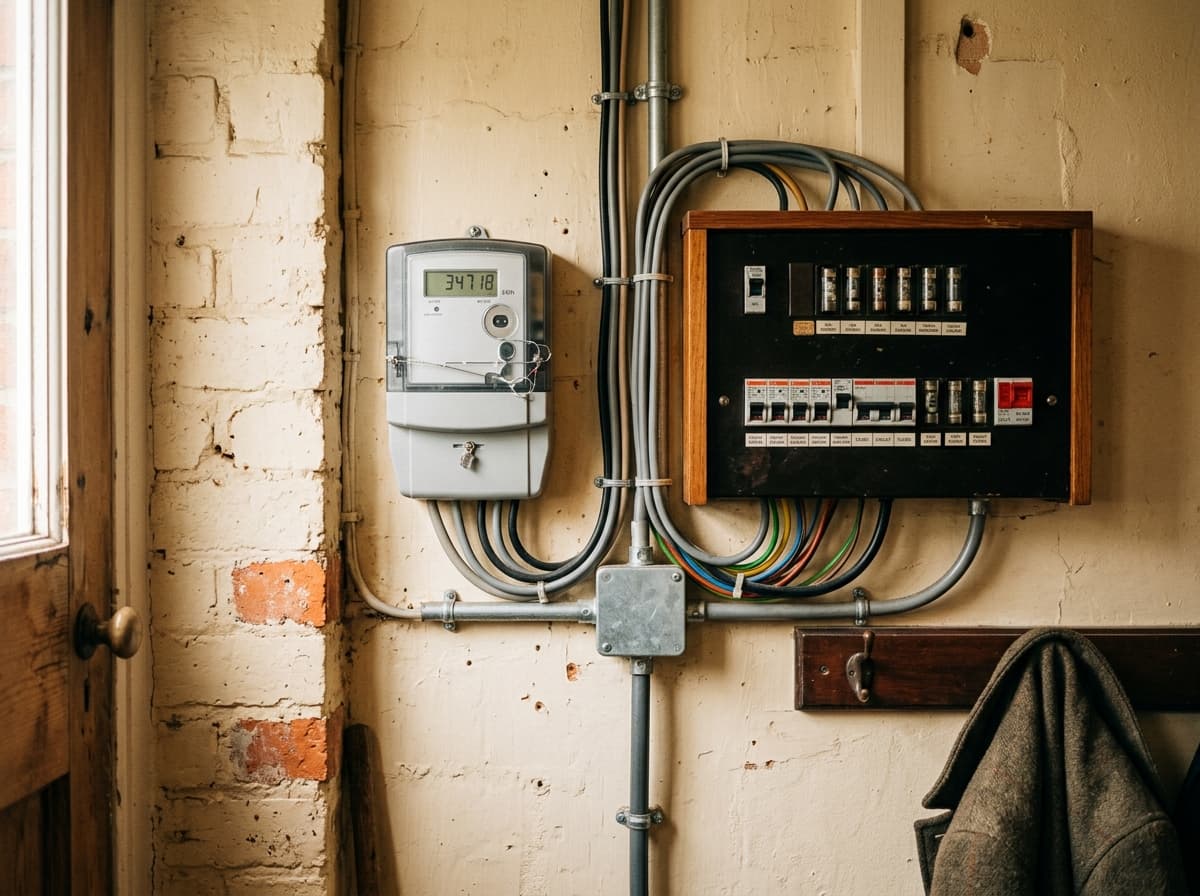
How do you know if a dual-hourly meter is worth it for you?
By reading your bill, not by guessing.
If you are already on a dual-hourly meter, the check takes three steps:
- Get out your annual settlement invoice: it lists the daytime and night-time kWh separately.
- Divide the off-peak kWh by the total consumed over the period.
- Place the result: above a quarter, the dual-hourly meter starts to make its case; above 40%, it almost always wins. Below that, a single meter on a single rate often comes out cheaper once the standing charge is factored in.
If you are on a single-hourly meter and hesitating to switch, reason about your shiftable usage:
- a programmable electric water heater;
- night-time charging of an electric vehicle;
- a dishwasher and washing machine run on a chosen schedule.
Without these big movable loads, the theoretical gain stays theoretical.
Who is the single-hourly meter better for?
For small consumers and households active during the day.
Three profiles typically fall into this category:
- a student studio;
- a couple with no children, away all day;
- a household with no large programmable appliance.
In these profiles, most consumption falls at the hours when the dual-hourly meter costs the most. The single rate then avoids paying top price by day for a handful of night-time kWh. Simplicity also has value: one price, a more readable bill, no time constraint to respect.
Do you need a dual-hourly meter with solar panels?
Often not: with output that covers most of your consumption, the single-hourly meter is enough.
When your photovoltaic panels produce as much as or more than you consume over the year, you mainly self-consume during the day and the appeal of the day/night split fades. In that case, a single meter is frequently recommended. The trade-off, however, depends on your installation, whether you have a home battery and the metering mechanism applicable in your region — all points to check before deciding, ideally with your network operator.
Does the choice of meter change depending on the supplier?
No for the meter, yes for the price.
The meter type and the time slots are the responsibility of your distribution network operator, identical whichever supplier you use. Each supplier, however, freely sets its prices per kWh at peak and off-peak, and the gap between the two varies from one offer to another. For a given meter, it therefore remains worthwhile to compare offers — which is exactly the purpose of our energy supplier ranking. To understand what each cent really covers, our article on the electricity price per kWh in Belgium breaks down the make-up of the bill.
✓ Pros
- Real savings if you consume at night or off-peak
- Ideal for electric vehicles, water heaters, shiftable appliances
- 105 off-peak hours a week in Wallonia since 2026
✗ Cons
- Higher daytime rate, penalising below 25-40% off-peak consumption
- Different slots by region, to be checked
- No network benefit in Flanders (capacity tariff)
How do you switch meter type?
Through a request to your network operator, usually via your supplier.
The procedure takes four steps:
- Estimate the expected gain first: if your profile does not clearly fall on the right side of the threshold, the fees may exceed the saving.
- Send the request to your distribution network operator, most often through your supplier.
- Check the cost of the operation: it may be charged. On a digital meter, it is frequently a simple remote reconfiguration, with no physical intervention.
- Reopen the contract file if you are taking the opportunity to compare offers.
One thing not to confuse: changing meter and switching energy supplier are two separate steps.
Key takeaways
The off-peak slots quoted here are dated — Wallonia and Brussels as of 1 January 2026 — and may change: re-check with your network operator before any decision. The meter determines when you pay more or less, but it is the supplier that sets how much. Once your meter type is chosen, compare offers on total annual cost with our energy supplier ranking to align the price with your real consumption profile.
Sources — 2026 off-peak slots and network tariffs: ORES and RESA for Wallonia, Sibelga for Brussels, Fluvius for Flanders (capacity tariff). Pages accessed 18 August 2026. Variable offers are reindexed every month: re-check the tariff card in force before signing.
Camille
Électricité comparator
Compare all électricité side by side.
Compare now →
Frequently asked questions
Camille suit le marché belge de l'énergie depuis une dizaine d'années. Elle a d'abord travaillé côté gestion de contrats B2B, puis est passée à l'analyse indépendante : elle éplucha les grilles tarifaires de Mega, Bolt, Engie, Luminus, TotalEnergies, Eneco ou Ecopower, recoupe chaque prix avec le CREG Scan, la CWaPE, le VREG et Brugel, et refait les calculs de facture à la main quand un fournisseur communique un chiffre trop rond. Sa conviction : la plupart des ménages belges ne changent jamais de fournisseur et paient chaque année quelques centaines d'euros de trop — pas par paresse, mais parce que les offres sont volontairement illisibles. Ici, elle traduit les conditions tarifaires en euros par an, et dit clairement quand une « promo » n'en est pas une.