
In Belgium there is not one price per kWh of electricity, but three — one per region. In the third quarter of 2026, the all-in kilowatt-hour costs 32.22 cents in Flanders, 37.19 cents in Brussels and 37.83 cents in Wallonia (CREG tariff, Q3 2026). In other words, a household in Wallonia pays nearly 17% more than one in Flanders for exactly the same electricity — and its supplier has almost nothing to do with it. Here is what that figure actually covers, and how to work out what you are paying.
What is the price per kWh of electricity in Belgium in 2026?
Between 32 and 38 cents all in, depending on where you live.
The most reliable benchmark is the CREG tariff: the average monthly all-in commercial price of electricity, calculated by the federal regulator for a residential customer, region by region. It includes energy, network costs, levies, surcharges and VAT. Unlike the prices shown in advertising, it is therefore a figure that matches what actually leaves your account.
32.22 c€
Flanders
37.19 c€
Brussels
37.83 c€
Wallonia
These amounts are those of the third quarter of 2026 (CREG). They move every quarter: treat them as a snapshot, not a constant.
Alongside this all-in price, you will often come across much lower figures — around 15 cents per kWh, for instance. These are not errors: they refer to the energy component alone, excluding network and taxes. Confusing the two is the single most common source of misunderstanding on this subject.
Why does the price per kWh change depending on your region?
Because most of the gap comes not from the supplier, but from the network and the levies.
Each distribution system operator sets its own tariffs: Fluvius in Flanders, ORES and RESA in Wallonia, Sibelga in Brussels. Those tariffs are then approved by the relevant regional regulator — the VREG in Flanders, the CWaPE in Wallonia, Brugel in Brussels. Network density, line length, the state of the infrastructure: all of it differs from one region to another, and all of it ends up in the price.
To that are added the levies, which are partly federal and partly regional. The result is mechanical: with identical consumption and an identical supplier, a household in Wallonia and one in Flanders do not pay the same bill.
| Region | All-in price (Q3 2026) | Network operator | Regulator | Distribution tariffs 2026 |
|---|---|---|---|---|
| Flanders | 32.22 c€/kWh | Fluvius | VREG | n/a |
| Brussels | 37.19 c€/kWh | Sibelga | Brugel | +3% |
| Wallonia | 37.83 c€/kWh | ORES, RESA | CWaPE | +7.5% |
This has an important practical consequence. Switching supplier never changes the network share or the levies on your bill. The lever exists, but it is narrower than people think — all the more reason to use it well.
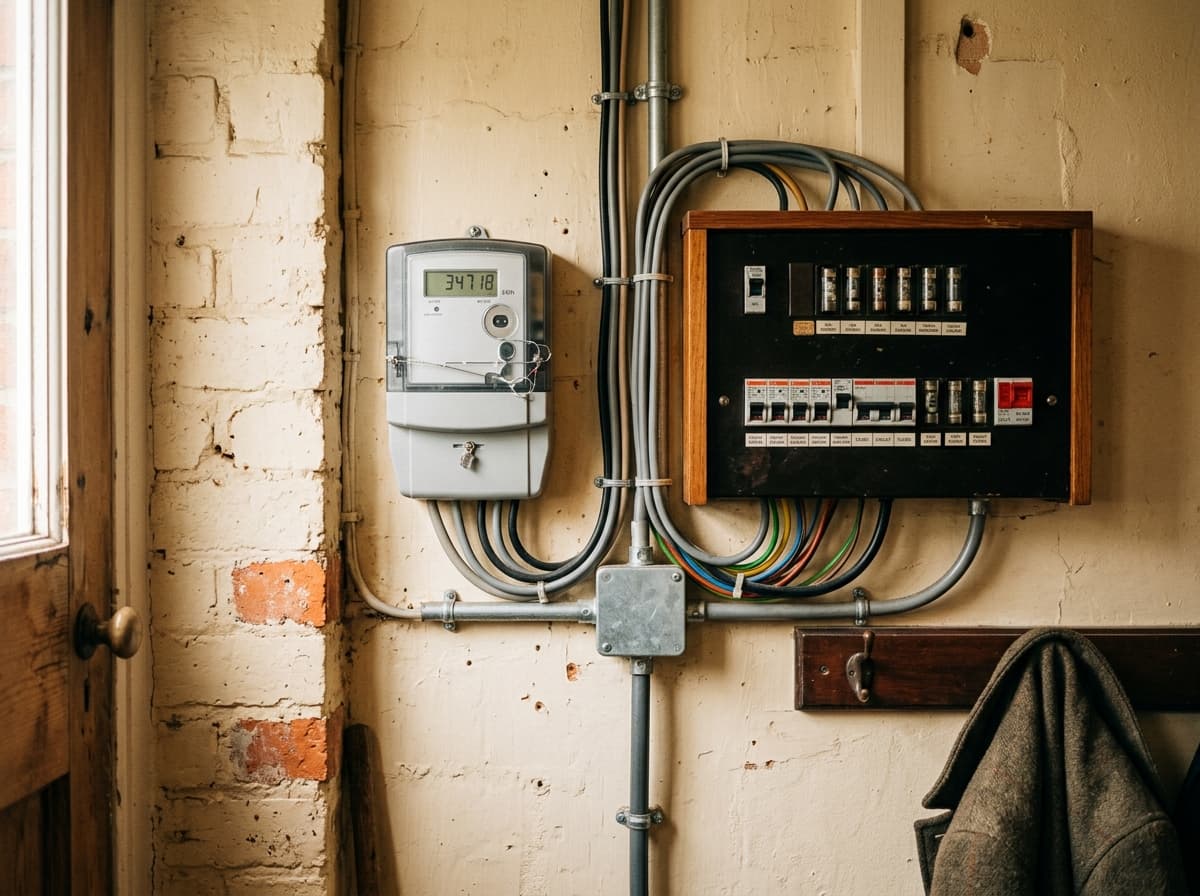
What is the price you pay per kWh made of?
Four blocks, only one of which is negotiable.
Energy. The kWh itself, bought on wholesale markets by your supplier and resold with a margin. It is the only component affected by competition and by the type of contract you sign.
Network costs. Transmission (Elia) and distribution (Fluvius, ORES, RESA, Sibelga). Regulated tariffs, identical whichever supplier you use.
Levies and surcharges. Federal contribution, financing of green certificates, public service obligations. Decided by public authorities.
VAT, applied on top of the whole.
On its website, the CWaPE details this breakdown for Wallonia (consulted in July 2026):
| Item | Share of the bill (Wallonia, CWaPE) |
|---|---|
| Price of the kWh (energy) | 56% |
| Network costs | 21% |
| Levies | 17% |
| VAT | 6% |
The proportion varies by region and consumption profile, but the order of magnitude gives the right intuition: about half your bill is entirely beyond your supplier's reach.
You do not negotiate your electricity bill. At best, you negotiate half of your electricity bill.
Why is your bill not falling even though excise duties are coming down?
Because two opposing movements cancelled each other out in 2026.
On one side, the tax shift reform reduced excise duties on electricity — a deliberate choice to encourage the energy transition and make electrification (heat pumps, electric cars) more attractive than gas, whose excise duties rose instead.
On the other, network operators raised their distribution tariffs in 2026 to fund the reinforcement of the electricity grid, made necessary by precisely that electrification: around +7.5% in Wallonia and +3% in Brussels, for residential and business customers alike.
The result: the tax gift given with one hand is partly taken back with the other. The average price per kWh is stabilising at around €0.35/kWh in early 2026, slightly below the €0.37/kWh peak of 2025 — a lull, not a collapse.
How do you calculate the real price of your kWh?
With one division, and one only.
- Take your annual settlement invoice.
- Note the total amount paid over the year — standing charge, network costs, levies and VAT included.
- Divide that amount by the number of kWh consumed over the same period.
The result is your real all-in price.
That figure is almost always higher than the price per kWh advertised on your supplier's tariff card, and that is normal: the card shows the energy component, your bill shows reality. Yet it is this real price — and it alone — that is comparable from one household to another and from one offer to another.
You can then set it against the CREG tariff for your region. Well above it? Two possible explanations: an atypical consumption profile, or a contract you have not reopened in far too long.
Is the price per kWh enough to compare two suppliers?
No — and relying on it alone is the surest way to pick the wrong offer.
✓ Pros
- Simple, immediately comparable figure
- Reflects the supplier's margin on energy well
- Useful for large consumers
✗ Cons
- Ignores the annual standing charge
- Says nothing about the indexation formula
- Unfairly penalises offers that suit small consumers
The annual standing charge is independent of your consumption. For a household that consumes little, a few dozen euros of standing charge weigh far more than a tenth of a cent on the kWh — enough to completely reverse the ranking of two offers.
The indexation formula matters just as much: two "variable" offers pegged to the same index can carry very different margins. The subject is covered in detail in our comparison of fixed, variable and dynamic contracts.
The right method is therefore to reason in total annual cost for your actual consumption, not in unit price. That is exactly the exercise carried out by our energy supplier ranking.
Is there a price per kWh below the market?
Yes: the social tariff, for households entitled to it.
In July 2026, the social tariff for electricity stood at 24.927 cents per kWh (FPS Economy) — well below the CREG tariff in any region. It is reserved for households with a specific social status:
- social benefit recipients;
- low-income pensioners;
- people with disabilities, among others.
Two useful clarifications. It applies automatically to the bills of those entitled to it, with no application to refile each month. And it does not cover second homes: only the official place of residence is eligible. If you are unsure about your situation, the FPS Economy can be reached on 0800 120 33 (free, 9 a.m. to 5 p.m.).
Key takeaways
Every figure quoted here is dated — CREG tariff for the third quarter of 2026, social tariff for July 2026, 2026 distribution tariffs — and variable prices change every month: re-check them at the moment you sign. To place your own bill, start by calculating your real all-in price, then look at which energy supplier matches your profile. And if you decide to move, our guide on how to switch energy supplier in Belgium sets out the full procedure.
Sources — CREG (average all-in commercial price, third quarter of 2026), CWaPE (breakdown of the Walloon bill and 2026 distribution tariffs), Brugel and VREG (regional network tariffs), Elia, Fluvius, ORES, RESA and Sibelga (transmission and distribution), FPS Economy (July 2026 social tariff). Pages accessed 18 August 2026. The CREG tariff is a monthly average published by region and variable offers are reindexed every month: re-check the grids before signing.
Électricité comparator
Compare all électricité side by side.
Compare now →
Frequently asked questions
Camille suit le marché belge de l'énergie depuis une dizaine d'années. Elle a d'abord travaillé côté gestion de contrats B2B, puis est passée à l'analyse indépendante : elle éplucha les grilles tarifaires de Mega, Bolt, Engie, Luminus, TotalEnergies, Eneco ou Ecopower, recoupe chaque prix avec le CREG Scan, la CWaPE, le VREG et Brugel, et refait les calculs de facture à la main quand un fournisseur communique un chiffre trop rond. Sa conviction : la plupart des ménages belges ne changent jamais de fournisseur et paient chaque année quelques centaines d'euros de trop — pas par paresse, mais parce que les offres sont volontairement illisibles. Ici, elle traduit les conditions tarifaires en euros par an, et dit clairement quand une « promo » n'en est pas une.