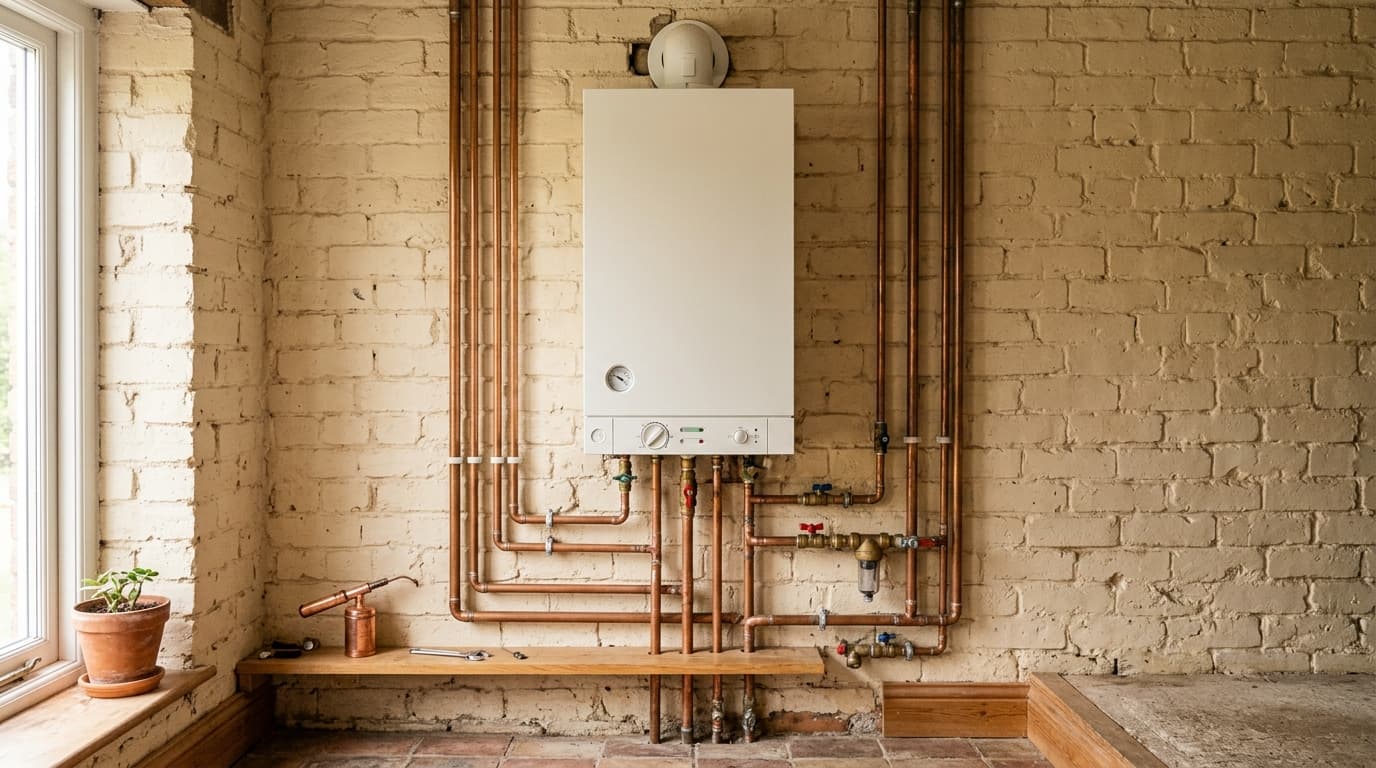
In 2026, gas costs less on the markets than it did a year ago — and yet your bill is going up. This is not an optical illusion: the fall in the energy component is more than offset by two rising items, excise duties and network costs. Gas has even become, in Belgium, the only form of energy whose taxation is deliberately climbing. Here is what the price of gas covers this year, and where the room for manoeuvre you have left actually sits.
What is the price of gas in Belgium in 2026?
Around 5 cents per kWh — but the gap between contracts is the real story.
In mid-March 2026, the average price per kWh of gas in Belgium stood at around 5.3 euro cents. That figure has the merit of giving an order of magnitude; it does, however, hide the essential point, namely the considerable spread of tariff cards.
In Wallonia, in July 2026, the prices advertised by suppliers ranged from roughly 4.44 to 7.47 cents per kWh. In other words, for exactly the same gas delivered over exactly the same network, a ratio of nearly 1 to 1.7 depending on the contract signed.
~5.3 c€
Average price per kWh (March 2026)
4.44 – 7.47 c€
Range of Walloon tariff cards (July 2026)
17,000 kWh
Reference annual consumption
Why is your gas bill rising when gas is falling?
Because the market decline is absorbed along the way by taxation and the network.
The start of 2026 illustrates this paradox perfectly. On international markets, wholesale prices are stabilising downwards. But Belgian households' bills remain under pressure, for two reasons that have nothing to do with gas itself.
The first is the federal energy tax shift, which is progressively raising excise duties on gas. The second is the increase in distribution tariffs, decided by network operators and approved by the regional regulators.
Put differently: your supplier is billing you slightly less energy, while the state and the network bill you slightly more of everything else. For most households, the balance is negative.
Gas is falling. Your gas bill is not following — because it is only partly a gas bill.

How much are excise duties on gas rising?
From €8.72 to €10.31/MWh since 1 April 2026, with a trajectory already set through to 2029.
The federal government decided to raise excise duties on natural gas and heating oil between 2026 and 2029, while reducing those on electricity. For gas, the timetable is explicit: €10.31/MWh since April 2026, then a gradual climb to €13.60/MWh in 2029.
| Energy | Before April 2026 | Since 1 April 2026 | 2029 target |
|---|---|---|---|
| Natural gas | €8.72/MWh | €10.31/MWh | €13.60/MWh |
| Heating oil | €17.3 / 1,000 L | €23 / 1,000 L | €26 / 1,000 L |
Translated into euros on a real bill, for a household consuming 17,000 kWh a year: roughly €20 more in 2026, and up to €75 more by 2029. Heating oil follows the same logic — excise duties rise from €17.3 to €23 per 1,000 litres from April 2026, targeting €26 in 2029.
Why is gas taxed more and electricity less?
Because that is precisely the aim of the reform, not a side effect.
The energy tax shift pursues a stated goal: making electrified heating more attractive than gas. Cutting excise duties on electricity and raising them on fossil fuels mechanically alters the trade-off between a heat pump and a gas boiler.
A European constraint compounds this. The reform prepares for the 21% VAT rate on fossil fuels imposed by the European Union from 2030. Raising excise duties gradually spreads out over time a shock that would otherwise arrive all at once.
The mirror image of this movement is set out in our analysis of the electricity price per kWh in Belgium in 2026: on the electricity side, the cut in excise duties is also largely neutralised, but by higher distribution tariffs.
Why are gas distribution tariffs rising?
Because network costs are fixed, and fewer and fewer people are sharing them.
In Wallonia, the weighted average of gas distribution costs for the typical residential customer consuming 17,000 kWh is up 14% in 2026 compared with 2025 (CWaPE). The overall authorised revenue of the two Walloon network operators, meanwhile, rises by only 6%.
That gap between 6% and 14% says everything about the mechanism. Consumption volumes are falling — the 2022 price crisis appears to have durably changed heating habits. Yet maintaining the network costs roughly the same whether it carries a lot of gas or very little. The result: a broadly stable network bill divided by fewer kilowatt-hours pushes up the price per kWh, without anyone having decided to raise anything.
Other regions are faring better. In Brussels, the rise in distribution charges is more contained in 2026 (+1.8%), and the combined annual cost of transmission, distribution and the new excise duties stands at around €365, against €326 in 2025. In Flanders, network charges remain relatively stable, at around €305.
In total, network and excise duties combined, an average household will pay roughly €34 more in Flanders and Brussels, and €53 more in Wallonia.
| Region | Distribution charges 2026 | Annual transmission + distribution + excise duties | Average extra cost 2026 |
|---|---|---|---|
| Wallonia | +14% (typical 17,000 kWh customer) | n/a | +€53 |
| Brussels | +1.8% | ≈ €365 (€326 in 2025) | +€34 |
| Flanders | Relatively stable | ≈ €305 | +€34 |
What share of your gas bill really depends on your supplier?
About 69% — the only part open to competition.
According to the CREG, the price per kWh accounts for around 69% of the gas bill: it is the component set by the supplier, at market rates, plus its margin. The rest breaks down into:
Network costs. Transmission, handled by Fluxys nationally, and distribution, handled by your municipality's network operator:
Taxes and excise duties, federal and regional, which fund among other things the regulator, public service obligations and connection costs.
The competitive share is therefore considerably wider than on the electricity side, where about half the bill is beyond the supplier's reach. That is good news: on gas, changing contract carries more weight.
How much can you really save by changing contract?
Several hundred euros a year — and it is the only figure that really counts.
For an identical consumption of 17,000 kWh a year in Wallonia, the annual gas bill ranged in July 2026 from roughly €1,310 to €2,124 depending on the contract signed. More than €800 of difference, for the same gas, the same network, the same house.
| Contract (17,000 kWh/year, Wallonia, July 2026) | Annual bill |
|---|---|
| Cheapest contract | ≈ €1,310 |
| Most expensive contract | ≈ €2,124 |
| Gap | More than €800 |
Set that figure against the €20 of additional excise duties and the €53 of extra network costs. The increase you are subjected to amounts to a few dozen euros; the gap between a good and a bad contract runs into the hundreds. That is where — and nowhere else — your bill is decided.
✓ Pros
- Gap between offers far wider than the tax increase
- High competitive share (~69% of the bill)
- Switching is free and involves no interruption
- No termination fee for a residential customer
✗ Cons
- The advertised price says nothing about the standing charge
- Variable offers are reindexed every month
- The network share never moves, whichever supplier you pick
The method is the same as for electricity: reason in total annual cost for your actual consumption, not in price per kWh. Our energy supplier ranking does that exercise, and our guide on how to switch energy supplier in Belgium sets out the procedure, which takes about twenty minutes.
Is there a gas tariff protected from these increases?
Yes, the social tariff — but it is rising too.
For the third quarter of 2026 (1 July to 30 September), the social tariff for gas is capped at 5.458 euro cents per kWh, VAT included. It is up 15% on the previous quarter, owing to the rise in gas quotations observed between February and May 2026.
That figure deserves an important qualification: without the price cap mechanism, the increase would have reached 33%. The social tariff therefore cushions the shock without cancelling it. Note too that social tariff beneficiaries heating with gas will pay less in excise duties than in 2025 across the three consumption profiles studied — the reform explicitly protected them.
Key takeaways
Every figure quoted here is dated — April 2026 excise duties, 2026 distribution tariffs, third-quarter 2026 social tariff, July 2026 Walloon tariff cards — and variable offers are reindexed every month: re-check them at the moment you sign. Start by calculating your real annual cost, then look at which energy supplier matches your profile. If your contract dates from before 2024, the potential gap alone justifies the twenty minutes a switch takes.
Sources — CREG (share of the price per kWh in the gas bill), CWaPE (Walloon gas distribution costs in 2026), Fluxys (transmission), Fluvius, Sibelga and ORES (distribution), together with the federal decisions on the excise duties applicable since 1 April 2026 and on the third-quarter 2026 social tariff. Pages accessed 18 August 2026. Variable offers are reindexed every month: re-check the tariff card in force before signing.
Gaz naturel comparator
Compare all gaz naturel side by side.
Compare now →
Frequently asked questions
Camille suit le marché belge de l'énergie depuis une dizaine d'années. Elle a d'abord travaillé côté gestion de contrats B2B, puis est passée à l'analyse indépendante : elle éplucha les grilles tarifaires de Mega, Bolt, Engie, Luminus, TotalEnergies, Eneco ou Ecopower, recoupe chaque prix avec le CREG Scan, la CWaPE, le VREG et Brugel, et refait les calculs de facture à la main quand un fournisseur communique un chiffre trop rond. Sa conviction : la plupart des ménages belges ne changent jamais de fournisseur et paient chaque année quelques centaines d'euros de trop — pas par paresse, mais parce que les offres sont volontairement illisibles. Ici, elle traduit les conditions tarifaires en euros par an, et dit clairement quand une « promo » n'en est pas une.