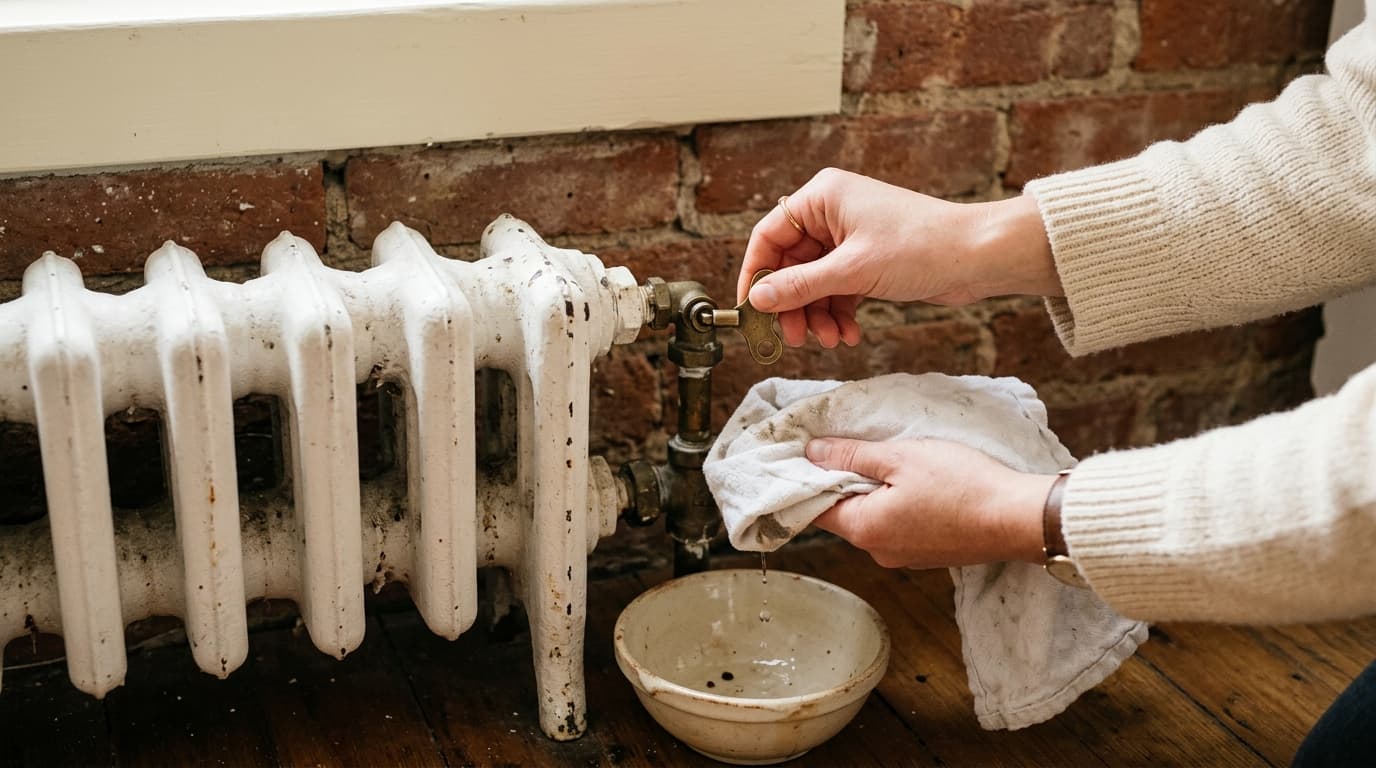
Bleeding a radiator means letting out the air trapped at the top of the unit, with the heating off, until water runs out with no bubbles. Twenty to forty minutes for a whole home, a radiator key, a cloth. The job touches neither gas nor electricity, but it always ends in front of the boiler's pressure gauge.
How do you know a radiator needs bleeding?
Two signs are unmistakable. Test-Achats, the Belgian consumer association, sums them up: strange noises in the system, such as bubbles, and a top section of the radiator that is clearly colder than the bottom. Air is lighter than water, so it rises and takes up the space where hot water should be flowing.
The opposite exists too. A radiator that is hot at the top and cold at the bottom does not need bleeding: it is clogged with sludge, and that is a different job.
When should you bleed your radiators, and how often?
In autumn, before the restart. The heating factsheet from the Public Service of Wallonia recommends bleeding at least once a year, ideally in that season. SuisseEnergie, the programme of the Swiss Federal Office of Energy, settles for once every three years, or as soon as the radiators make noise. Both agree on the essentials: if nothing gurgles and everything heats evenly, a yearly check is enough, and it takes less time than reading this article.
Equipment, time and cost of the job
| Item | Detail |
|---|---|
| Square-socket radiator key (or flat screwdriver, depending on the model) | From a DIY store, reusable for life |
| Cloth and small container | To catch the water, sometimes black |
| Heating downtime before you start | About an hour according to SuisseEnergie |
| Time per radiator | Two to five minutes |
| Time for a home with eight radiators | Twenty to forty minutes, pressure check included |
| Gas used during the job | None, the boiler is off |
Bleeding a radiator in six steps
- Switch the heating off. Radiator cold, circuit at rest: that is the Test-Achats instruction. Wait an hour so the air collects at the top of the units.
- Choose the order. Start with the radiator closest to the boiler, or the lowest one in the home, and work up through the floors. Air pushed out of one radiator migrates to the next.
- Close the valve of the radiator you are about to bleed.
- Place the container and cloth under the bleed screw, at the top of the radiator, on the side opposite the valve.
- Open the screw a quarter to half a turn. The air hisses. As soon as water runs in a steady trickle, with no spluttering, close it again without forcing.
- Reopen the valve and move on to the next radiator.
Never unscrew the bleed screw all the way.
What boiler pressure should you aim for after bleeding?
Every radiator you bleed takes a little water out of the circuit, and so a little pressure. Test-Achats refers you to the boiler manual and the green zone on the gauge, which remains the only valid reference for your model. Two benchmarks give the order of magnitude. SuisseEnergie applies a simple physical rule, 1 bar of pressure per 10 metres of building height, to which the expansion vessel pressure is added. Selectra turns it into ranges by type of home, read when cold.
| Home | Indicative pressure when cold |
|---|---|
| Single storey or flat | 1 to 1.5 bar |
| House with one upper floor | 1.2 to 1.4 bar |
| House with two upper floors | 1.4 to 1.9 bar |
| Upper alert threshold | 3 bar: too much water in the circuit |
A needle that falls back below 1 bar a few days after topping up is not a bleeding problem.
How much does bleeding really save?
Nobody knows to the nearest percent, and you should be wary of anyone who claims to. Test-Achats gives no figure. Ademe, the French energy agency, quoted by Selectra, speaks of 8 to 12% less fuel for a well-maintained boiler compared with a neglected one, full servicing included. SuisseEnergie puts forward "up to 15%" for regular maintenance of the whole system. Bleeding is only one part of those gains, and it cannot be isolated.
The stakes, on the other hand, can be quantified. We took the average all-in price per kWh of gas recorded by Selectra Belgium on 16 September 2026, for a typical household using 17,000 kWh a year, and worked out the value of one percentage point of consumption in each region.
| Region | All-in price per kWh | Annual bill | 1% saved | Theoretical ceiling (15%) |
|---|---|---|---|---|
| Wallonia | 14.75 c€ | €2,508 | €25 | €376 |
| Brussels | 12.89 c€ | €2,191 | €22 | €329 |
| Flanders | 11.88 c€ | €2,020 | €20 | €303 |
Our own calculation, 2 October 2026. Variable tariffs move every month: redo the sum with your own bill. The honest reading of the table fits in one sentence: if bleeding half-cold radiators saves you from pushing the thermostat up a degree to compensate, it is worth far more than the twenty minutes it costs, since the same Walloon factsheet puts the saving from one degree less at 7%, or €141 to €176 a year depending on the region. Getting the setting right is covered in our guide to the ideal heating temperature.
When should you stop and call a heating engineer?
Bleeding fixes an air problem, nothing more. Five situations fall outside its scope:
- air comes back in the same radiators every few weeks;
- pressure drops regularly despite top-ups, a sign of a leak or a tired expansion vessel;
- the bleed screw is seized, painted over or damaged;
- a radiator stays cold at the bottom, or cold all over while its neighbours heat up;
- you live in a building with collective heating, where bleeding and pressure are the responsibility of the syndic, the building manager.
In the first four cases, the visit can be combined with the mandatory servicing of the gas boiler, whose frequency differs by region: every three years in Wallonia for a boiler under 100 kW, every two years in Brussels and Flanders, by a technician certified by the Region. Ask them to check the expansion vessel and the balancing at the same time. If your radiators have thermostatic valves, our feature on the smart thermostat for a gas boiler explains how the two work together.
Bled radiators do nothing to the price of a kWh. For that part of the bill, compare your contract with the average gas consumption of a home like yours, then with the energy supplier ranking.
Sources. Signs, steps, order of radiators and pressure check: Test-Achats, article of 22 December 2025. Yearly frequency, 7% per degree: Public Service of Wallonia, factsheet 9, February 2013. Bleeding every three years, stopping the pump, the bar per 10 metres rule, "up to 15%": SuisseEnergie, November 2021. Pressure ranges by home and the Ademe quote: Selectra. Gas price per kWh by region: Selectra Belgium, recorded on 16 September 2026. Servicing frequency: Callmepower. Pages checked on 2 October 2026.
Gaz naturel comparator
Compare all gaz naturel side by side.
Compare now →
Frequently asked questions
Camille suit le marché belge de l'énergie depuis une dizaine d'années. Elle a d'abord travaillé côté gestion de contrats B2B, puis est passée à l'analyse indépendante : elle éplucha les grilles tarifaires de Mega, Bolt, Engie, Luminus, TotalEnergies, Eneco ou Ecopower, recoupe chaque prix avec le CREG Scan, la CWaPE, le VREG et Brugel, et refait les calculs de facture à la main quand un fournisseur communique un chiffre trop rond. Sa conviction : la plupart des ménages belges ne changent jamais de fournisseur et paient chaque année quelques centaines d'euros de trop — pas par paresse, mais parce que les offres sont volontairement illisibles. Ici, elle traduit les conditions tarifaires en euros par an, et dit clairement quand une « promo » n'en est pas une.