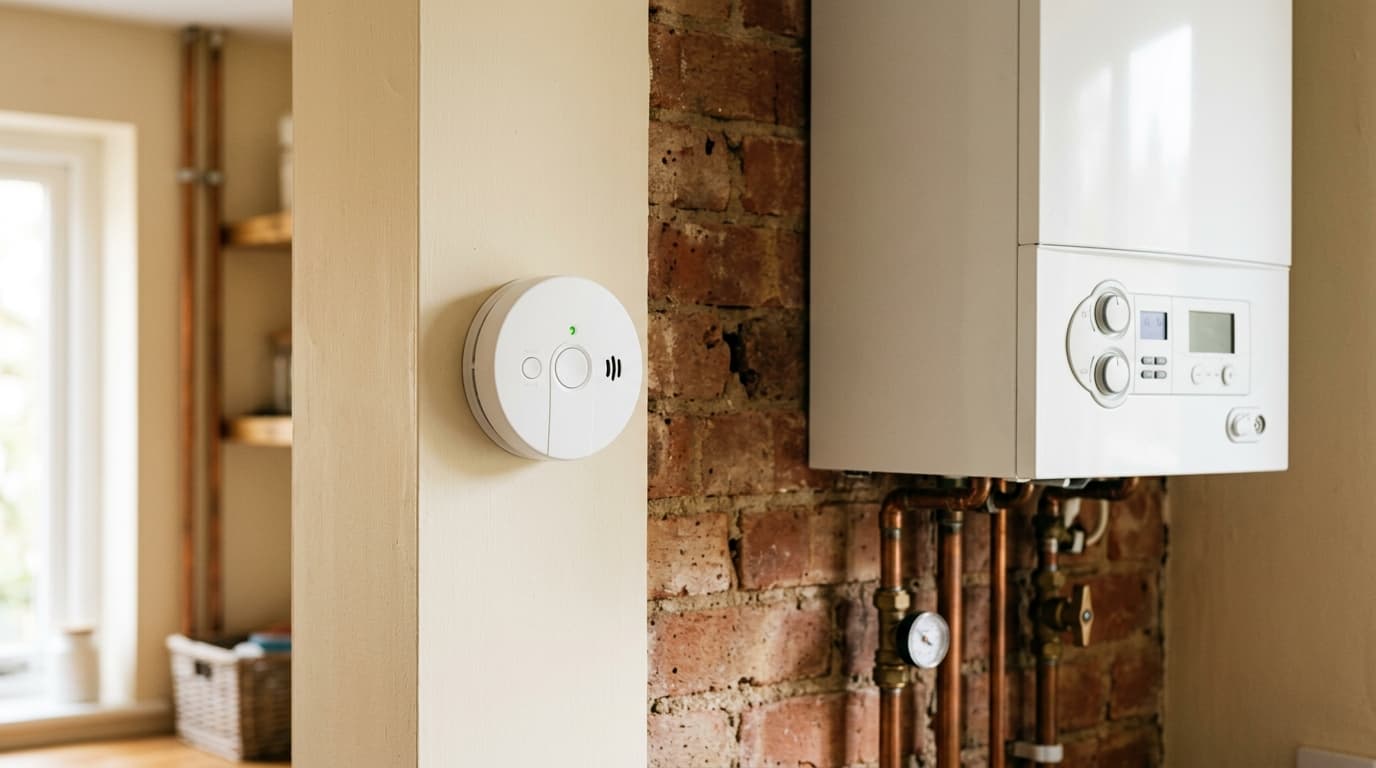
Carbon monoxide has no smell, no colour, and does not irritate the throat. It takes the place of oxygen in the blood and puts you to sleep before it warns you. It is the leading cause of fatal poisoning reported to the Belgian Poison Centre, averaging 19 deaths a year between 2018 and 2023 and more than a hundred hospital admissions. A 20 € device solves the detection problem. You still have to buy the right one, and put it in the right place.
Is a carbon monoxide detector compulsory in Belgium?
No, in none of the three regions.
The confusion comes from smoke alarms, which genuinely are compulsory: in Brussels since 2005, and in Wallonia and Flanders in every dwelling. Many owners assume the CO detector follows the same rule. It does not. The FPS Economy, the federal service that polices product safety in Belgium, notes that CO detectors sold here fall under the general product safety obligation in Book IX of the Code of Economic Law, with EN 50291-1 as the technical reference. No regional legislation requires you to install one at home.
| Region | Smoke alarm | CO detector | Periodic gas boiler inspection, 20 to 100 kW |
|---|---|---|---|
| Wallonia | Compulsory | Not compulsory, recommended | Every 3 years |
| Brussels | Compulsory since 2005 | Not compulsory, recommended | Every 2 years |
| Flanders | Compulsory | Not compulsory, recommended | Every 2 years |
The asymmetry is striking. The legislator mandates the boiler inspection, mandates the smoke alarm, and leaves entirely to personal choice the one device that watches over the only completely silent hazard in the house. For a landlord, that freedom is deceptive: after an accident, the absence of a detector in a gas-heated or oil-heated property is argued before a judge, not before a regulation.
CO detector or CO2 detector: what is the difference?
These are two unrelated gases, and two devices that cannot substitute for each other.
Belgian search data leaves no doubt about the scale of the mix-up: "CO2 detector" is queried almost as often as "carbon monoxide detector", even though the two products share neither function nor sensor type. Carbon monoxide, CO, comes from incomplete combustion and binds to haemoglobin in place of oxygen. Carbon dioxide, CO2, is what you exhale, measured in schools and offices to judge air renewal.
A CO2 sensor will never detect a faulty boiler. Never.
EN 50291-1, and why an over-sensitive detector is a bad detector
A compliant detector does not sound at the first ppm. It waits, and that delay is deliberately calibrated.
EN 50291-1 defines trigger windows rather than a single threshold, because it is built around the way CO accumulates in the blood: a low concentration tolerated for a few minutes becomes dangerous after two hours. A device that fired instantly at 30 ppm would produce cascading false alarms every time a candle smoked, and would end up unplugged. A device that fired too late would let a family fall asleep.
| CO concentration | Must not alarm before | Must alarm before |
|---|---|---|
| 30 ppm | 120 minutes | No obligation to alarm |
| 50 ppm | 60 minutes | 90 minutes |
| 100 ppm | 10 minutes | 40 minutes |
| 300 ppm | Not applicable | 3 minutes |
That table also explains the very common complaint of a CO alarm going off for no reason. A device that triggers several times a week in a room with no combustion appliance is not being extra vigilant: either its sensor is drifting towards end of life, or it never passed the standard's test regime in the first place.
Nine detectors out of ten failed: the figure nobody quotes
The FPS Economy ran a market surveillance campaign in 2018-2019 on CO detectors sold in Belgian shops. Ten models were sampled and sent to the BSI laboratory. On the initial tests, nine of the ten failed the selected requirements of EN 50291-1:2010+A1:2012. Manufacturers then had to submit counter-expertise and corrective measures, and the models presenting a serious risk were handled separately.
The campaign is old, and the market has moved on since. Its lesson holds all the same: on this particular shelf, being on sale guarantees nothing. A CO detector is the only device in the house whose correct operation you can never verify through use. The test button checks the sounder and the battery, not the electrochemical cell.
A smoke alarm that does not work, you will eventually discover by burning a pan. A CO detector that does not work stays silent until the day it should have spoken.
Six criteria before choosing a model
- An EN 50291-1 reference on the manufacturer's official datasheet, with the certifying body where possible. The Honeywell Home XC70, for instance, states BSI certification against EN 50291-1:2010 and EN 50291-2:2010, part 2 covering recreational vehicle use.
- The stated sensor life, not the battery life. Honeywell Home gives 7 years for its EcoSure cell; Kidde states 10 years for its sealed electrochemical sensors. Past that date the unit is replaced, not repaired.
- The power arrangement: replaceable battery, or a sealed cell for the whole service life. The second option removes the forgotten replacement, which remains the leading cause of a dead detector.
- A ppm concentration display. Useful for telling a persistent 20 ppm trace from a brief spike, and above all for handing the fire service a number when they arrive.
- Alarm memory, which keeps a record of a trigger that happened while you were out. Without it, a night-time episode nobody heard leaves nothing to work from.
- A clear end-of-life signal, distinct from both the alarm and the low-battery chirp.
Few brands are genuinely distributed in Belgium on this segment: Honeywell Home, Kidde, FireAngel and Smartwares are the names that recur at Belgian retailers and DIY chains. We have tested none of these units and we rank no brand; the specifications quoted here come from the manufacturers' official datasheets.
Where should a carbon monoxide detector go in a house?
At living height, not on the ceiling.
This is where instruction manuals contradict each other most, and Test Achats, the Belgian consumer association, is clearer than most manufacturers: CO has a density close to that of air, so it diffuses fairly evenly through the volume of a room instead of stratifying under the ceiling the way hot smoke does. The practical consequence is straightforward. Put the unit at sleeping height in a bedroom, at seated height in a living room, and stop reasoning as you would with a smoke alarm.
The second parameter is horizontal distance: between 1 and 3 metres from the potential source. Too close, and the device picks up the small normal release at ignition and produces a false alarm that will eventually make you pull the battery.
| Room | Detector useful? | Recommended height | Distance from appliance |
|---|---|---|---|
| Boiler or water heater room | Yes, first priority | Head height | 1 to 3 m horizontally, never above |
| Bedroom | Yes | Sleeping height | Not applicable |
| Living room with stove, insert or open fire | Yes, 27 % of domestic accidents | Seated height | 1 to 3 m |
| Bathroom with gas water heater | Yes, 16 % of accidents | Head height, clear of splashes | 1 to 3 m |
| Kitchen with gas cooker | Useful, false alarms frequent | Well away from the hob | 3 m if the room allows |
| Cellar or garage with no combustion appliance | Not a priority | Not applicable | Not applicable |
The distribution of accidents deserves a pause. The living room accounts for 27 % of cases and the bathroom for 16 %, while the instinctive move is to equip the plant room and stop there. A gas water heater in a poorly ventilated bathroom, door closed, in a small volume, remains one of the deadliest scenarios in the Belgian housing stock.
For a typical three-bedroom gas-heated house, two units rarely cover the risk properly: one in the boiler room, one in the bedroom corridor, one in the living space if it holds an open fire or a stove.
How much does a carbon monoxide detector cost per year?
A CO detector is not judged on its purchase price but on its annual price, because its sensor has an expiry date.
Budget 15 to 40 € for a compliant residential unit, an order of magnitude observed at Belgian retailers in September 2026. Divide by the sensor life and the figure becomes far more telling.
| Bracket | Device type | Sensor life | Annual cost of protection |
|---|---|---|---|
| 15 to 25 € | Basic CO detector, replaceable battery | 5 to 7 years | 2 to 5 € |
| 25 to 40 € | Sealed sensor, ppm display, alarm memory | 7 to 10 years | 2.5 to 5.5 € |
| 40 to 70 € | Combined smoke and CO, or connected model | 7 to 10 years | 4 to 10 € |
| 70 € and above | Connected multi-room model with a gateway | 10 years | 7 € and above |
Now set that against the bill. A reference Belgian household heating with gas consumes on the order of 23,000 kWh a year; at roughly 0.065 €/kWh all in, an order of magnitude for the residential market observed in early September 2026, that comes to approximately 1,500 € of gas over the year. Three euros of detector therefore represent two tenths of one percent of the annual gas bill. Our tracking of the gas price in Belgium gives the current figure, which needs refreshing since variable contracts are re-indexed every month, and our article on average gas consumption breaks the profiles down by dwelling type.
No regional grant specifically targets CO detectors in 2026. At this price level the subsidy question does not really arise.
The detector does not replace boiler servicing
A detector flags an accident in progress. It prevents nothing.
The periodic gas boiler inspection is the legal obligation, and its frequency differs by region: every 3 years in Wallonia for an output of 20 to 100 kW, every 2 years in Brussels and Flanders. That inspection is what checks combustion, gas-tightness and flue evacuation, the three mechanisms through which CO appears. Civil Protection and Brussels Environment hammer the same three points every autumn: serviced appliance, swept flue, unobstructed ventilation.
Brussels illustrates the link between an ageing housing stock and accidents rather well, with two to three people poisoned every week across the region and several deaths recorded each year. The dominant cause is not the missing detector, but the non-compliant installation.
Four mistakes that come back every winter
Fitting the detector to the ceiling like a smoke alarm. CO does not rise appreciably. Living height is the right call.
Mounting it directly above the boiler. Guaranteed false alarms at every ignition, then a battery pulled out three weeks later.
Forgetting the bathroom with a gas water heater. It accounts for 16 % of domestic accidents, and it is the room where the door gets closed.
Keeping the same unit for eighteen years. The electrochemical cell exhausts itself, alarm or no alarm, new battery or not. Write the purchase date on the back of the housing with a marker.
What comes next?
The safety of your gas installation and the price you pay for that gas are two separate files, but they get handled in the same week. Once your detectors are up and your service visit is booked, feed your annual consumption into the energy supplier ranking, which reasons in total annual cost rather than headline price per kWh. None of the suppliers active on the Belgian market, from Engie to Luminus, TotalEnergies to Mega, Eneco to OCTA+, Bolt to Ecopower, adjusts its tariff according to the safety equipment in your home: this one is entirely on you. If you are also setting your radiators this autumn, our guide to the ideal heating temperature puts a figure on the annual cost of one extra degree by dwelling type.
Sources. Belgian Poison Centre, "Carbon monoxide" page and the "Together against CO poisoning" communication: leading cause of fatal poisoning reported, average of 19 deaths a year between 2018 and 2023, more than 100 hospital admissions annually (accessed 10 September 2026). FPS Economy, "Report of the 2018-2019 market surveillance campaign, carbon monoxide detectors": legal framework of the general safety obligation (Book IX of the Code of Economic Law), technical standard EN 50291-1:2010+A1:2012, 10 models sampled from the Belgian market and 9 non-compliant on the initial BSI laboratory tests (accessed 10 September 2026). Test Achats, dossiers on the use and installation of CO detectors: CO density close to that of air, sleeping height and seated height, 1 to 3 metres from the source, distribution of domestic accidents (living room 27 %, bathroom 16 %) (accessed 10 September 2026). EN 50291-1 trigger thresholds: 30 ppm with no alarm before 120 minutes, 50 ppm between 60 and 90 minutes, 100 ppm between 10 and 40 minutes, 300 ppm in under 3 minutes. Resideo, official datasheet for the Honeywell Home XC70: BSI certification against EN 50291-1:2010 and EN 50291-2:2010, EcoSure cell warranted 7 years; Kidde, manufacturer documentation: sealed electrochemical sensor rated 10 years (accessed 10 September 2026). Brussels Environment and Civil Protection, CO prevention campaigns; Brussels figures of 2 to 3 poisonings per week and the annual death toll relayed by the Belgian press in October 2025. Periodicity of gas boiler inspections for 20 to 100 kW: 3 years in Wallonia, 2 years in Brussels and Flanders, position as at 10 September 2026. Equipment prices: orders of magnitude observed at Belgian retailers in September 2026, to be checked against the exact model's datasheet before purchase. Gas price used in the calculation: approximately 0.065 €/kWh all in, an order of magnitude for the Belgian residential market in early September 2026, taxes, network costs and VAT included. No device mentioned here has been tested, no link in this article is affiliated, and no brand is ranked.
Gaz naturel comparator
Compare all gaz naturel side by side.
Compare now →
Frequently asked questions
Camille suit le marché belge de l'énergie depuis une dizaine d'années. Elle a d'abord travaillé côté gestion de contrats B2B, puis est passée à l'analyse indépendante : elle éplucha les grilles tarifaires de Mega, Bolt, Engie, Luminus, TotalEnergies, Eneco ou Ecopower, recoupe chaque prix avec le CREG Scan, la CWaPE, le VREG et Brugel, et refait les calculs de facture à la main quand un fournisseur communique un chiffre trop rond. Sa conviction : la plupart des ménages belges ne changent jamais de fournisseur et paient chaque année quelques centaines d'euros de trop — pas par paresse, mais parce que les offres sont volontairement illisibles. Ici, elle traduit les conditions tarifaires en euros par an, et dit clairement quand une « promo » n'en est pas une.