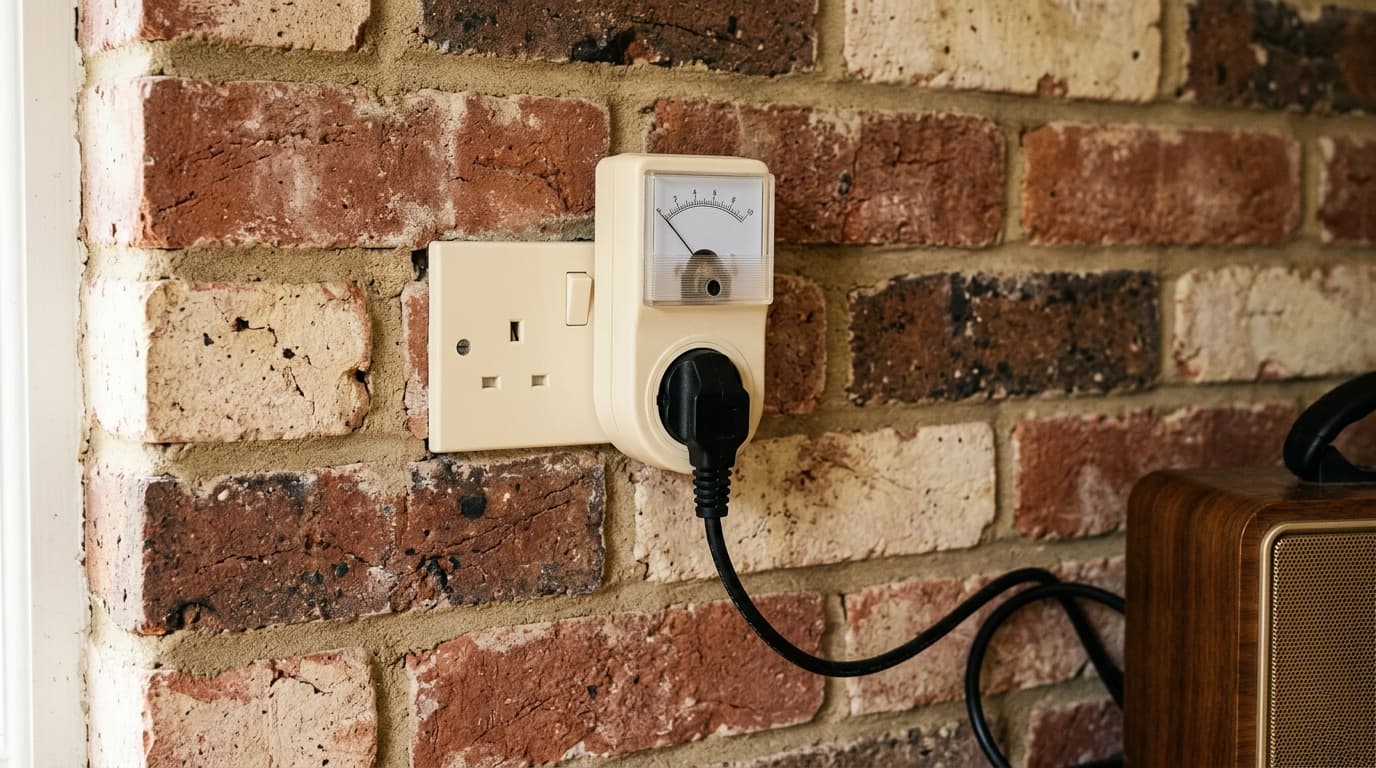
Your bill gives you an annual total. It never tells you which appliance pushed it up. To move from one global figure to a list of culprits you need a measuring device, and there are three very different families: the plug-in wattmeter, the smart plug with built-in metering, and the monitor connected to the P1 port of your digital meter. The right choice depends less on budget than on what you are actually trying to find out.
Two Belgian specifics matter throughout. The DSO (in French GRD, gestionnaire de réseau de distribution) is your regional grid operator: Fluvius in Flanders, ORES or RESA in Wallonia, Sibelga in Brussels. You do not choose it. The capacity tariff is a Flemish grid charge based on your quarter-hourly power peak rather than on volume alone.
Which device measures household electricity use?
A plug-in wattmeter for a single appliance; a monitor wired to the P1 port for the whole home.
That is the only question worth settling before looking at a price. A plug-in wattmeter slots between the wall socket and the appliance cable: it displays instantaneous power in watts, accumulates energy in kilowatt-hours, and often converts to euros once you enter your kWh price. It answers "what does this freezer cost me". A whole-home monitor reads the meter or the incoming cables and answers "where is my electricity going", without ever naming a specific appliance unless it does signature recognition.
The two are not competitors. They answer two different questions.
The three families, by budget bracket
The table below compares the ranges available on the Belgian market, with payback calculated on a single assumption: removing 30 W of permanent standby load, roughly €92 a year at the August 2026 kWh price.
| Bracket | Device type | Scope measured | Payback on 30 W removed |
|---|---|---|---|
| Under €30 | Plug-in wattmeter with screen | 1 appliance, 230 V single-phase | ~4 months |
| €30 to €100 | Smart plug with metering, simple P1 reader | 1 appliance, or meter index | 4 to 13 months |
| €100 to €250 | P1 monitor or current clamps (Smappee, Shelly, HomeWizard) | Whole home, real time, quarter-hourly peak | 13 to 33 months |
| €250 and above | Multi-circuit DIN-rail system (Smappee Infinity, Shelly Pro EM, Eastron) | Circuit by circuit, single or three-phase | Rarely pays back on standby hunting alone |
Verdict: if you are starting from scratch, buy the cheapest bracket first. A €20 plug-in wattmeter finds the big loads within a week, and you will then know whether a whole-home monitor would teach you anything more. The reverse order is the most common, and the most disappointing.
These brackets are orders of magnitude observed at Belgian retailers in August 2026. Prices move and ranges get refreshed: check the official page for the exact model before ordering. Smappee is a Belgian manufacturer; Shelly is a European maker whose meters are stocked by most home-automation retailers in the country.
Six criteria before buying anything
- Scope: one appliance, one circuit, or the whole installation. This single criterion eliminates 80 % of the catalogue in a second.
- Rated power: consumer plug-in wattmeters often cap at 16 A, around 3,680 W. Fine for a fridge, tight for a kettle, inadequate for an EV charger.
- Access to history: a screen shows the moment, an app keeps the curve. Without history you cannot compare January with July.
- Time granularity: the P1 port delivers one frame per second according to Sibelga. An hourly reading will never reveal a start-up peak.
- Digital meter compatibility: a P1 reader is useless if your meter is still electromechanical, in which case a clamp-based monitor is the only route.
- Three-phase: many entry-level models are single-phase only. If your home is three-phase, half the market's references drop out.
The digital meter's P1 port: what it changes, and how to switch it on
The P1 port turns your meter into a local, free, real-time data source.
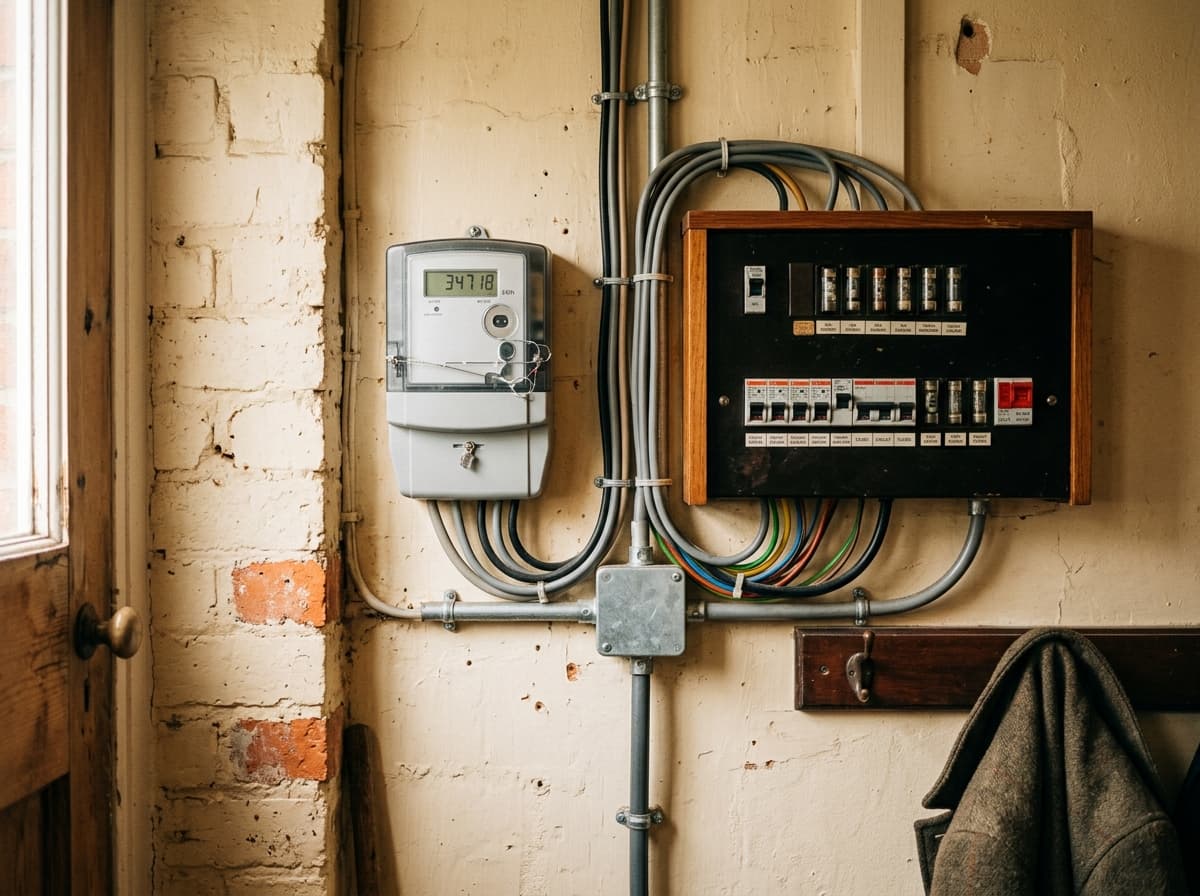
Sibelga describes it as a window onto your consumption: the digital meter has two client ports, the P1 which sends data once per second and the much faster S1, which is not used in Brussels. The connection uses an RJ12 cable, under a rubber cover on the side of the meter. The data never leaves your home, unless the device you plug in sends it to a cloud itself.
And this is where Belgium complicates matters: the activation procedure depends on your DSO.
| Region | DSO | P1 port by default | How to activate it |
|---|---|---|---|
| Brussels | Sibelga | Enabled | Nothing to do, just plug in the RJ12 cable |
| Flanders | Fluvius | Disabled | Port management in My Fluvius; a ▼ triangle above "P1" confirms activation |
| Wallonia | ORES | Disabled | Phone request on 078/15.78.01, on installation day or later |
In Wallonia, ORES states that the client port is disabled by default for privacy reasons and is only opened after the customer's explicit authorisation. The operator adds a warning worth repeating: once the port is open, if your meter sits in a shared utility room, your real-time consumption data can be captured by anyone who plugs a reader into it. RESA customers follow that operator's own procedure and should check directly with it.
What a permanent standby load actually costs at the Belgian kWh price
A continuous 30 W draw represents 263 kWh over a year, roughly €92.
The arithmetic is trivial yet almost never done: watts × 8,760 hours ÷ 1,000 = kWh per year. The rest is one multiplication by your kWh price. We use €0.35/kWh all-in, an order of magnitude for the Belgian residential market observed in August 2026, taxes, grid costs and VAT included. Our survey of the electricity price per kWh in Belgium carries the current figure, which needs refreshing since variable contracts are re-indexed monthly.
| Continuous power | Energy over one year | Annual cost at €0.35/kWh |
|---|---|---|
| 5 W | 44 kWh | €15 |
| 10 W | 88 kWh | €31 |
| 30 W | 263 kWh | €92 |
| 50 W | 438 kWh | €153 |
| 100 W | 876 kWh | €307 |
A set-top box, an internet router, a home-cinema amplifier and two forgotten chargers comfortably exceed 30 W between them. That kind of total is what makes a plug-in wattmeter pay for itself before the quarter is out, while the same device will teach you nothing in a home that has already been stripped back.
A measuring device saves not one kilowatt-hour. It points. The entire gain lies in what you decide once you have seen the number.
The Flemish capacity tariff: where a monitor earns the most
In Flanders the payback calculation changes in nature, because the bill no longer depends on consumed energy alone.
The capacity tariff bills your quarter-hourly power peak, meaning the highest average power recorded over fifteen minutes in the month, with a minimum contribution equivalent to a 2.5 kW peak. Suppliers and comparison sites active on the Flemish market quote a 2026 range of €52 to €60 per kW of peak per year depending on the grid operator, averaging around €56/kW. The official schedule is published by the VREG, the Flemish energy regulator, and is the only source to trust for the amount applying to your DSO.
The consequence: a real-time monitor that warns you when the oven, the washing machine and the EV charger all start together can earn more through peak shaving than through standby hunting. Shaving 1 kW off your average peak is worth €52 to €60 a year, which pays back a €120 monitor in a little over two years, independently of any energy saving.
In Wallonia the IMPACT tariff follows a comparable logic with its own parameters, and in Brussels the tariff structure remains mainly volumetric. The same device therefore does not have the same economic value depending on the region, and that is a point generic buying guides never mention.
Can you measure your consumption with a multimeter?
No, not correctly.
A multimeter reads an instantaneous quantity. It does not accumulate energy and it ignores power factor, which skews the result as soon as a motor or a switched-mode supply is involved. Multiplying voltage by current gives you apparent power, not the active power you are billed for.
The mistakes that come up most often
Measuring for too short a time. A fridge consumes in cycles. A ten-minute reading tells you nothing: twenty-four hours is the minimum, a week for a water heater.
Extrapolating one winter day across a year. The symmetric error, and it leads to estimates twice too high.
Confusing power with energy. A 2,000 W appliance run for six minutes uses less than a 10 W bulb left on for two days. The watt describes a rate, the kilowatt-hour a quantity.
Buying a P1 reader without checking the port is open. Two regions out of three leave it closed by default.
What next?
Knowing where your electricity goes solves only half the problem. The other half is the price you are being charged for it. Once your big loads are identified, feed your annual consumption into the energy supplier ranking, which reasons in total annual cost rather than headline price per kWh. If your meter has just been replaced, our guide to the digital meter in Belgium sets out what changes in billing. And if the real goal is to pay less each month, the method for lowering your advance payments starts from exactly the figures your measuring device has just produced.
Sources — Sibelga, "The P1 port: a window into your electricity consumption", client ports P1 and S1, P1 enabled by default in Brussels, one frame per second (accessed 23 August 2026); ORES, "Le port client", port disabled by default, activation by phone on 078/15.78.01, RJ12 cable required (accessed 23 August 2026); Fluvius, port management via the My Fluvius portal, ▼ indicator above "P1" (procedure described by several suppliers and service providers active in Flanders, accessed 23 August 2026); VREG, capacity tariff, quarter-hourly peak and 2.5 kW minimum contribution; the €52 to €60/kW/year range for 2026 quoted by suppliers and comparison sites active on the Flemish market (accessed 23 August 2026). Electricity price: €0.35/kWh all-in, an order of magnitude for the Belgian residential market observed in August 2026, to be re-checked before any decision, since variable offers are re-indexed monthly. Hardware price brackets: orders of magnitude observed at Belgian retailers in August 2026. None of the models cited has been tested; they are named as range markers, with no affiliate links.
Électricité comparator
Compare all électricité side by side.
Compare now →
Frequently asked questions
Camille suit le marché belge de l'énergie depuis une dizaine d'années. Elle a d'abord travaillé côté gestion de contrats B2B, puis est passée à l'analyse indépendante : elle éplucha les grilles tarifaires de Mega, Bolt, Engie, Luminus, TotalEnergies, Eneco ou Ecopower, recoupe chaque prix avec le CREG Scan, la CWaPE, le VREG et Brugel, et refait les calculs de facture à la main quand un fournisseur communique un chiffre trop rond. Sa conviction : la plupart des ménages belges ne changent jamais de fournisseur et paient chaque année quelques centaines d'euros de trop — pas par paresse, mais parce que les offres sont volontairement illisibles. Ici, elle traduit les conditions tarifaires en euros par an, et dit clairement quand une « promo » n'en est pas une.