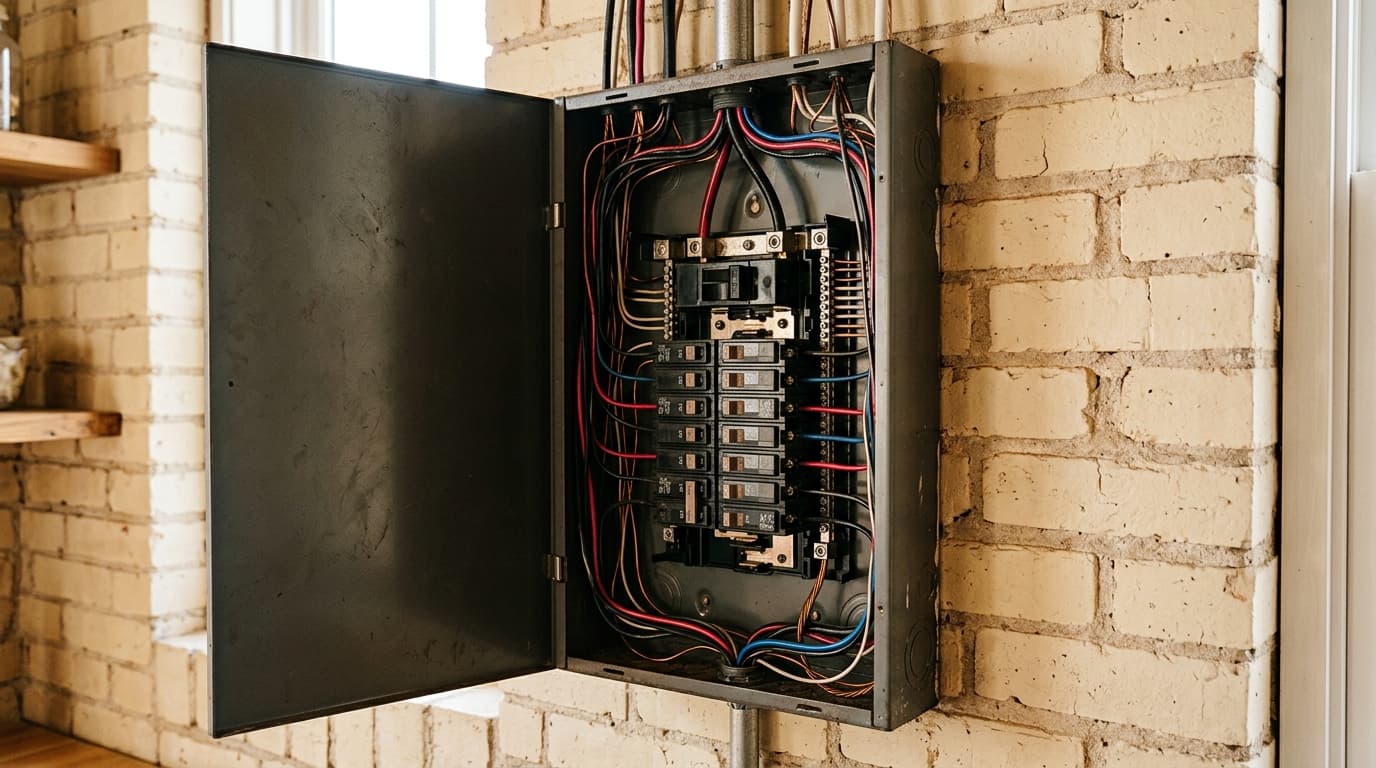
Open your electrical panel and count the wires arriving at the main breaker. Two wires means single-phase. Three or four means three-phase. The question is settled in ten seconds, and yet it fills hundreds of Belgian forum threads, because the country keeps an oddity almost none of its neighbours share: a three-phase network at 230 V, with no neutral, that barely exists anywhere else in Europe.
How do I know whether I am on single-phase or three-phase?
By the colour and the number of incoming wires, before you even look at the meter.
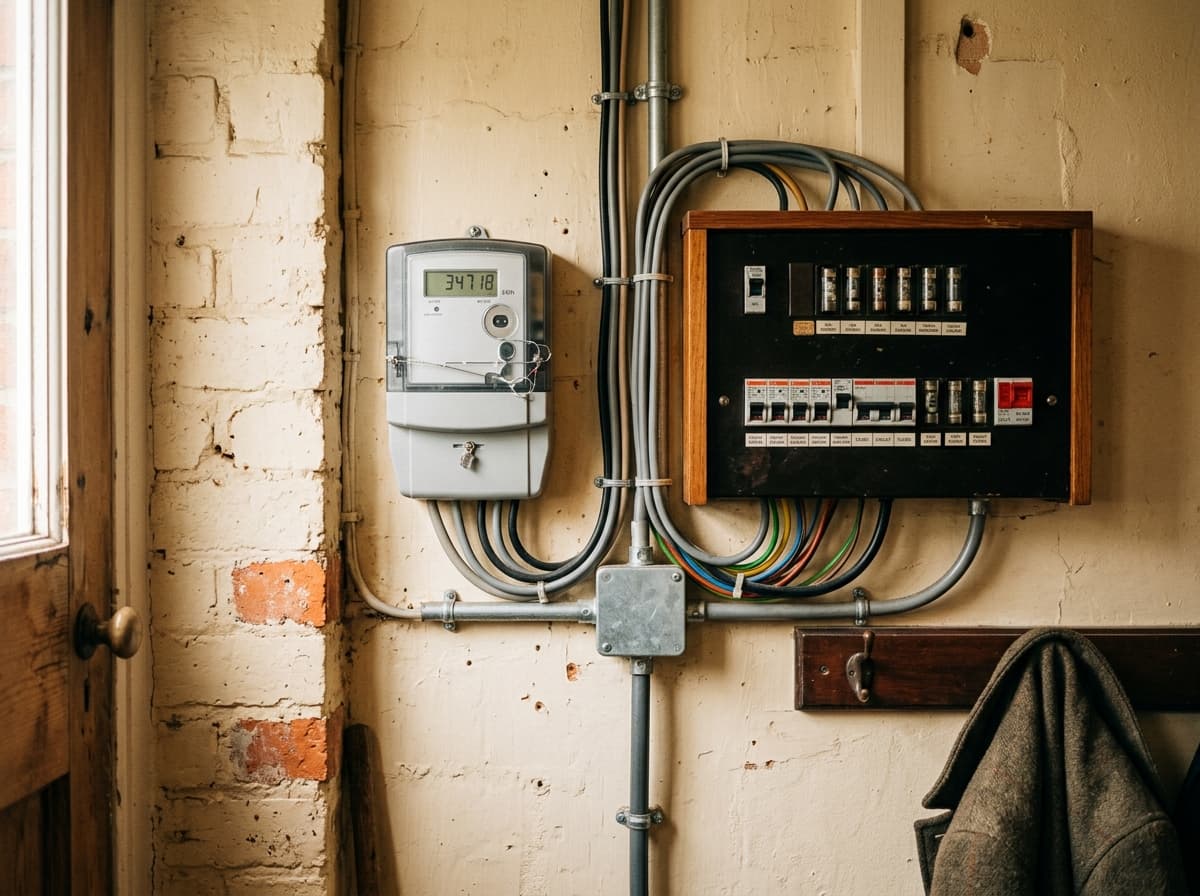
Sibelga, through its Energuide information service, describes both configurations in the simplest possible terms. On single-phase, two wires come in: one live wire in black or red, one blue neutral. On three-phase, three live wires arrive, coloured black, red, brown or grey, possibly accompanied by a blue neutral.
The yellow and green wire does not count here. That is the earth, and it carries no working current.
Three connection types coexist in Belgium, not two
The table below is the heart of the matter. The right-hand column is the one nobody calculates, even though it answers the only real question, namely how many appliances can run at once.
| Connection | Wires at the panel | Voltage | Typical breaker | Available power |
|---|---|---|---|---|
| Single-phase 230 V | 2 (live + neutral) | 230 V between the two wires | 40 A | 9,2 kVA |
| Single-phase 230 V upgraded | 2 (live + neutral) | 230 V | 63 A (maximum) | 14,5 kVA |
| Three-phase 3x230 V | 3 live wires, no neutral | 230 V between each pair | 40 A | 15,9 kVA |
| Three-phase 3x400 V + N | 3 live wires + neutral | 400 V between phases, 230 V phase to neutral | 25 A | 17,3 kVA |
| Three-phase 3x400 V + N | 3 live wires + neutral | 400 V between phases, 230 V phase to neutral | 40 A | 27,7 kVA |
The power figures come from the standard calculation: voltage times current on single-phase, and the square root of three times the phase-to-phase voltage times the current on three-phase. They are expressed in kVA because that is the unit of the connection contract, not in kW.
One thing jumps out once the five rows sit side by side. A single-phase supply pushed to 63 A delivers 14,5 kVA, barely less than a 3x230 V three-phase supply at 40 A. The reasoning that runs "I need three-phase to get power" is therefore wrong in a great many Belgian residential situations, and it is an argument that regularly costs homeowners more than a thousand euros they did not need to spend.
The 3x230 V network without neutral is a Belgian peculiarity
Three wires, 230 V between each of them, no neutral at all. This network is a legacy of the country's early electrification, and it survives across a meaningful share of the building stock, particularly in Walloon and Brussels town centres.
It works perfectly well for ordinary domestic use. Each lighting or socket circuit is fed between two live wires, which does produce the expected 230 V, and an electrician distributes the circuits to keep the three phases balanced.
Trouble starts with modern equipment. A device designed for 3x400 V + N finds no neutral and simply cannot be connected. The best documented case is solar: on a 3x230 V network with no neutral, Belgian technical resources for prosumers point out that a three-phase inverter cannot be installed, and that you have to work with one or two single-phase inverters spread across the phases. The same logic applies to certain EV chargers and certain heat pumps whose datasheet explicitly calls for 400 V three-phase with neutral.
Is a three-phase contract more expensive than a single-phase one?
Not on the supplier side at all.
The price per kilowatt-hour, the annual fixed term and the contract conditions are identical whether you are fed by one phase or three. No supplier active in Belgium, not Engie, not Luminus, not TotalEnergies, not Mega, not Eneco, not OCTA+, not Bolt, not Ecopower, adjusts its tariff on the number of phases. If you are comparing offers, this parameter does not enter the calculation, and our energy supplier ranking works purely on annual cost against your real consumption.
Three items do move, and none of them belongs to the contract.
- The cost of switching to three-phase, billed once by the DSO and by the electrician, detailed further down.
- The Flemish capacity tariff, a network charge based on your monthly power peak, which therefore prices indirectly what three-phase lets you do.
- The compliance inspection, mandatory after any substantial modification to the installation, carried out by an approved body.
kW, kVA, kWh: three units the bill keeps mixing up
Vocabulary is half the problem. These three symbols look alike and measure nothing alike.
| Unit | Quantity measured | Where you see it | Who bills it |
|---|---|---|---|
| kW | Instantaneous power | Appliance datasheet, digital meter peak | The Flemish DSO, through the capacity tariff |
| kVA | Apparent power of a connection | Connection contract, breaker rating | Nobody, for a household |
| kWh | Energy consumed | Meter index, main line of the bill | Your supplier, on every bill |
The tap analogy beats any definition. kVA is the diameter of the pipe, kW is the flow the moment you open it, kWh is the total volume that went through over the year. You pay for the volume, almost never for the diameter.
The distinction between kW and kVA comes down to the power factor, which sits close to 1 in a home running modern appliances. For domestic purposes, treating 1 kVA as 1 kW is an acceptable approximation, and it is the one grid operators use in their consumer-facing documents.
How much does switching from single-phase to three-phase cost?
Between 500 and 2 500 €, depending on the scale of the works.
The range is wide because it covers two very different situations. If the three-phase cable already runs past the house and the connection cabinet is close by, the job comes down to replacing the meter, adapting the panel and redistributing the circuits, and you stay at the bottom of the range. If a new cable has to be pulled from the street, the pavement opened and the municipality involved, the bill climbs towards the top, and sometimes beyond.
These are orders of magnitude gathered from Belgian trade sources in early September 2026, not a quote. The only figure that applies to your home is the one your DSO will produce.
The contrast with new-build deserves stating, because it changes the decision. Specifying three-phase during construction adds roughly 200 to 600 €. Retrofitting it ten years later costs three to five times more. For a new house that will one day host an EV charger and a heat pump, raising the question with the builder costs one conversation and avoids a building site.
The procedure itself does not vary. Application to the relevant DSO, meaning Fluvius in Flanders, ORES or RESA in Wallonia, Sibelga in Brussels. Adaptation works by an electrician. Meter replacement by the DSO. Compliance inspection by an approved body before the supply is switched back on. Fluvius publishes a technical sheet on the electrical connection of a standard single-family home setting out the accepted configurations.
In Flanders, charging on three-phase can cost 400 € more a year
Here is the calculation generic guides never run, because it only means something in the north of the country.
Since the capacity tariff came into force, a Flemish household with a digital meter no longer pays its network charges on kilowatt-hours alone. Part of the charge is calculated on the average monthly peak, meaning the average of the twelve monthly peaks over the year, each peak being the highest average power measured across a quarter hour. Fluvius explains which appliances cause a high quarter-hour value and how the peak is measured. The average rate applied by Flemish operators sits around 56 € per kW per year in 2026, within a range of 52 to 60 € depending on the operator, with a minimum billed peak of 2,5 kW for everyone.
Take a household installing an EV charger.
| Setup | Charging power | Time for 20 kWh | Estimated monthly peak | Annual capacity cost |
|---|---|---|---|---|
| Single-phase 16 A | 3,7 kW | 5 h 25 | 4,7 kW | about 263 € |
| Three-phase 3x400 V, 16 A | 11 kW | 1 h 50 | 12 kW | about 672 € |
| Three-phase capped at 3,7 kW overnight | 3,7 kW | 5 h 25 | 4,7 kW | about 263 € |
Our assumptions are stated openly, so the calculation can be redone. A domestic baseline of 1 kW during charging, charging happening every month of the year, a rate of 56 €/kW/year, and no smart management smoothing the peak. The gap between the first two rows reaches 7,3 kW of peak, worth roughly 409 € a year, rounded to 400.
Three-phase costs nothing in itself. It is the speed it allows that gets billed, and only in Flanders.
The third row is the real lesson. A three-phase connection capped at single-phase power during overnight charging produces exactly the same network bill as single-phase, while keeping the capacity available for everything else. The peak is a control decision, not a fate written into the connection.
Wallonia, Brussels, Flanders: the connection does not weigh in the same place
Three regulators, three tariff structures, and a different answer in each region to the same question.
| Region | 2026 network tariff structure | Does the connection affect the bill? |
|---|---|---|
| Flanders | Capacity term on the average monthly peak, about 56 €/kW/year, minimum 2,5 kW | Indirectly yes, through the peaks three-phase allows |
| Wallonia | Optional IMPACT tariff since 1 January 2026, five time bands labelled PIC, MEDIUM and ECO | No, what counts is the hour you consume |
| Brussels | Proportional to kilowatt-hours, no residential power term | No |
The new Walloon tariff framework published by the CWaPE, the regional energy regulator for Wallonia, runs on the opposite logic to Flanders. It does not penalise power, it rewards time-shifting, with savings announced at up to 28 % on distribution charges for households that move their loads into the ECO bands. A Walloon switching to three-phase to charge quickly overnight is therefore making exactly the right call, whereas the same move in Flanders gets billed.
In Brussels the question is neutral. The network bill stays proportional to the kilowatt-hours consumed, and the number of phases enters nowhere in the calculation.
Five situations where three-phase genuinely becomes necessary
- An EV charger above 7,4 kW. Below that, an upgraded single-phase supply is enough, and the charging-time gain is marginal for a daily use of 40 to 60 km.
- A heat pump combined with other heavy electrical loads. On its own it generally fits on single-phase 63 A. Added to a charger and a heat-pump water cylinder, it no longer does.
- Any appliance whose manufacturer datasheet requires 400 V three-phase, typically some professional ovens, lift motors or workshop machines. The need there is technical, not economic.
- A power requirement above what 63 A single-phase can supply, roughly 14,5 kVA. Single-phase upgrading stops there, and that is a physical limit of the connection.
- A high-output solar project with a three-phase inverter, impossible on a 3x230 V network without neutral, and therefore conditional on moving to 3x400 V + N.
Outside those five cases, switching to three-phase is a matter of comfort or anticipation, not necessity. It will not bring any bill down.
What next?
The connection sets what your installation can draw. The contract sets the price of every kilowatt-hour drawn, and the two are decided independently. Once you know your configuration, put your annual consumption into the energy supplier ranking and reason in total annual cost rather than headline price. If your meter was replaced along the way, our guide to the digital meter in Belgium covers what changes in measurement and in billing, and our tracking of the electricity price per kWh in Belgium gives the basis to use in the tables above.
Sources: Sibelga and Energuide, description of single-phase and three-phase connections, existence of 3x230 V without neutral, 63 A ceiling on single-phase (accessed 3 September 2026); Fluvius, technical sheet on the electrical connection of a standard single-family home and official page on high quarter-hour values under the capacity tariff (accessed 3 September 2026); CWaPE, the Walloon energy regulator, press communication on the 2026 changes to low-voltage distribution tariffs and on the IMPACT tariff in force since 1 January 2026 (accessed 3 September 2026); Belgian technical resources for prosumers on the impossibility of a three-phase inverter on a 3x230 V network (accessed 3 September 2026). Flemish capacity tariff: about 56 €/kW/year in 2026, range 52 to 60 € depending on the operator, minimum billed peak of 2,5 kW. Price ranges for switching to three-phase: orders of magnitude gathered from Belgian trade sources in early September 2026, to be confirmed by quotation. The kVA figures in the table, the 409 € annual capacity surcharge calculation and its assumptions are our own, set out in the article so they can be redone with your own numbers. Network tariffs are revised annually and variable contracts are re-indexed monthly.
Électricité comparator
Compare all électricité side by side.
Compare now →
Frequently asked questions
Camille suit le marché belge de l'énergie depuis une dizaine d'années. Elle a d'abord travaillé côté gestion de contrats B2B, puis est passée à l'analyse indépendante : elle éplucha les grilles tarifaires de Mega, Bolt, Engie, Luminus, TotalEnergies, Eneco ou Ecopower, recoupe chaque prix avec le CREG Scan, la CWaPE, le VREG et Brugel, et refait les calculs de facture à la main quand un fournisseur communique un chiffre trop rond. Sa conviction : la plupart des ménages belges ne changent jamais de fournisseur et paient chaque année quelques centaines d'euros de trop — pas par paresse, mais parce que les offres sont volontairement illisibles. Ici, elle traduit les conditions tarifaires en euros par an, et dit clairement quand une « promo » n'en est pas une.