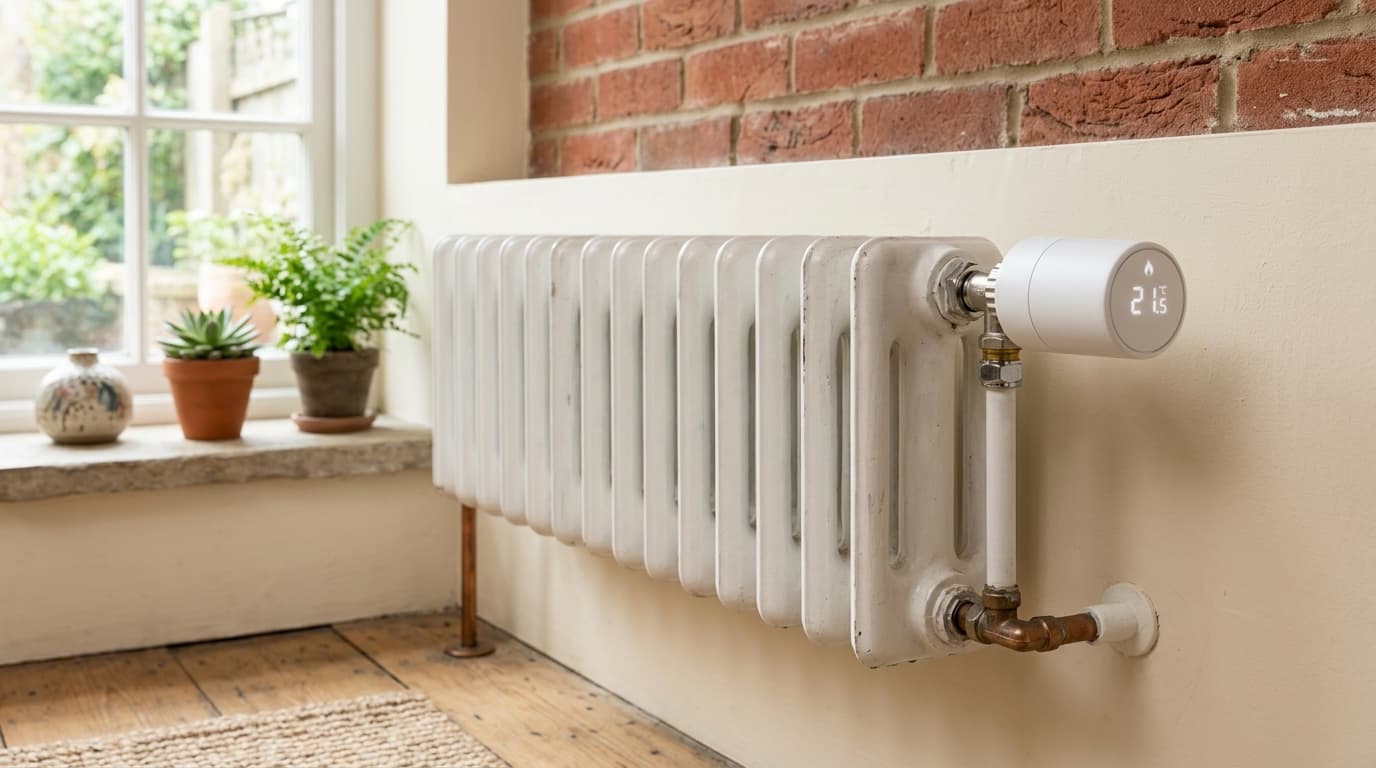
A smart radiator valve only pays in rooms that are heated for nobody. In a Belgian gas-heated house that means 23 to 35 euros a year per radiator concerned, at October 2026 gas prices, so three to four years to pay back a 100 euro head. Everywhere else, the mechanical head with its numbered dial does the same job.
Smart or mechanical radiator valve: what is the difference?
Both perform exactly the same action: they throttle the flow of hot water into the radiator once the room reaches the wanted temperature.
The mechanical head does it with a wax or liquid cartridge that expands with heat and pushes a pin. No battery, no app, a dial numbered 1 to 5. The smart head, also sold as a smart thermostatic head or smart TRV, replaces the cartridge with an electronic sensor and a small motor. It targets a temperature in degrees, follows a schedule, can be controlled remotely and, on some models, closes when a window opens.
Neither one touches the boiler.
| Criterion | Mechanical head | Smart head alone | Smart head plus same-brand thermostat |
|---|---|---|---|
| Limits the room temperature | Yes | Yes | Yes |
| Setpoint in degrees | No, marks from 1 to 5 | Yes | Yes |
| Schedule per room | No, by hand | Yes | Yes |
| Controls the boiler | No | No | Yes |
| Power | None | Batteries | Batteries |
| Budget per radiator | Low | 50 to 120 € according to Test-Achats | 50 to 120 €, plus the thermostat |
| Worth it when | Always | A room is heated while empty | The house is occupied irregularly |
18% for the standard head, the remainder for the smart one
The most solid figure in this file has nothing to do with connected devices.
In 2018 the University of Salford measured, in its whole-house test facility, the overheating of a home with no thermostatic heads over a full heating season, then compared heating energy with and without regulation. The report, commissioned by the British trade body BEAMA and followed by BRE, concludes that plain mechanical heads have an average saving potential of 18% of heating costs. Put differently, the bulk of the gain comes from limiting each radiator, not from linking it to a phone.
Makers of smart heads advertise far more: 22% on average and up to 28% at tado, 25 to 40% at Netatmo. Test-Achats took apart the assumption behind those figures in an analysis dated 29 January 2026: they presume rooms held at 20 degrees all day, which almost no household does. The organisation adds a point seldom made, namely that automation can raise consumption, for instance by preheating in the morning a room you used to leave cold.
A smart head does not heat better than a dial head. It remembers to turn it down when you forget.
How much does a smart valve save, room by room?
Between zero and 35 euros a year per radiator, depending on the room.
We reran the numbers for a Belgian terraced house heated with gas. The assumptions are laid out so that you can swap in your own: 14,000 kWh of gas a year, 80% of it for heating, so 11,200 kWh, based on our benchmarks for average gas consumption; a price of 10 c€/kWh all in; eight radiators, hence 140 euros of heating per radiator per year on average; and the rule detailed in our article on the ideal heating temperature, one degree less being worth about 7% of heating.
| Room | Starting point | With a smart head | Average drop | Yearly saving | Payback of a 99.99 € head |
|---|---|---|---|---|---|
| Living room | Run by the central thermostat | Nothing more | 0 °C | 0 € | Never |
| Bedroom, mechanical head already on 2 | 16 to 17 °C at all times | Nothing more | 0 °C | 0 € | Never |
| Bedroom left at 20 °C all day | 20 °C, around the clock | 16 °C for 14 hours a day | 2.3 °C | 23 € | 4.4 years |
| Study, home working 2 days a week | 20 °C, around the clock | 20 °C for 20 hours a week, 16 °C otherwise | 3.5 °C | 35 € | 2.9 years |
These amounts are ceilings. Heat moves between rooms through partitions and doors, so a bedroom lowered by four degrees takes some of its calories back from the hallway. And the two profitable rows are profitable for one precise reason: nobody was turning the dial. A mechanical head turned down every morning would deliver the same saving for free.
The gas price shifts the result in proportion. At 8 c€/kWh the study saves 28 euros and the head pays back in 3.6 years; at 12 c€/kWh, 41 euros and 2.4 years. On 8 October 2026 the comparison site Callmepower listed Walloon offers between 7.56 and 10.65 c€ per kWh, and our gas price tracker gives the full range.
Should you fit every radiator?
No.
Take the house from the table, with two bedrooms empty during the day and a part-time study. Three heads at 99.99 euros cost 300 euros and save at best 81 euros a year: payback in 3.7 years. Eight heads cost 800 euros for the same saving, since the five other radiators have nothing to recover, and payback slides to nearly ten years, five times the two-year warranty of a device whose small motor works several times a day.
Then comes the subscription, where there is one. At tado, advanced automation goes through the AI Assist plan at 3.99 euros a month, recorded on 9 October 2026: 47.88 euros a year, or 59% of the maximum saving of the three heads.
Tado, Netatmo, Danfoss, Honeywell Home: protocol before brand
We have tested none of these devices. The data below come from the official product pages consulted on 9 October 2026.
| Model | Protocol | Box required | Power | Adapters | Official price |
|---|---|---|---|---|---|
| tado Smart Radiator Thermostat X | Thread, Matter compatible | Bridge X or Thread border router | Battery recharged over USB-C, about once a year | Six included, 95% of valve bodies claimed | 99.99 € |
| Danfoss Ally | Zigbee 2.4 GHz | Zigbee gateway, Danfoss or certified third party | Two AA batteries, up to two years | RA and M30 x 1.5 in the basic kit | Not shown on the data sheet |
The tado product page also states a two-year warranty. The Danfoss data sheet specifies a noise level below 30 dBA, a setpoint range of 5 to 35 degrees and an IP20 rating, so a head to keep out of damp rooms.
Netatmo, Honeywell Home, Bosch and Somfy also sell smart heads in Belgium, all of them bench-tested by Test-Achats. Because we could not verify their official pages that day, we quote neither price nor battery life for those brands.
Five criteria come before the name on the box:
- The existing valve body. M30 x 1.5 thread, Danfoss RA or something else: it determines which models fit without an exotic adapter.
- The protocol and the box. Wi-Fi, Zigbee or Thread, the head never talks to your phone on its own. Count the gateway in the budget.
- Brand lock-in. Thermostats and heads almost never mix across manufacturers. The first purchase commits all the following ones.
- The subscription. Read which functions stay free, and work out the cost over five years.
- The power source. Batteries or rechargeable, you will come back to it every year or two, radiator by radiator.
Without a smart thermostat, is the valve still worth it?
Yes, in one case: collective heating.
In a building where the boiler is shared, you only control your own radiators. Test-Achats says so explicitly: you cannot modulate the boiler, but you can schedule each room. If your costs are split according to what each radiator uses, every closed hour shows up on the statement.
In a single-family house it is less clear-cut. A smart head on its own closes the radiator, but the boiler keeps obeying a thermostat that knows nothing of what the heads are doing. Two rules avoid trouble. The room that holds the central thermostat keeps its radiator open, otherwise the two controls contradict each other and the boiler runs without ever reaching its setpoint. And the system must not end up with every radiator closed while the pump is pushing: that hydraulic point is checked with a heating engineer, not with an app. For the thermostat itself, our payback calculation for a smart thermostat on a gas boiler follows the same method.
Wallonia, Brussels, Flanders: grants and collective heating
None of the three regions subsidises a thermostatic head bought on its own, according to the schemes we consulted in October 2026. Everything around it differs.
| Region | Grant for heads alone | Situation in October 2026 | Specific point |
|---|---|---|---|
| Wallonia | None found | Temporary heating grant scheme closed on 30 September 2026, new scheme awaited | Gas boiler service every 3 years |
| Brussels | None | Renolution grants suspended since 1 January 2025 | Many buildings on collective heating: a head alone makes sense there |
| Flanders | To be checked on Mijn VerbouwPremie | Conditions to verify on the official portal before buying | Gas boiler service every 2 years |
A radiator that heats poorly at the top is not fixed by a new head: it first needs bleeding.
Four common mistakes
- Fitting the living room first. It is the room where the central thermostat already does the work.
- Hiding the head behind a curtain or a radiator cover. The sensor then measures trapped warm air and shuts off too early.
- Dropping a room next to the living room to 12 degrees. The partition becomes a cold wall, and the living room pays the difference.
- Leaving the gateway and the subscription out of the price, then comparing heads as though they worked alone.

The next item
The heads decide how many kilowatt-hours are burned, room by room. The contract decides their price, and the gap between two gas offers quickly exceeds what three smart heads recover in a year. Enter your annual consumption in the energy supplier ranking, which compares total cost, gas and electricity included.
Sources. BEAMA and University of Salford, "Assessing the energy savings from Thermostatic Radiator Valves in a whole house test facility", 2018 report published on 10 January 2019 (average potential of 18% of heating costs compared with a system without thermostatic heads). Test-Achats, "Comment choisir les vannes thermostatiques connectées de vos radiateurs ?", 18 February 2026 (50 to 120 euros apiece, brand lock-in, collective heating) and "Comment économiser l'énergie avec un thermostat ou une vanne thermostatique connectés ?", 29 January 2026 (critique of the savings advertised by tado and Netatmo). tado, Smart Radiator Thermostat X product page, consulted on 9 October 2026 (list price of 99.99 euros, Thread and Matter, Bridge X, six adapters, AI Assist at 3.99 euros a month). Danfoss, Ally head data sheet, consulted on 9 October 2026. Gas price: assumption of 10 c€/kWh all in, taken from our price tracker; per-kWh prices of Walloon offers recorded by Callmepower on 8 October 2026, within the scope used by that comparison site. Grants: regional portals, schemes in force in October 2026. The savings per room, the payback times and the three heads versus eight comparison are our own calculations, theoretical ceilings explained in the article. Variable contracts are re-indexed every month: check your price per kWh again before deciding.
Camille
Gaz naturel comparator
Compare all gaz naturel side by side.
Compare now →
Frequently asked questions
Camille suit le marché belge de l'énergie depuis une dizaine d'années. Elle a d'abord travaillé côté gestion de contrats B2B, puis est passée à l'analyse indépendante : elle éplucha les grilles tarifaires de Mega, Bolt, Engie, Luminus, TotalEnergies, Eneco ou Ecopower, recoupe chaque prix avec le CREG Scan, la CWaPE, le VREG et Brugel, et refait les calculs de facture à la main quand un fournisseur communique un chiffre trop rond. Sa conviction : la plupart des ménages belges ne changent jamais de fournisseur et paient chaque année quelques centaines d'euros de trop — pas par paresse, mais parce que les offres sont volontairement illisibles. Ici, elle traduit les conditions tarifaires en euros par an, et dit clairement quand une « promo » n'en est pas une.