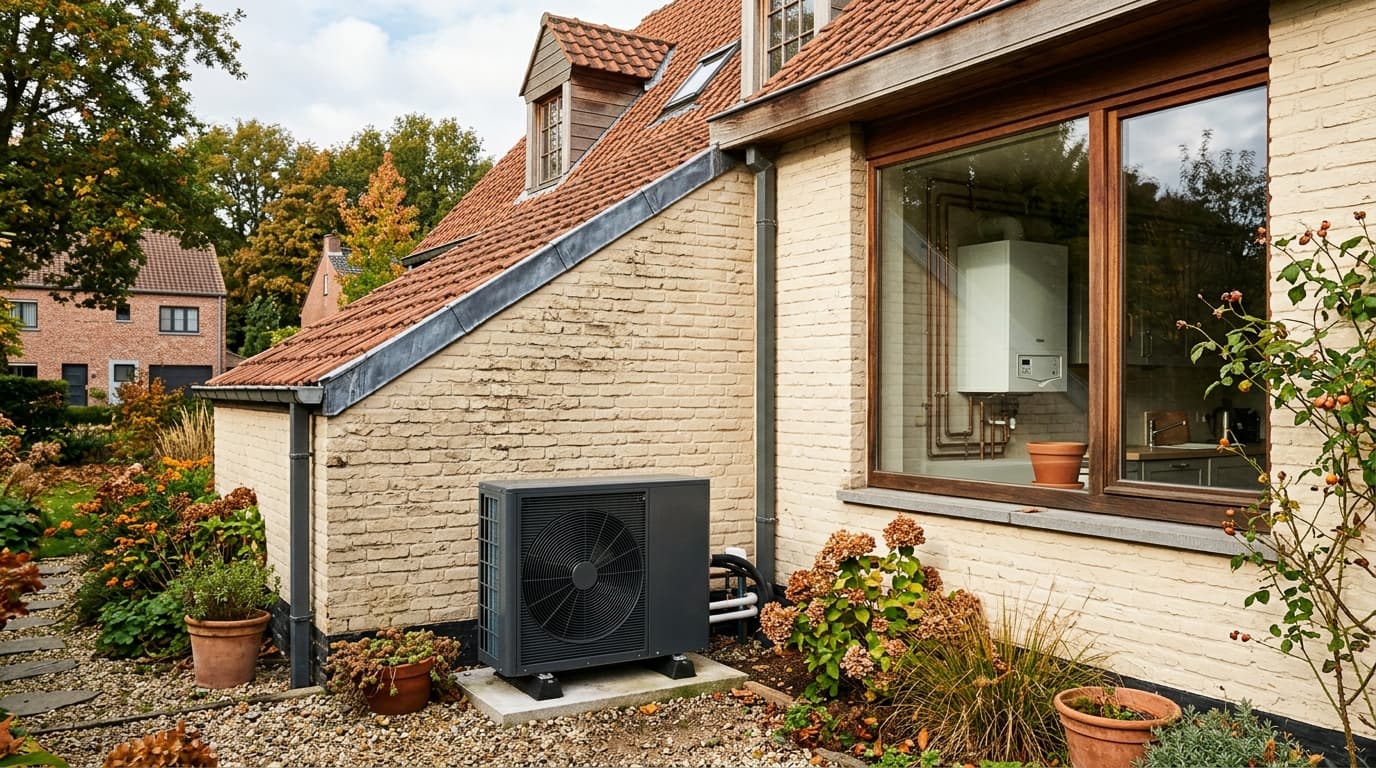
A hybrid gas heat pump pairs an air-to-water heat pump with a condensing gas boiler, and picks at every moment whichever energy produces the cheapest heat. At Belgian prices in September 2026, it saves between 48 and 365 € a year in an average house. That is not much. The electricity contract signed alongside it can double that figure.
How does a hybrid gas heat pump work?
Two heat generators, one radiator circuit, one controller that arbitrates.
The heat pump, a small one, covers most of the season: autumn, spring, the mild winters that make up the bulk of the Belgian climate. The gas boiler takes over when the cold drags the heat pump's efficiency down, or when a lot of power is needed at once, for domestic hot water for instance. The major manufacturers active in Belgium, including Daikin, Vaillant and Viessmann, sell complete packages or modules that can be added to an existing boiler.
The heart of the system is not the machine. It is the switchover rule, and Énergie Plus, the Belgian technical reference site on heat pump controls, sets out the logic. Three modes recur across most manufacturers:
- Alternating mode: only one generator runs at a time, and the switch happens at an outdoor temperature set during installation.
- Parallel mode: the heat pump runs continuously and the boiler tops up when power runs short.
- Economy mode: the controller compares the cost of a kWh of heat from each source, based on energy prices, and picks the cheaper one.
The third mode is the only one that talks money, and it is the one that ties the machine directly to your energy contract. On models that offer it, the prices entered at commissioning are rarely updated afterwards, even though a variable contract changes price every month.
The switchover point is 2.94 in Wallonia and 3.36 in Brussels
The formula fits on one line: price of a kWh of electricity divided by the cost of a kWh of heat from gas, which is itself the gas price divided by the boiler's efficiency. Above that coefficient of performance, the heat pump produces cheaper heat than gas. Below it, the boiler wins.
| Region | Electricity, average incl. VAT | Gas, average incl. VAT | Cost of a kWh of heat from gas (92 % efficiency) | Switchover COP |
|---|---|---|---|---|
| Wallonia | 0.4496 € | 0.1407 € | 0.153 € | 2.94 |
| Flanders | 0.4021 € | 0.1146 € | 0.125 € | 3.23 |
| Brussels | 0.4568 € | 0.1250 € | 0.136 € | 3.36 |
Selectra averages from 16 September 2026. Because the Flemish capacity tariff (a network charge based on your peak power draw rather than on kWh) is billed separately, the real threshold there sits above 3.23.
A Belgian paradox. Wallonia, where gas costs the most, is the region where the heat pump stays in charge the longest.

How much does a hybrid boiler save over a year?
Less than people imagine, at September 2026 prices.
The scenario is the one this site uses for all its heating comparisons: a house needing 15,000 kWh of heat a year, currently heated by a condensing gas boiler at 92 % efficiency. For the share of heat covered by the heat pump, the most solid benchmark comes from the Netherlands, where Milieu Centraal, the Dutch public energy information body, puts the average drop in gas use at about 60 %. We therefore assign 60 % of the heat to the heat pump, with two seasonal COP assumptions on that share: 3.5 and 4.
| Region | Gas boiler alone | Hybrid, COP 3.5 | Saving | Hybrid, COP 4 | Saving |
|---|---|---|---|---|---|
| Wallonia | 2,294 € | 2,074 € | 220 € | 1,929 € | 365 € |
| Flanders (excl. capacity tariff) | 1,868 € | 1,781 € | 87 € | 1,652 € | 216 € |
| Brussels | 2,038 € | 1,990 € | 48 € | 1,843 € | 195 € |
The boiler alone burns 16,304 kWh of gas. The hybrid burns only 6,522, and uses 2,250 to 2,571 kWh of electricity in exchange. Gas use falls by 60 %, the bill by 2 to 16 %, because every kWh of electricity costs three to four times as much as the kWh of gas it replaces and the heat pump barely makes up that gap.
Sixty per cent less gas, and sometimes less than fifty euros saved: a hybrid heat pump cuts a volume of gas first, not a bill.
Hybrid heat pump prices and an effective 11.25 % VAT
Ranges published by Belgian renovation guides run from about 4,500 to 10,000 € including VAT and installation. The low end is a module added to a recent boiler, the high end a brand new package. Indicative figures only.
The tax side, by contrast, is known to the cent. Since the summer 2025 reform, a gas or oil boiler is invoiced at 21 % VAT, even in renovation work, while a heat pump stays at 6 %. For a hybrid system supplied and installed at a single price, the FPS Finance accepts a flat split: 65 % of the price at the reduced rate, 35 % at the standard rate. The effective rate works out at 11.25 %. On a system at 8,000 € excluding VAT, that means 900 € of VAT, against 480 € for a heat pump alone and 1,680 € for a gas boiler alone at the same price.
2026 grants: 800 to 4,000 € in Flanders, nothing left in Brussels
Three regions, three policies, and a Walloon deadline that closes the day after this article is published.
| Region | Support for a hybrid heat pump | Main conditions | Watch out |
|---|---|---|---|
| Flanders | 800 € (categories 1 and 2), 3,000 € (category 3), 4,000 € (category 4), since 1 March 2026 | Capped at 20 to 50 % of the invoice excl. VAT by category, RESCert certified installer, invoice of at least 1,000 € | The hybrid grant was nearly halved for higher incomes (1,500 € before March 2026) |
| Wallonia | Temporary scheme in force since February 2025, home energy audit required before works | Appliance on the official list, contractor registered with the Crossroads Bank for Enterprises | The scheme ends on 30 September 2026, its successor must be checked on the Region's portal |
| Brussels | No regional Renolution grant for invoices from 2025 onwards | ECORENO loan and possible municipal grants | Gas connections banned in new buildings |
Flemish rates are published on the official Mijn VerbouwPremie page. For Wallonia, only the Region's energy portal is authoritative: schemes there have been suspended, reopened and re-capped several times since 2023.
One detail changes the Flemish equation. The grant for an all-electric air-to-water heat pump reaches 1,500 to 6,000 € depending on the category, nearly double the hybrid amount. Flanders is clearly paying people to leave gas, not to keep it as back-up.
The electricity contract weighs more than the machine
Take the Walloon house again, COP 3.5, gas at the regional average price, and change one variable only: the price per kWh of the electricity that powers the heat pump. The result moves more than it would between two brands of machine, and so does the payback period.
| Electricity price (Wallonia) | Annual hybrid cost | Saving vs gas alone | Switchover COP | Payback on 6,000 € |
|---|---|---|---|---|
| 0.4496 €, regional average incl. VAT | 2,074 € | 220 € | 2.94 | 27 years |
| 0.3923 €, cheapest offer on the Walloon market | 1,926 € | 368 € | 2.57 | 16 years |
| 0.3637 €, average off-peak price on a dual-rate meter | 1,853 € | 441 € | 2.38 | 14 years |
| 0.30 €, assumption for a well-used dynamic contract | 1,689 € | 605 € | 1.96 | 10 years |
The first three rows use the Selectra averages from 16 September 2026. The last one is a calculation assumption, not a recorded price.
Two effects stack up, and that is the whole point of this table. Cheaper electricity directly lowers the cost of the 2,571 kWh the heat pump uses. It also lowers the switchover COP, which lets an economy-mode controller keep the heat pump running at lower temperatures and hand it more than the 60 % of heat assumed here: the savings in these rows are a floor in that sense. The reverse holds too. A household that installs a hybrid without ever revisiting its electricity contract pays full price for the machine and gets the weakest return from it, whereas the same installation, fed by a well-chosen offer and set up with the right prices, halves its payback period without the installer coming back to touch anything.
Night-time rate windows are no longer the same everywhere since January 2026, with Wallonia adding off-peak hours in the middle of the day: our guide to the dual-rate meter sets out what each region applies. And the choice between a fixed, variable or dynamic contract carries a weight here that it does not have with a boiler alone.

Heat pump or gas boiler: when is the hybrid the right compromise?
When the home is not yet ready for a heat pump on its own, and only then.
Our comparison of gas against electric heating shows that a standalone heat pump beats gas once its SCOP clears the regional threshold, provided it runs on a low-temperature circuit. The hybrid answers the in-between situation, and four cases genuinely justify it:
- High-temperature radiators you will not replace right away. The heat pump handles mild weather, the boiler supplies power in deep cold. Flanders does, however, require a circuit designed for 55 °C maximum to grant its premium.
- A boiler at the end of its life in a poorly insulated house. The choice is no longer between keeping and investing, but between a new boiler at 21 % VAT and a hybrid at 11.25 %.
- Insulation planned within five years. The hybrid cuts gas straight away and the heat pump takes a growing share of the heat as demand falls.
- A limited electrical connection, typically a low-rated single-phase supply, that would struggle with a heat pump sized to cover frosty days on its own.
Outside those cases, the hybrid stacks the costs of both worlds. Two appliances to service. A gas meter that stays open, with its standing charge and fixed network costs, where a heat pump alone lets you close it. And an annual saving that, at September 2026 prices, does not repay the outlay before the machine's likely end of life.
Before signing a quote, compare both energies together in the energy supplier ranking, which reasons in total annual cost for a given consumption. Engie, Luminus, TotalEnergies and most of their competitors sell both gas and electricity, but the best price on one energy is not always found at the same supplier as the best price on the other. The reference gas price is tracked month by month in our gas price in Belgium survey, and the comparative trend of both energies by CREG, the federal electricity and gas regulator.
Sources and assumptions. Average all-in prices by region (single-rate electricity and gas, 6 % VAT, 3,500 and 17,000 kWh a year), cheapest Walloon electricity offer and average Walloon off-peak price: Selectra comparison site, page updated on 16 September 2026. In Flanders, the capacity tariff is billed outside the per-kWh price. Condensing boiler efficiency: 92 %. Heat demand: 15,000 kWh a year, space heating only. Share of heat covered by the heat pump: 60 %, based on the average reduction in gas use published by Milieu Centraal. Seasonal COP of the heat pump on its share: 3.5 and 4, assumptions. The 0.30 €/kWh price for a dynamic contract is a calculation assumption. 65/35 VAT split for hybrid systems: FPS Finance, reform in force since July 2025. Mijn VerbouwPremie rates since 1 March 2026: vlaanderen.be, as reported by Facq and warmtepompkiezen.be (checked on 29 September 2026). End of the temporary Walloon scheme on 30 September 2026 and suspension of Renolution grants since 1 January 2025: Facq, page checked on 29 September 2026. Investment range: Belgian renovation guides published in 2026, indicative. Variable contracts are reindexed every month, so redo the calculation with your own tariffs. No appliance tested, no affiliate link.
Contrats & tarifs comparator
Compare all contrats & tarifs side by side.
Compare now →
Frequently asked questions
Camille suit le marché belge de l'énergie depuis une dizaine d'années. Elle a d'abord travaillé côté gestion de contrats B2B, puis est passée à l'analyse indépendante : elle éplucha les grilles tarifaires de Mega, Bolt, Engie, Luminus, TotalEnergies, Eneco ou Ecopower, recoupe chaque prix avec le CREG Scan, la CWaPE, le VREG et Brugel, et refait les calculs de facture à la main quand un fournisseur communique un chiffre trop rond. Sa conviction : la plupart des ménages belges ne changent jamais de fournisseur et paient chaque année quelques centaines d'euros de trop — pas par paresse, mais parce que les offres sont volontairement illisibles. Ici, elle traduit les conditions tarifaires en euros par an, et dit clairement quand une « promo » n'en est pas une.