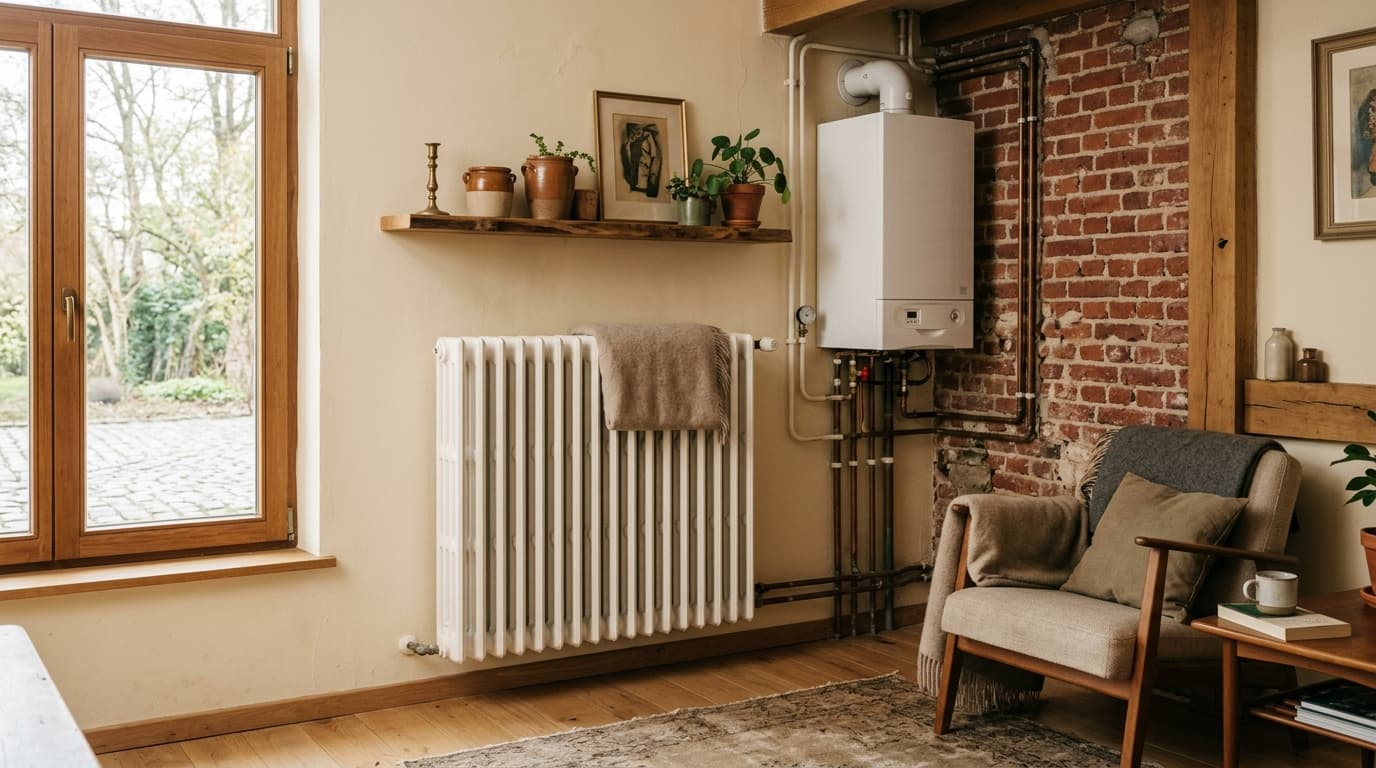
A kilowatt-hour of gas costs three times less than a kilowatt-hour of electricity in Belgium. The sentence is accurate, it is verifiable, and it does not answer the question. Nobody buys kilowatt-hours for their own sake: you buy heat, and between the energy billed and the heat delivered to the radiator sits an efficiency figure that changes everything. Here is the full calculation, redone at Belgian August 2026 prices, for the five systems competing for the market.
The price per kWh compares nothing until you divide it by efficiency
Two meters, two billing units, and only one quantity that matters: the cost of one kilowatt-hour of heat actually delivered inside the home.
Efficiency is the bridge. An electric convector turns 1 kWh of electricity into 1 kWh of heat with no loss, which sounds flattering until you look at the entry price. A recent condensing gas boiler returns about 92 % of the energy contained in the gas it burns, the remainder going up the flue and into circuit losses. A heat pump does not produce heat at all: it moves heat, and returns three to four times more thermal energy than the electricity it consumes.
Three different physical logics. One common denominator.
The prices used throughout this article are orders of magnitude for the Belgian residential market recorded in late August 2026, including taxes, network costs and VAT: 0.35 EUR/kWh for electricity, 0.11 EUR/kWh for natural gas. Comparison sites active on the market put the electricity average between 0.30 and 0.35 EUR depending on profile and region, and the pure energy share of gas around 0.05 EUR. Our reading of the electricity price per kWh and of the gas price in Belgium gives the current values. They move every month on a variable contract.

The real cost of a kilowatt-hour of heat, system by system
| Heating system | Energy purchased | Efficiency or SCOP used | Cost per kWh of heat |
|---|---|---|---|
| Electric convector or radiator | Electricity at 0.35 EUR/kWh | 100 % | 0.350 EUR |
| Condensing oil boiler | Heating oil at 1.25 EUR/L | 90 % | 0.139 EUR |
| Air-to-water heat pump, high-temperature radiators | Electricity at 0.35 EUR/kWh | SCOP 2.5 | 0.140 EUR |
| Condensing gas boiler | Gas at 0.11 EUR/kWh | 92 % | 0.120 EUR |
| Air-to-water heat pump, low-temperature circuit | Electricity at 0.35 EUR/kWh | SCOP 3.5 | 0.100 EUR |
Heating oil enters the table through a conversion: at 1.25 EUR per litre for an order of 2,000 litres or more, recorded on 29 August 2026, and a calorific value of roughly 10 kWh per litre, a kilowatt-hour of oil costs 0.125 EUR before efficiency. Orders below 2,000 litres cost 1.29 EUR per litre the same day, and the price peaked around 1.43 EUR in early August. It is stored energy, bought in one go, whose price freezes at delivery while gas and electricity follow monthly indexation.
Two results jump out. The electric convector is three times more expensive than everything else. And the heat pump only beats gas in its high-performance form, the gap closing completely once its seasonal efficiency drops.
An electric radiator is not a bad appliance. It is an excellent appliance plugged into the most expensive energy in the country.
SCOP 2.9: the exact threshold where a heat pump overtakes gas
The calculation is one division. Cost per kWh of heat from gas: 0.120 EUR. Price per kWh of electricity: 0.35 EUR. The ratio gives 2.9, and that is the minimum seasonal efficiency a heat pump must hold to avoid costing more to run than a condensing gas boiler.
This figure is the data point that general comparisons never publish, even though it makes any quotation readable in ten seconds. A properly sized air-to-water heat pump on underfloor heating or low-temperature radiators routinely reaches 3.5 to 4.2 in real Belgian conditions, and Wallonia in fact requires a coefficient of performance of at least 3.5, measured under EN 14511 at the A7/W35 point, to qualify for its subsidy. The same machine fitted to cast-iron radiators set at 65 °C falls back towards 2.5. It then drops below the threshold, and the bill goes up.
The threshold moves with prices. If electricity falls or gas rises, it goes down, and the heat pump becomes worthwhile more easily. Redo the division with your own tariffs: it takes two minutes.
Fifteen thousand kilowatt-hours of heat: the annual bill for five systems
From unit price to actual bill. The assumption used is a heat demand of 15,000 kWh a year, the order of magnitude for a moderately insulated detached house in Belgium, space heating only, excluding domestic hot water.
| System | Annual heating cost | Gap against gas |
|---|---|---|
| Electric convectors | 5,250 EUR | + 3,450 EUR |
| Heat pump, SCOP 2.5 | 2,100 EUR | + 300 EUR |
| Condensing oil boiler | 2,085 EUR | + 285 EUR |
| Condensing gas boiler | 1,800 EUR | reference |
| Heat pump, SCOP 3.5 | 1,500 EUR | 300 EUR less |
The table reads both ways. Upwards, it prices what a home still heated by convectors costs: more than three thousand euros a year thrown into a unit price gap, and by far the largest pool of savings in the Belgian housing stock. Downwards, it cools a stubborn assumption.
Should you drop a recent gas boiler for a heat pump?
On the bill alone, no, not in this scenario.
Three hundred euros a year. That is what an efficient heat pump saves against a condensing gas boiler in good working order, at August 2026 prices. Against that sits an investment of 8,000 to 18,000 EUR including installation according to Belgian trade sources, with VAT reduced to 6 % for works in a home more than ten years old. Even after deducting a maximum regional subsidy, the payback period runs into decades, not years. No honest calculation says otherwise.
The reasoning flips completely in three situations. Against electric convectors, the annual saving reaches 3,750 EUR and the investment pays back in three to five years. Against an oil boiler, it reaches 585 EUR a year, plus the disappearance of the tank, the tightness inspection and the lump-sum purchase. And when the gas boiler reaches end of life, the comparison is no longer 8,000 to 18,000 EUR but the extra cost over a new boiler, which shifts the balance by a good third.
Five parameters that shift the threshold
- The circuit flow temperature. This is the dominant parameter, far ahead of the brand. Every degree gained on water temperature improves the SCOP by 2 to 3 %, and going from 65 °C to 35 °C moves an installation from one side of the 2.9 threshold to the other.
- The insulation level. It does not change the cost per kilowatt-hour, it changes the number of kilowatt-hours. Halving demand halves the gap between systems, and makes the choice of system less decisive than a renovation of the building envelope.
- The contract type. A variable contract reindexed monthly moves the threshold with every bill. Our comparison of fixed, variable and dynamic contracts sets out the risk each one carries.
- The night tariff. A dual-hourly meter cuts the price of electricity consumed at night, which favours storage heaters and the early-morning preheating of a heat pump. The gain depends entirely on your day and night split, as our guide to the dual-hourly meter explains.
- The electric backup heater. Almost every air-to-water heat pump carries a backup resistance that takes over in deep cold. It heats at convector cost, 0.350 EUR per kilowatt-hour, and a few days of frost are enough to drag the annual SCOP below the threshold.
Wallonia, Brussels, Flanders: three regulatory frameworks, three trade-offs
The physics is the same everywhere. The rules, the subsidies and the network tariffs are not.
| Region | Gas connection in new builds | Heat pump support in 2026 | Regional point to watch |
|---|---|---|---|
| Wallonia | Still allowed | Base subsidy of 600 EUR multiplied by income bracket, capped at 3,600 EUR, mandatory home audit, scheme running until 30 September 2026 | From 1 October 2026, direct subsidies give way to a zero-interest loan of the enhanced Rénopack type |
| Brussels | Banned | Renolution subsidies for air-to-water and geothermal systems, amounts and 2026 timetable to be checked before ordering | Old housing stock and widespread high-temperature radiators, so real SCOP values often sit close to the threshold |
| Flanders | Banned | Mijn VerbouwPremie, amount modulated by income and by the overall scope of works | The capacity tariff bills the quarter-hourly power peak: the heat pump and its backup starting together get charged twice |
The Walloon timetable deserves emphasis, because it closes in exactly one month. A Walloon household hesitating between gas and a heat pump is not only choosing between two energies: it is choosing between a direct subsidy that still exists and a zero-interest loan that will replace it. What is announced for afterwards is a cash-flow mechanism, not a grant.
Always check the amount that applies on your region's official portal, never on a commercial simulator. The schemes have been suspended, reopened and recapped several times since 2023. The official links appear at the end of this article.

Does heating oil still hold up in the comparison?
Barely, and less and less.
At 0.139 EUR per kilowatt-hour of heat, condensing oil stays in the same range as gas, with a 285 EUR annual gap in our scenario. It has one real advantage: it needs no network, which makes it irreplaceable in municipalities the gas grid does not reach. It also has three drawbacks the price per litre does not show. The purchase happens in large quantities, so your cash flow absorbs in one go what gas spreads over twelve instalments. The price follows crude oil and it moved by more than 14 % during August 2026 alone, between 1.25 and 1.43 EUR per litre. And installing a new oil boiler is being progressively closed off in all three regions, with timetables and exemptions that differ and need checking case by case before any quotation.
A hybrid boiler, pairing a heat pump with a gas boiler that takes over automatically depending on outdoor temperature, exists precisely for this threshold problem: the machine switches to gas when its SCOP falls below the break-even point. Technically it is the most refined answer to the calculation in this article. It is also two appliances to buy, service and set up.
Water heaters, hybrids, and the calculation to redo every year
Domestic hot water follows exactly the same arithmetic, with one nuance: an electric tank loses heat continuously to hold its temperature, which pushes its effective efficiency well below 100 % if it sits in a garage or a cellar. Gas therefore keeps its lead. A heat pump water heater, which is nothing more than a small dedicated heat pump, drops below both as soon as its coefficient of performance passes 3.
The calculation gets redone, because prices move. A boiler lasts twenty years, an energy contract is renegotiated in fifteen minutes, and the gap between the most expensive and the cheapest supplier often exceeds the saving promised by changing system. Before ordering anything, put your consumption into the energy supplier ranking, which works in total annual cost rather than headline unit price. If your current bill feels unreadable, our guide to understanding an energy bill separates the energy share from the network share, the one you have no control over. And if the goal is simply to pay less each month without touching the installation, the method for lowering your advance payments starts from the same figures.
Two acronyms for readers new to Belgium. The CREG is the federal energy regulator, which publishes price monitoring for electricity and gas. Your DSO, the distribution system operator (Sibelga in Brussels, Fluvius in Flanders, ORES and others in Wallonia), owns the cables and pipes and is not chosen: it comes with your address, and the EAN code on your bill identifies your connection point. The Flemish capacity tariff bills the highest quarter-hourly average power recorded in the month, on top of the energy consumed.
Official frameworks and applicable amounts can be checked on the Walloon energy portal, on Renolution in Brussels, on the Mijn VerbouwPremie page of the Flemish government, and comparative energy price trends on the CREG monitoring page. The Flemish capacity tariff is published by the VREG.
Sources and calculation assumptions. Electricity price: 0.35 EUR/kWh all-inclusive, order of magnitude for the Belgian residential market recorded in late August 2026; comparison sites put the average between 0.30 and 0.35 EUR/kWh depending on profile and region. Natural gas price: around 0.11 EUR/kWh all-inclusive in August 2026, pure energy share around 0.05 EUR/kWh. Heating oil price: 1.25 EUR/L for orders of 2,000 litres and above and 1.29 EUR/L below, recorded on 29 August 2026; peak around 1.43 EUR/L on 4 August 2026. Calorific value of heating oil used: 10 kWh/L. Efficiencies used: 92 % for a condensing gas boiler, 90 % for a condensing oil boiler, 100 % for an electric convector. SCOP values used: 2.5 on high-temperature radiators, 3.5 on a low-temperature circuit, consistent with the 3.5 to 4.2 range observed in real Belgian conditions and with the Walloon requirement of a minimum coefficient of performance of 3.5 measured under EN 14511 at A7/W35. Walloon air-to-water heat pump subsidy: base of 600 EUR multiplied by income bracket, capped at 3,600 EUR, mandatory audit, scheme running until 30 September 2026 and then replaced by a zero-interest loan of the enhanced Rénopack type. Investment range for an air-to-water heat pump: 8,000 to 18,000 EUR including installation, VAT at 6 % for a home more than ten years old. Ban on new gas connections in new builds: in force in Flanders and Brussels, not in Wallonia at the date of publication. All subsidy amounts and regional rules must be rechecked on the official portal of the region concerned before committing, the schemes having been amended several times since 2023. Since variable energy contracts are reindexed monthly, every calculation in this article should be redone with your own tariffs. No affiliate links, no products tested, no equipment brand recommended.
Contrats & tarifs comparator
Compare all contrats & tarifs side by side.
Compare now →
Frequently asked questions
Camille suit le marché belge de l'énergie depuis une dizaine d'années. Elle a d'abord travaillé côté gestion de contrats B2B, puis est passée à l'analyse indépendante : elle éplucha les grilles tarifaires de Mega, Bolt, Engie, Luminus, TotalEnergies, Eneco ou Ecopower, recoupe chaque prix avec le CREG Scan, la CWaPE, le VREG et Brugel, et refait les calculs de facture à la main quand un fournisseur communique un chiffre trop rond. Sa conviction : la plupart des ménages belges ne changent jamais de fournisseur et paient chaque année quelques centaines d'euros de trop — pas par paresse, mais parce que les offres sont volontairement illisibles. Ici, elle traduit les conditions tarifaires en euros par an, et dit clairement quand une « promo » n'en est pas une.