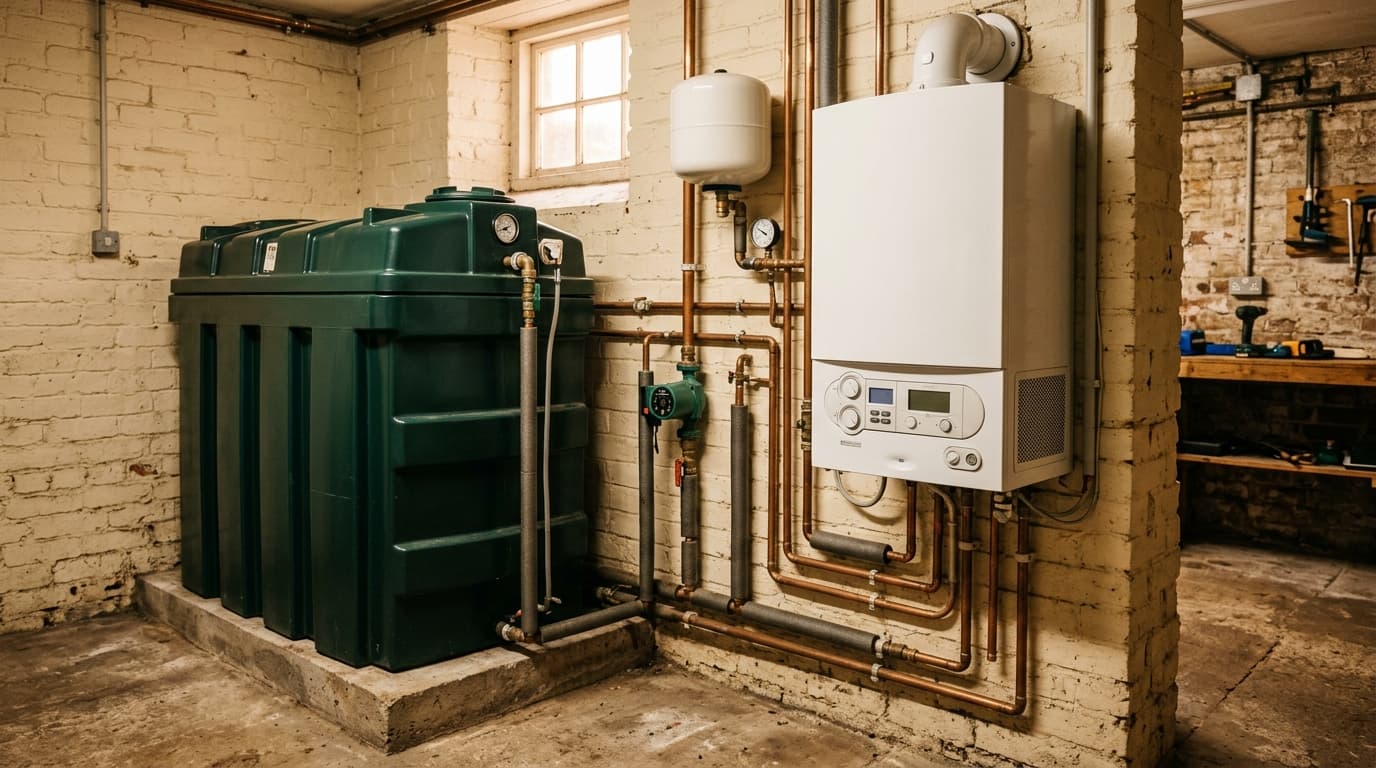
On 15 September 2026, heating oil costs 15.68 cents per kilowatt hour delivered in Belgium, against 7.7 to 12.5 cents for natural gas all in. Gas wins, and it wins comfortably. Two questions remain that most comparisons skip: does the gap cover the cost of converting, and is your street even connected to the gas main.
Heating oil or gas: which costs less today?
Gas, with enough margin to absorb almost any contract.
The official maximum price of heating oil is recalculated every working day by the Energy Directorate General of the FPS Economy, the federal economy ministry. In force from 15 September 2026: 1.5679 €/litre including VAT for orders under 2,000 litres, and 1.5274 €/litre from 2,000 litres upward. That price is complete, with excise duty, the inspection levy and 21 % VAT already inside it.
On the gas side, an honest comparison demands the same perimeter. Not just the supplier's energy component, but the whole bill, network charges and taxes included. For 17,000 kWh a year in Wallonia, it ranged in July 2026 between 1,310 € and 2,124 € depending on the contract, figures set out in our analysis of gas prices in Belgium in 2026.
| Fuel, 17,000 kWh purchased | Unit price | Annual cost | c€/kWh all in |
|---|---|---|---|
| Heating oil, order < 2,000 L | 1.5679 €/L | 2,665 € | 15.68 |
| Heating oil, order ≥ 2,000 L | 1.5274 €/L | 2,597 € | 15.27 |
| Gas, cheapest Walloon contract | 7.71 c€/kWh | 1,310 € | 7.71 |
| Gas, most expensive Walloon contract | 12.49 c€/kWh | 2,124 € | 12.49 |
The annual gap therefore runs from 541 € to 1,355 € for the same amount of heat. The bottom of that range deserves a second reading: even on the most expensive gas contract on the Walloon market, a household heated by gas still pays 541 € a year less than a household heated by oil.
15.68 c€
Heating oil, per kWh delivered, 15/09/2026
7.71 c€
Gas, cheapest Walloon contract
1,355 €
Maximum annual gap over 17,000 kWh
How do you convert a litre of heating oil into kWh?
Multiply by 10. Nothing more complicated than that.
A litre of standard heating oil releases roughly 9.96 kWh on a gross calorific value basis, and the working figure used everywhere in Belgium is 10 kWh per litre. A 2,000 litre tank therefore holds the equivalent of 20,000 kWh, and the 1,700 litres used as the basis of this comparison match exactly the 17,000 kWh reference annual consumption of a Belgian household heated by gas.
That conversion is the only thing that makes any comparison possible. A price per litre and a price per kilowatt hour cannot look each other in the eye. The same exercise exists on the gas side between the cubic metres read off the meter and the kilowatt hours billed, covered in our guide to converting gas m³ into kWh.

Why does heating oil pay 21 % VAT and gas 6 %?
Because European law allows the reduced rate on one and not on the other.
Belgium cut VAT on residential natural gas and electricity to 6 % during the energy crisis, then made the measure permanent on 1 April 2023. Heating oil never followed. The European VAT directive opens the door to a reduced rate for natural gas and electricity supplied to households; it does not open it for heating oil. With no legal basis, no reduced rate is possible, whatever the political appetite of the moment.
Over our 17,000 kWh, the arithmetic is blunt. VAT paid on heating oil comes to roughly 462 €. On gas at the cheapest contract, it falls to 74 €. Close to 390 € a year of difference, which depends on neither the market, nor the supplier, nor the quality of your insulation.
Excise duty hits gas harder than heating oil
The finding is surprising, and it is nonetheless arithmetic.
Since 1 April 2026, excise duty on natural gas has risen from 8.72 to 10.31 €/MWh under the federal energy tax shift. Over 17,000 kWh that comes to roughly 175 €. On the same date, excise on heating oil rose from 17.3 to 23 € per 1,000 litres, roughly 39 € for the 1,700 equivalent litres.
| Levy, 17,000 kWh | Heating oil | Gas (cheapest contract) |
|---|---|---|
| VAT | 462 € (21 %) | 74 € (6 %) |
| Excise duty | 39 € | 175 € |
| Total levies | 501 € | 249 € |
| Share of the bill | 18.8 % | 19.0 % |
Both fuels are taxed to the tune of roughly 19 % of the bill. Heating oil pays mostly VAT, gas pays mostly excise. Same weight, opposite route.
One point of honesty is due about what comes next. The federal trajectory sets 13.60 €/MWh on gas in 2029 against 26 € per 1,000 litres of heating oil, widening the excise gap by roughly 51 € a year to the disadvantage of gas. Against a total gap of 541 to 1,355 €, that reverses nothing. It does explain why heating oil is not falling away as fast as its reputation suggests.
What does the law say in your region in 2026?
The regulatory framework differs across the three regions, and it sometimes settles the question for you.
In Wallonia, heating oil is still the leading heating fuel with roughly 52 % of households, ahead of gas at 29 %. The Walloon Government decree of 5 June 2025 amends the EPB rules, Belgium's regional energy performance of buildings regime, and bans heating and domestic hot water systems running on oil or coal in buildings to be built or rebuilt. The requirement applies to projects whose permit application was acknowledged after 31 December 2025, alongside a parallel obligation to source 35 % of energy from renewables. Replacing an existing oil boiler is not yet banned: a timetable for existing buildings has been announced but not enacted.
In Brussels, where 78 % of households are already on gas, the rule is the simplest of the three. Installing a new oil boiler has been banned since 1 June 2025, in new build and in existing homes alike. The question no longer arises for a replacement.
In Flanders, 55 % of households heat with gas and 29 % with oil. The ban on installing a new oil boiler has applied since 1 January 2022, with one notable exemption: replacement remains possible in buildings whose street has no natural gas main. Since 1 January 2025, tighter technical criteria also govern any tank replacement.
| Region | Households on oil | New oil boiler | Gas network |
|---|---|---|---|
| Wallonia | 52 % | Banned in new build since 01/01/2026 | 29 % of households, absent in many rural municipalities |
| Brussels | ~20 % | Banned since 01/06/2025, new build and existing | 78 % of households, near universal network |
| Flanders | 29 % | Banned since 01/01/2022, unless street has no main | 55 % of households |
How much does switching from oil to gas cost?
From 5,445 to 10,890 € including VAT as an order of magnitude, when the main already runs past your door.
Three items make up that budget. The condensing gas boiler and its installation. The network connection through your DSO, the distribution system operator, between 800 and 2,000 € depending on the distance to the main and how awkward the works are. Finally, decommissioning or removing the oil tank, between 500 and 1,500 € depending on whether it sits above ground or buried.
One tax detail changed the picture recently, and it went fairly unnoticed. Since 29 July 2025, installing or replacing a boiler running on a fossil fuel, gas included, no longer qualifies for the reduced 6 % VAT rate in renovation work. The standard 21 % rate applies. A conversion quoted at 7,000 € excluding VAT therefore costs 8,470 € instead of 7,420 € before that date, which is 1,050 € more for exactly the same job.
| Item | Range excl. VAT | With 21 % VAT |
|---|---|---|
| Condensing gas boiler and installation | 3,200 to 5,500 € | 3,872 to 6,655 € |
| Connection to the gas network | 800 to 2,000 € | 968 to 2,420 € |
| Tank decommissioning or removal | 500 to 1,500 € | 605 to 1,815 € |
| Total | 4,500 to 9,000 € | 5,445 to 10,890 € |
How long does the conversion take to pay back?
Between 4 and 20 years. The spread comes from the gas contract you sign afterwards, not from the quote.
Take the two extremes. Against a household spending 2,665 € a year on heating oil, the cheapest Walloon gas contract brings the bill down to 1,310 €, an annual saving of 1,355 €. The most expensive one brings it to 2,124 €, a saving of 541 €.
| Gas contract signed after conversion | Annual saving | Payback on 5,445 € | Payback on 10,890 € |
|---|---|---|---|
| Cheapest Walloon contract | 1,355 € | 4.0 years | 8.0 years |
| Most expensive contract | 541 € | 10.1 years | 20.1 years |
The ratio is one to two and a half. Two neighbours who have the same boiler fitted by the same installer in the same month pay their job off in four years for one and twenty for the other, purely because one compared the offers and the other signed whatever the installer handed over.
The costs of heating oil that never show up on the bill
Six items escape the price per litre, and they all pull the same way.
- The cash advance. Filling 2,000 litres costs 3,055 € in a single payment at the 15 September 2026 rate. Gas is paid through smoothed monthly instalments, whose amount can be negotiated and brought down mid year.
- The Promaz levy. From October 2026, the price of heating oil rises by close to one cent per litre to fund the scheme that covers soil decontamination after a tank leak. Roughly 17 € a year on 1,700 litres.
- Periodic tank inspection. Tightness testing, a compliance plate, and a frequency that varies by region and tank volume. Gas has no equivalent.
- Leak risk. A tank that splits contaminates the soil, and decontamination runs into tens of thousands of euros. Promaz exists precisely because that risk is real.
- Annual mandatory servicing of the oil boiler, against every two or three years for a gas boiler depending on the region.
- Timing the order. The price of heating oil changes every working day. A fill ordered at the wrong moment costs several hundred euros more than the same fill six weeks later.

Is staying on heating oil ever the better call?
Yes, in five cases. None of them rests on the price of the fuel.
- The gas network does not reach your street. The choice then does not exist, and that is the situation in a meaningful share of rural Walloon municipalities. Extending a main from a neighbouring street runs into thousands of extra euros.
- Your condensing oil boiler is under ten years old. Replacing it means writing off an asset that still has life in it to gain a few years of payback.
- You are selling the property soon. The EPB certificate improves, but rarely enough to recover 8,000 € on the sale price.
- A heat pump is planned within three to five years. Moving to gas now only to move to electric later means paying for two jobs to meet one need. Our comparison of gas against electric heating sets out that trade off.
- The buried tank is recent and compliant. Decommissioning it becomes a pure cost with nothing in return.
✓ Pros
- Gas cheaper per kWh than heating oil in every scenario tested
- 6 % VAT on gas against 21 % on heating oil
- Smoothed monthly instalments instead of 3,000 € fills
- No tank, no tightness test, no soil pollution risk
- A dozen suppliers to choose from and real negotiating room
✗ Cons
- Conversion invoiced at 5,445 to 10,890 € including VAT since the reduced rate ended
- No gas network in part of the rural municipalities
- Excise duty on gas rising on a schedule out to 2029
- Gas is still a fossil fuel, facing the same bans down the line
- Payback multiplied by 2.5 if the gas contract is poorly chosen
Can you compare oil merchants the way you compare gas suppliers?
No. The two markets are not the same kind of market, and that changes how you compare.
Engie, Luminus, TotalEnergies, Mega, Eneco, OCTA+, Bolt, Ecopower, Aspiravi, EnergyVision and Cociter sell natural gas under contract, with an indexed price, a term, general conditions and a regulated right to terminate. Heating oil is bought from a merchant, at the price of the day, with no contract and no commitment.
That asymmetry has two practical consequences. On the oil side, no supplier comparison is possible, because the maximum price is set by the State and almost everyone aligns with it: the only variable is the date of the order. On the gas side, the gap between the best and the worst contract exceeds 800 € a year for identical consumption, and that is exactly where the return on your conversion is decided. The mechanics are set out in our guide to understanding your energy bill.
Key points
Every figure in this article is dated: maximum heating oil price at 15 September 2026, Walloon gas tariffs from July 2026, excise duties from April 2026, VAT rate on installation since 29 July 2025. Heating oil changes price every working day and variable gas offers are reindexed every month. Check again before signing anything.
If your street is connected and your oil boiler is nearing the end of its life, the conversion stands up economically. Start with the contract, not the quote: look at which energy supplier matches your profile, then cost the job against the real annual saving.
Sources. FPS Economy, Energy Directorate General (official maximum prices for petroleum products, schedule applicable from 15 September 2026). CREG (gas and electricity price monitoring, 2026). CWaPE, the Walloon energy regulator (gas distribution tariffs 2026). Union of Walloon Cities and Municipalities (Walloon Government decree of 5 June 2025, renewable requirement and heating oil ban in buildings to be built). Brussels regulation of 1 June 2025 and Flemish regulation of 1 January 2022 plus the 2025 tank criteria. Reform of the VAT rate on fossil fuel boilers since 29 July 2025. Federal excise duty trajectory 2026 to 2029. Regional breakdown of household heating fuels in Belgium. Pages consulted on 15 September 2026.
Contrats & tarifs comparator
Compare all contrats & tarifs side by side.
Compare now →
Frequently asked questions
Camille suit le marché belge de l'énergie depuis une dizaine d'années. Elle a d'abord travaillé côté gestion de contrats B2B, puis est passée à l'analyse indépendante : elle éplucha les grilles tarifaires de Mega, Bolt, Engie, Luminus, TotalEnergies, Eneco ou Ecopower, recoupe chaque prix avec le CREG Scan, la CWaPE, le VREG et Brugel, et refait les calculs de facture à la main quand un fournisseur communique un chiffre trop rond. Sa conviction : la plupart des ménages belges ne changent jamais de fournisseur et paient chaque année quelques centaines d'euros de trop — pas par paresse, mais parce que les offres sont volontairement illisibles. Ici, elle traduit les conditions tarifaires en euros par an, et dit clairement quand une « promo » n'en est pas une.