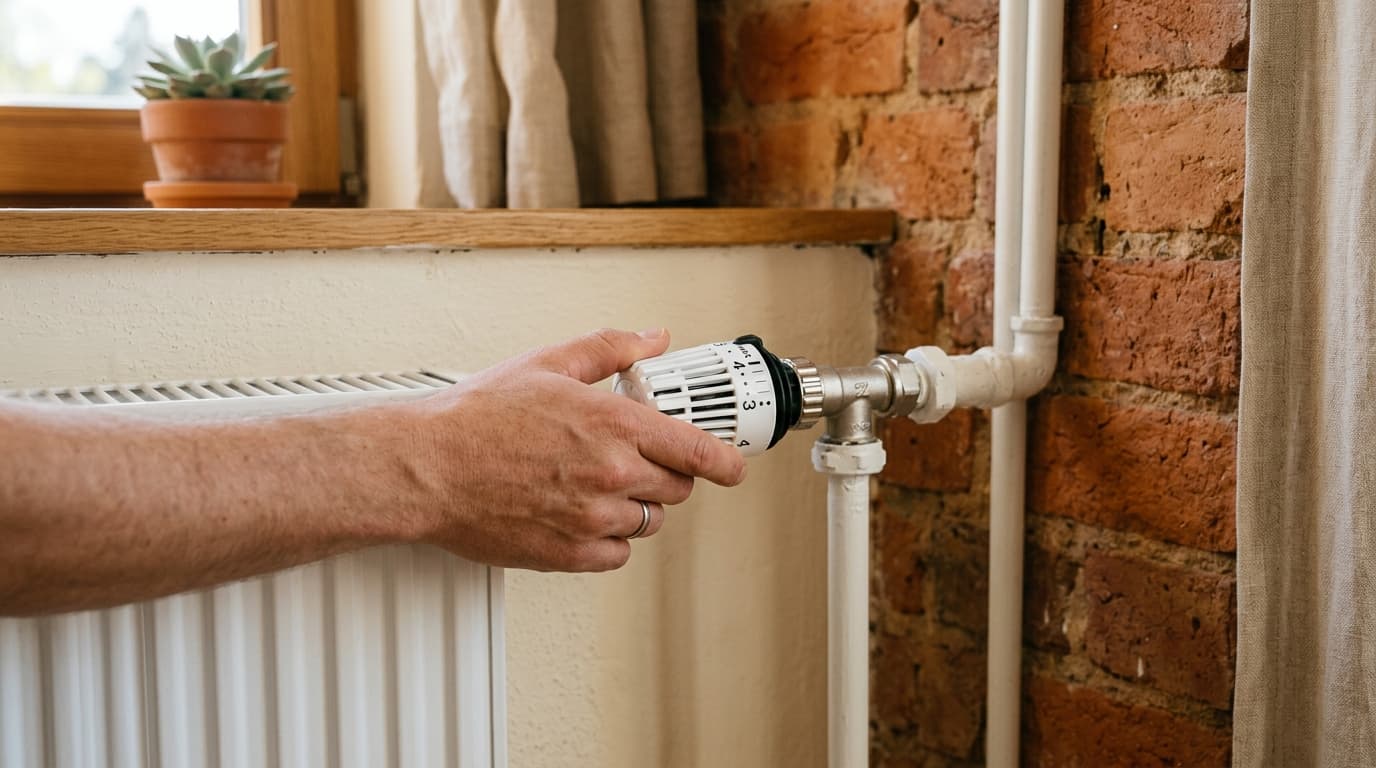
A thermostatic radiator valve is set by temperature, not by power: on 3, it lets hot water in until the room reaches about 20 °C, then closes by itself. Each notch adds nearly four degrees. A stuck pin is freed in a quarter of an hour, and a head is replaced in five minutes.
How does a thermostatic radiator valve work?
It has two parts, and the distinction matters for everything that follows.
The valve body is screwed onto the pipework at the radiator inlet. It holds a small plug at the end of a short rod, the pin. The thermostatic head, with its numbered dial, fits on top. It contains a bulb filled with liquid, wax or gas that expands as the room air warms up, presses on the pin and gradually closes off the hot water.
The boiler sets the water temperature. The valve sets the flow into each radiator. The information sheet from the Province of Liège sums it up in one line: a thermostatic valve is not an on/off switch.
Which number gives which temperature?
The marks are not standardised to the exact degree, but Belgian advice sheets and manufacturers land on the same scale.
| Mark | Target temperature | Recommended use |
|---|---|---|
| ❄ or * | 6 to 8 °C | Frost protection, long absence |
| 1 | about 12 °C | Hall, corridor, unused bedroom |
| 2 | about 16 °C | Occupied bedroom |
| 3 | about 20 °C | Living room, kitchen, study |
| 4 | about 24 °C | Bathroom while in use |
| 5 | about 28 °C | Room with the room thermostat |
These values come from the Homegrade heating brochure, published in 2026 by the Brussels advice centre. The Danfoss Redia data sheet (February 2024) gives a setting range of 8 to 28 °C for its built-in sensor heads, which matches the scale. Ecoconso counts about four degrees between two numbers, so half a notch is worth two.
How do you set the valves room by room?
Allow one day of heating for everything to settle. The method takes five steps:
- Find the room with the room thermostat and set its valves to 5. The thermostat does the regulating there; a half-closed valve would stop it reaching its setpoint, and the boiler would run for nothing.
- Set living areas to 3, about 20 °C. Homegrade advises 19 to 20 °C in the living room and 18 °C in the kitchen.
- Turn bedrooms down to between 2 and 2.5, for 16 to 18 °C.
- Put through rooms on 1, and the bathroom on 4 only while it is in use.
- Wait four to six hours, check with a thermometer, and correct by half a notch at most.
A head hidden behind a curtain or wedged under a shelf measures the warm air trapped around the radiator. It shuts off too early.
What does one notch too high cost?
Up to 39 euros a year per radiator, in a gas-heated house.
The calculation rests on assumptions you can swap for your own. A terraced house burning 14,000 kWh of gas a year, 80% of it for heating, based on our benchmarks for average gas consumption, spends about 11,200 kWh on heating; at 10 c€ per kWh all in, that comes to 1,120 euros, or 140 euros per radiator across eight radiators. Ecoconso and the Province of Liège both work on the basis that one degree less cuts consumption by about 7%, the rule detailed in our article on the ideal heating temperature, and one notch is about four degrees, so close to 28% of what the radiator concerned uses if the room actually reaches the higher setpoint.
| Situation | Setpoint gap | Extra cost a year at 10 c€/kWh | Extra cost at 12 c€/kWh |
|---|---|---|---|
| A bedroom on 3 instead of 2 | 4 °C | up to 39 € | up to 47 € |
| A head stuck open in a bedroom (5 instead of 2) | 8 to 12 °C, capped by the radiator output | 78 € and more | 94 € and more |
| The whole house one notch too high | 4 °C | up to 314 € | up to 376 € |
These are ceilings: a room heated harder passes part of its heat to the rooms next door, and an undersized radiator never reaches 28 °C. Keep the order of magnitude. A new 33 euro head replacing one stuck open pays for itself in less than one heating season.
The gas price moves everything in proportion, and variable contracts are re-indexed every month: check yours against our gas price tracker.
Stuck thermostatic valve: how do you free it?
A radiator that stays cold while its valve is on 5, especially on the first heating day in October, very often has a seized pin. Limescale and a summer without movement glue it in the closed position. The method described by the French consumer magazine Que Choisir takes a quarter of an hour, and needs neither switching off the heating nor draining, since the valve body is never opened:
- Turn the head to 5, then unscrew its ring by hand or unclip it.
- Find the metal pin sticking out of the body. Press it: it should spring back on its own.
- If it stays down, tap it sideways with the handle of a screwdriver, or spray a little penetrating oil, wipe and try again.
- Refit the head and wait half an hour.
Never pull the pin with pliers. It can bend, and a damaged pin leaks.
If the pin moves freely but the radiator stays cold at the top and warm at the bottom, the problem is air in the circuit, and you need to bleed the radiator. If it stays cold all over, call a heating engineer.
When should you replace the head, and at what price?
The head needs replacing when it no longer reacts to temperature: a radiator scorching hot in a 24 °C room on mark 2, a dial that spins freely, a cracked bulb. A stuck pin, by contrast, is freed first.
| Job | Materials | Time | Indicative cost (recorded on 14/10/2026) | Who |
|---|---|---|---|---|
| Free the pin | Screwdriver, penetrating oil, cloth | 15 min | A few euros | You |
| Replace an M30 x 1.5 head | Compatible head, no tools | 5 min | 32.99 € (Danfoss RAE-K at Gamma) | You |
| Replace a head on an old Danfoss RA/V body | Dedicated head | 5 min | 50.20 € (Danfoss Aero at Bricozor) | You |
| Replace the valve body | Body, fittings, draining | Half a day | On quotation | Certified heating engineer |
Before buying, read the brand engraved on the valve body. Danfoss heads come in two fittings, a clip for Danfoss RA bodies and an M30 x 1.5 nut that covers most other brands; Honeywell Home, Heimeier, Giacomini and Comap also sell heads, each with its own fitting or an adapter. The RAE-K head at Gamma can also be paid with Belgian eco-vouchers (écochèques).
In summer, on 0 or on 5?
On 5. Belgian sources do not all say the same thing, though: the Province of Liège sheet recommends the closed position for summer, whereas Ecoconso, a French-speaking Belgian non-profit on sustainable consumption, recommends opening every valve fully once the boiler is off, so that the mechanism does not seize. The second advice has the right mechanical argument: on 0, the bulb presses on the pin for five months, and it is precisely that prolonged pressure that glues it. With the boiler off, an open valve uses nothing. Before the first heating day, turn each dial from 0 to 5 once to check nothing has stuck.
Brussels, Wallonia, Flanders: the rules around the valve
Our sources show no obligation to fit thermostatic valves in an existing home as long as the installation stays in place. The rules kick in when the boiler changes.
| Region | Rule linked to valves | Where to ask |
|---|---|---|
| Brussels | Thermostatic valves required at the PEB (energy performance) inspection that follows the fitting of a new boiler, according to Homegrade | Homegrade, free advice |
| Wallonia | No grant for heads alone; temporary heating grant scheme closed on 30 September 2026, new scheme awaited | Guichets Énergie Wallonie (regional energy desks) |
| Flanders | EPB (energy performance) requirements on any heating system replaced since 2015, set out in the installation requirement tables | Vlaanderen.be, local Energiehuis |
The most expensive mistakes
- Turning to 5 to heat faster. The valve is already wide open while the room is cold; on 5, it will simply close later.
- Closing the valve in the thermostat room. The boiler runs non-stop without reaching its setpoint.
- Shutting off a bedroom next to the living room. The shared wall becomes a cold surface that the living room pays for.
- Leaving valves on 0 all summer, then finding three stuck radiators in October.
- Replacing a head when the radiator simply needs bleeding.
After the valves, the price per kWh
The valves decide how many kilowatt-hours are burned, the contract decides their price. Enter your annual consumption in the energy supplier ranking, which compares total cost, gas and electricity included.
Sources. Homegrade, "Chauffage" brochure, Brussels, 2026 (marks 1 to 5 and matching temperatures, recommended temperatures per room, valves required at the PEB inspection after a new boiler). Danfoss, data sheet for the Redia range of thermostatic valves, February 2024 (8 to 28 °C range, RA and M30 x 1.5 fittings). Province of Liège and Province of Luxembourg, "Petits gestes au quotidien" sheet, undated (operation, setting mistakes, about 7% per degree, closed position in summer). Ecoconso, "Chauffage : comment régler le thermostat et les radiateurs ?", consulted on 14 October 2026 (about 4 °C per notch, valves on 5 in summer, pin). Que Choisir, "Comment débloquer un robinet thermostatique", 18 May 2022. Vlaanderen.be, EPB-pedia, installation requirements, consulted on 14 October 2026. Head prices: Gamma.be and Bricozor.com, recorded on 14 October 2026. Walloon grant scheme: energie.wallonie.be portal, October 2026. The extra cost per notch is our own calculation, theoretical ceilings based on an assumption of 10 c€/kWh of gas all in (and 12 c€/kWh as a variant); variable tariffs move every month.
Camille
Gaz naturel comparator
Compare all gaz naturel side by side.
Compare now →
Frequently asked questions
Camille suit le marché belge de l'énergie depuis une dizaine d'années. Elle a d'abord travaillé côté gestion de contrats B2B, puis est passée à l'analyse indépendante : elle éplucha les grilles tarifaires de Mega, Bolt, Engie, Luminus, TotalEnergies, Eneco ou Ecopower, recoupe chaque prix avec le CREG Scan, la CWaPE, le VREG et Brugel, et refait les calculs de facture à la main quand un fournisseur communique un chiffre trop rond. Sa conviction : la plupart des ménages belges ne changent jamais de fournisseur et paient chaque année quelques centaines d'euros de trop — pas par paresse, mais parce que les offres sont volontairement illisibles. Ici, elle traduit les conditions tarifaires en euros par an, et dit clairement quand une « promo » n'en est pas une.