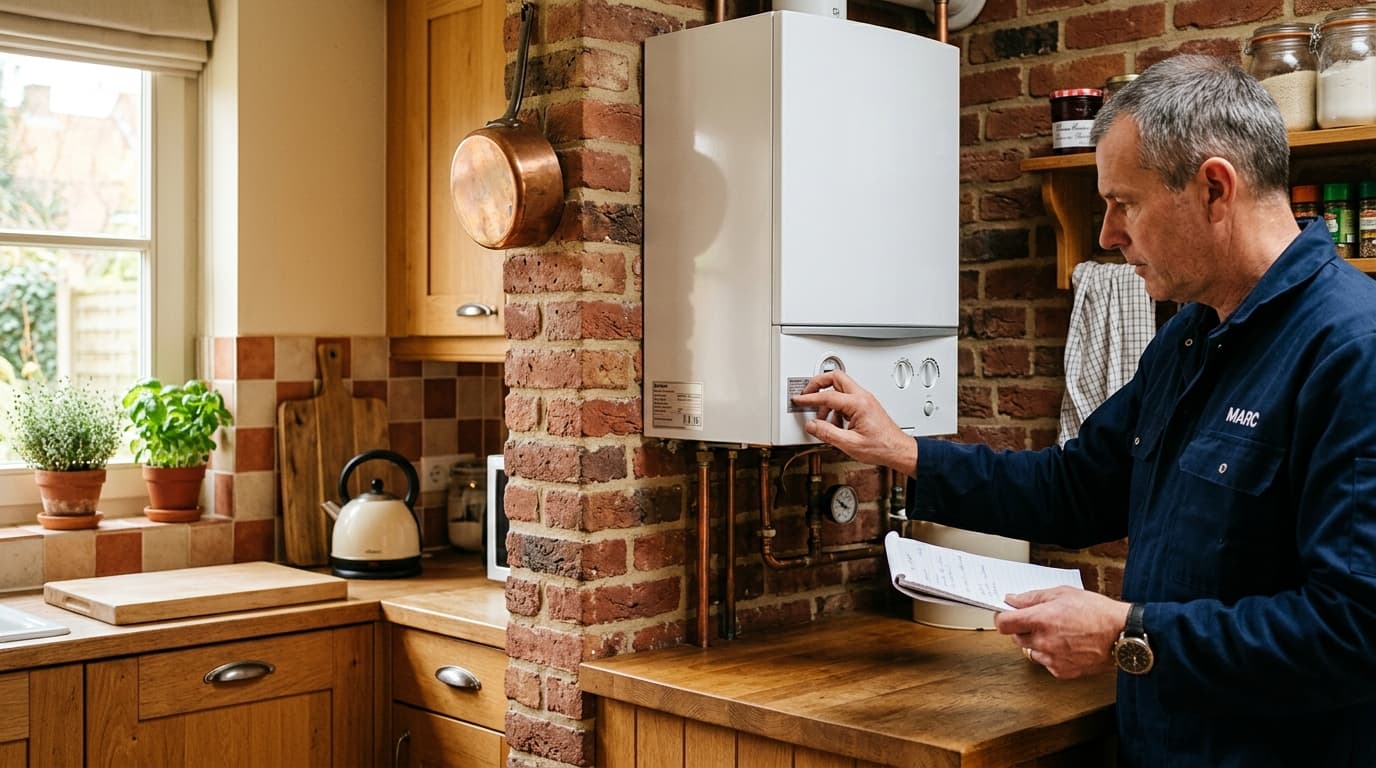
Lean gas disappeared from the Belgian networks in late summer 2024. If your boiler heats normally and has been serviced since, there is nothing to do. The exceptions come down to four cases, listed below.
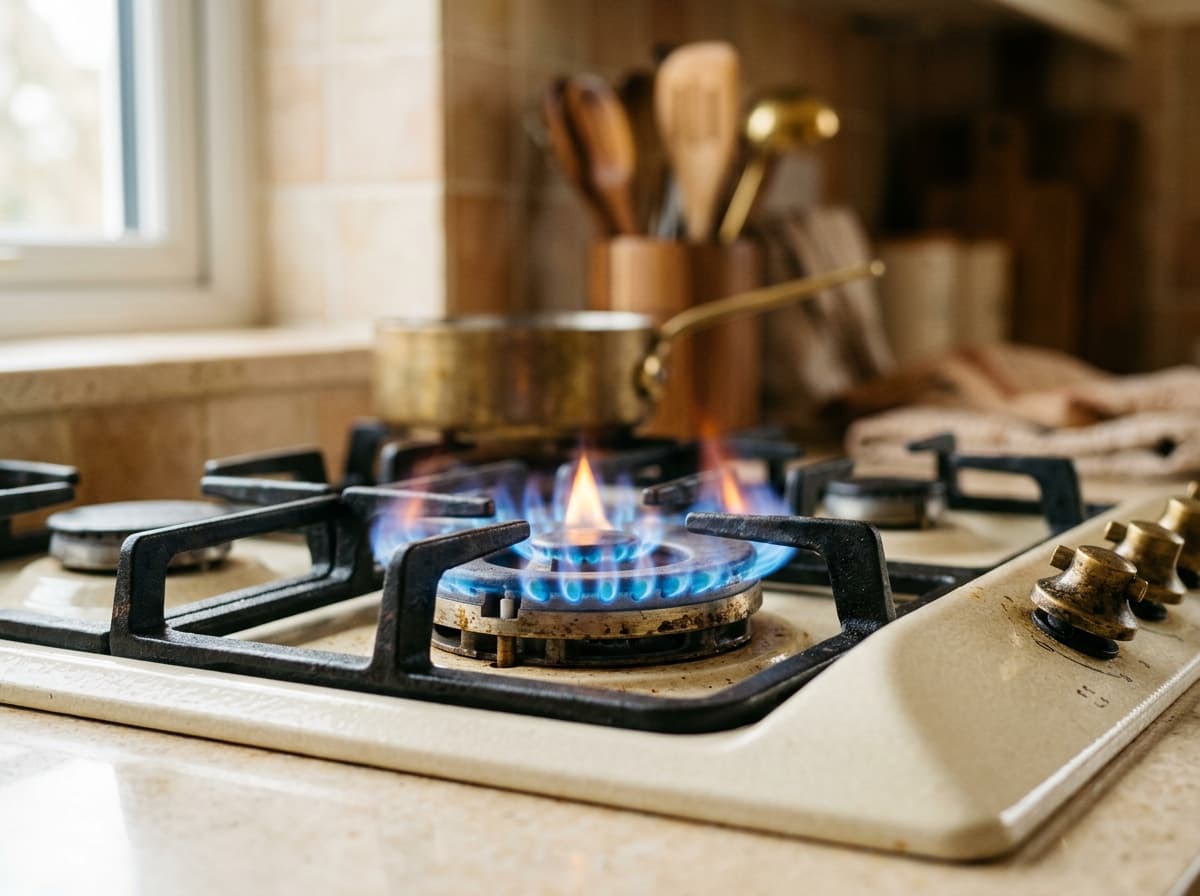
What is the difference between rich gas and lean gas?
Rich gas holds more energy per cubic metre.
The CREG, the federal energy regulator, uses about 11.6 kWh per m³ for rich gas (H) and 10.3 kWh for lean gas (L). That is about 11% less energy per m³ of lean gas. The "10%" or "15%" you may read elsewhere depend on the averages used.
Is the switch to rich gas finished in Belgium?
Yes, since late summer 2024.
Lean gas came from the Dutch Groningen field, while rich gas arrives from Norway, the United Kingdom and by LNG tanker, according to Bulex. In 2018 the Netherlands decided to stop production at Groningen, citing depleted reserves and earthquakes, and to end exports by late 2029 at the latest. Synergrid, the federation of network operators, converted about 1.6 million households and businesses, half of the country's gas customers, five years early. FEBEG, the suppliers' federation, dates the announcement of completion to 19 September 2024. ORES, the main Walloon distribution system operator (DSO, the company that runs the local grid), confirms it has supplied only rich gas since 1 September 2024.
Any page still telling you about a conversion "running until 2029" is out of date.
When did your municipality switch to rich gas?
The date depends on your region and your DSO. Here is the timeline pieced together from press releases and regional media.
| Period | Area converted | Source |
|---|---|---|
| 2018 and 2019 | First Walloon areas (RESA from 2018, ORES from 2019) | Atlas Contrôle, 2022 |
| 2020 and 2021 | 11 Brussels municipalities, nearly 325,000 households, including Schaerbeek, Jette, Evere and Laeken on 1 June 2021 | L'Avenir, BX1 |
| 1 September 2022 | Last 8 Brussels municipalities: Forest, Uccle, Ixelles, Etterbeek, Auderghem, Watermael-Boitsfort and both Woluwes | L'Avenir, 12/09/2022 |
| 2023 | Central Walloon Brabant (Wavre, Ottignies-Louvain-la-Neuve, Rixensart, La Hulpe…) | Callmepower |
| Around 1 September 2024 | Last 390,000 customers, some sixty municipalities in Flanders (Antwerp, Limburg, Flemish Brabant) and Wallonia (Nivelles, Waterloo, Tubize…) | VRT, 13/08/2024 |
In Brussels, Sibelga therefore finished two years before everyone else. In Wallonia, the conversion covered Walloon Brabant and parts of Hainaut, Namur and Liège province (Hannut, Waremme). In Flanders, Fluvius finished with the provinces of Antwerp, Limburg and Flemish Brabant. The rest of the country, notably West and East Flanders, was already on rich gas.
Is my boiler compatible with rich gas?
Almost certainly, if it was bought in Belgium after 1978.
Test-Achats, the Belgian consumer association, sums it up: every appliance sold on the Belgian market since 1978 is designed for both gases. Sibelga announced in 2021 that 98% of Brussels appliances were ready. The gas category is shown on the appliance's rating plate:
- I2E+ or I2: conventional boilers, water heaters, cookers, convectors. No check, no adjustment.
- I2E(S): condensing boilers and water heaters. A check is needed unless the installer certifies the appliance was never re-tuned; adjustment only if the seal was broken to set it for lean gas.
- I2E(R): boilers of 70 kW and more, gas burners fitted on a former oil boiler. Adjustment required.
- I2N: recent self-adapting boilers. Nothing to do.
- G20/G25: a marking VRT cites as a sign of suitability for rich gas. G20 is the reference test gas for H gas, G25 the one for L gas.
Vaillant, Bulex or Viessmann: the brand makes no difference.
Only the plate counts.
Do you need to have your boiler adjusted for rich gas?
Only in two cases: an I2E(S) condensing boiler whose seal was broken for lean gas, and an I2E(R) installation. Appliances older than 1978, about 2% of the Brussels stock according to Sibelga, had to be replaced. For an appliance bought in France or the Netherlands, Test-Achats and Atlas Contrôle recommend a case-by-case check, because it may have been factory-set for a different gas from the one on your network.
The easiest moment to check is the mandatory periodic boiler service, whose frequency differs by region: every two years in Brussels (Sibelga, 2021) and in Flanders, every three years in Wallonia for a gas boiler of 100 kW or less (Callmepower, September 2025). Ask the technician to record the gas category and compliance on the certificate.
Why does my gas meter run slower than before?
Because every cubic metre now carries more energy. Take the CREG standard profile, 17,000 kWh a year. On lean gas, producing it took 17,000 ÷ 10.3 = 1,650 m³. On rich gas, 17,000 ÷ 11.6 = 1,466 m³ is enough, 184 m³ less for exactly the same heat, and if you compare your meter readings from before and after the conversion without knowing this, you will wrongly believe you saved 11% of your gas when your home, your thermostat and your winter have not changed one bit.
The opposite mistake costs money. Applying the old lean gas coefficient to 1,466 m³ of rich gas gives 15,100 kWh instead of 17,000: consumption underestimated by 1,900 kWh, about 209 € at 0.11 €/kWh all in (order of magnitude on the Belgian market in August 2026, to be rechecked). Enough to set your advance payments too low and get a nasty balancing bill.
Your bill itself did not move: it is calculated in kWh. Our m³ to kWh converter applies the right coefficient, and average gas consumption in Belgium places you by type of home.
Your situation, and what to do in 2026
| Your case | What to do |
|---|---|
| Appliance bought in Belgium after 1978, serviced on time | Nothing beyond the periodic service |
| I2E(S) condensing boiler set for lean gas | Adjustment by a certified technician at the next service |
| Appliance older than 1978 | Replacement, on a professional's advice |
| Appliance bought in France or the Netherlands | Check of the category and setting by a certified technician |
| You are moving into a gas-heated home | Ask the seller or landlord for the latest service certificate |
| Meter reading in m³ lower than before 2024 | Normal: compare your consumption in kWh |
| Bottled gas or propane | Not affected |
A yellow flame, soot, an unusual smell? Switch the appliance off, ventilate and call a professional. Our guide to the carbon monoxide detector explains where to fit one.
The conversion changed nothing about the price of your gas: your contract sets it. To compare gas and electricity offers on annual cost, see our energy supplier ranking.
Sources. CREG, "Conversion du m³ de gaz en kWh" (consulted on 18/10/2026); Synergrid, press release on the network conversion completed five years early (2024); FEBEG, "Conversion gaz L/H", news item of 19/09/2024; ORES, "Le pouvoir calorifique du gaz"; VRT NWS, 13/08/2024; L'Avenir, 12/09/2022; BX1, 31/05/2021; Test-Achats, "Passage du gaz pauvre au gaz riche", 2017 updated in 2024; Atlas Contrôle, 16/06/2022; Bulex, gas conversion page; Callmepower, rich gas guide (02/2024) and boiler service guide (09/2025); AFP via Connaissance des énergies, 27/03/2019. kWh price: order of magnitude recorded in August 2026, variable tariffs change every month.
Camille
Gaz naturel comparator
Compare all gaz naturel side by side.
Compare now →
Frequently asked questions
Camille suit le marché belge de l'énergie depuis une dizaine d'années. Elle a d'abord travaillé côté gestion de contrats B2B, puis est passée à l'analyse indépendante : elle éplucha les grilles tarifaires de Mega, Bolt, Engie, Luminus, TotalEnergies, Eneco ou Ecopower, recoupe chaque prix avec le CREG Scan, la CWaPE, le VREG et Brugel, et refait les calculs de facture à la main quand un fournisseur communique un chiffre trop rond. Sa conviction : la plupart des ménages belges ne changent jamais de fournisseur et paient chaque année quelques centaines d'euros de trop — pas par paresse, mais parce que les offres sont volontairement illisibles. Ici, elle traduit les conditions tarifaires en euros par an, et dit clairement quand une « promo » n'en est pas une.