
Moving home tends to push energy to the very last box — and that is exactly where the nasty surprises start: double billing, the previous occupant's kWh landing on your account, or a switch to a costlier fallback tariff. Yet the procedure comes down to two actions and one form. Here is exactly what to do for your electricity and gas, and when to do it.
What should you do about your energy when you move home in Belgium?
Two distinct operations, not to be confused with a simple supplier switch. On one side, you close the contract at the address you are leaving; on the other, you open a contract at the new address. Each rests on a precise meter reading, recorded on a document shared with the other occupant.
In practice, on handover day — whether you are leaving or arriving — the sequence comes down to three actions.
- Read the meter figures: electricity, and gas if there is a gas meter.
- Enter them on the energy takeover document and have both occupants sign it.
- Send everything to your supplier, with the EAN code and the effective date.
The rest is settled remotely, with no technical intervention.
What is the energy takeover document and why is it essential?
It is the pivot of the whole energy move. The energy takeover document is a legally binding form that records the readings taken at the point an occupant changes, for both electricity and gas. It is signed by both the person leaving and the person taking over, which locks both parties onto a single figure.
Its purpose is simple: it protects you. Without it, nothing proves where your consumption ends and the next person's begins. With it, each party pays only for its own kWh. In the event of a dispute over a reading, this document — and this document alone — is what counts.
It is free and available from several places, depending on your region:
- ORES or RESA, grid operators in Wallonia;
- Sibelga, grid operator in Brussels;
- Fluvius, grid operator in Flanders;
- the regional regulators, CWaPE in Wallonia and Brugel in Brussels.
Every Belgian supplier is legally obliged to accept it.
How do you read and submit your meter readings?
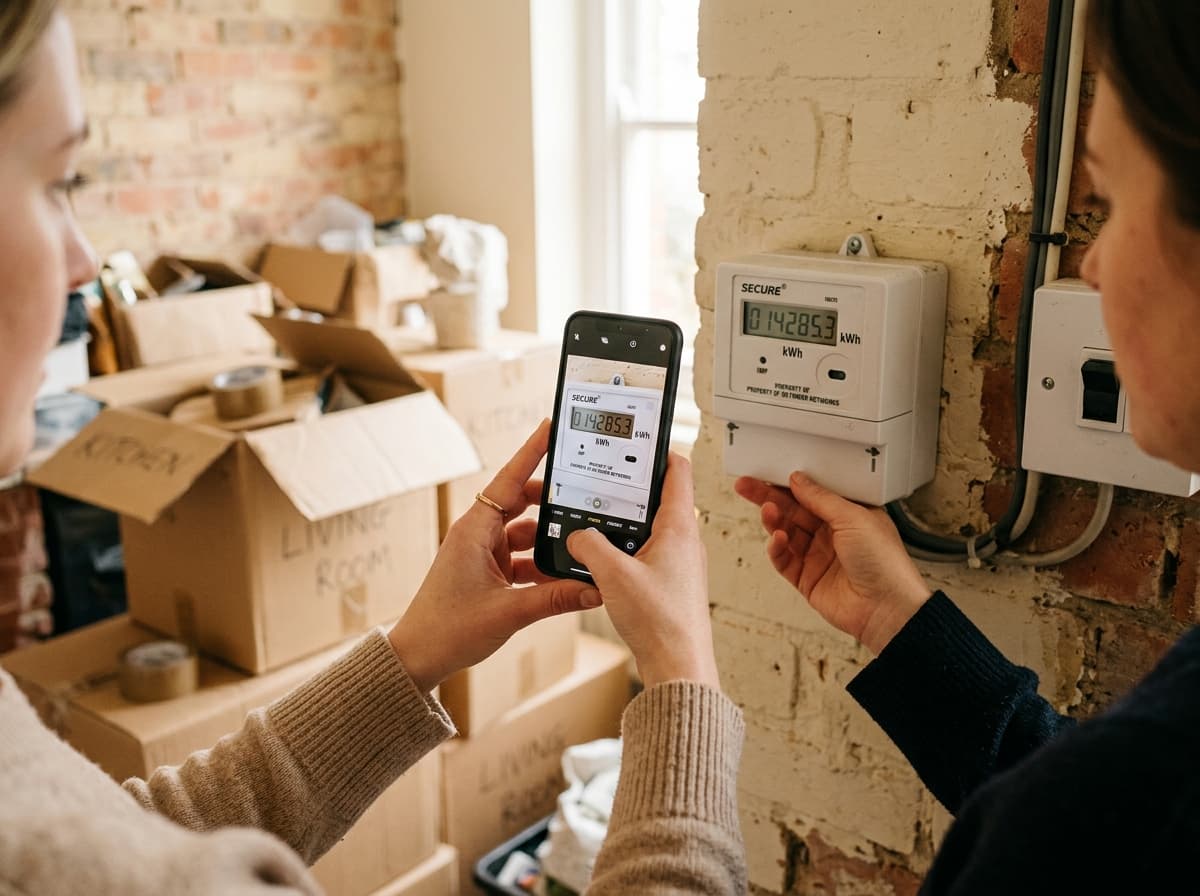
Note the figures, photograph them, send them quickly. On a dual-rate electricity meter, read both the day and the night index; add the gas meter if there is one. Take a sharp photo where the EAN number and the figures are legible: this is your personal safety net, on top of the signed document.
Then pass these readings to your supplier — by phone, email or through your online account — as quickly as possible, and within 7 days of leaving the property at the latest. The move must in any case be reported to the supplier within 30 days. The longer you wait, the greater the risk of a rough estimate, and an estimate rarely works in your favour.
On a digital meter, the reading is sent automatically to the grid operator, but the photo and the takeover document remain useful: transmission errors do happen, and this is your dated proof.
The deadlines to respect fit in a single table.
| Deadline | What to do |
|---|---|
| 2 to 4 weeks before | Compare offers and sign the contract at the new address |
| Handover day | Take the readings and sign the energy takeover document |
| Within 7 days | Send the readings to your supplier |
| Within 30 days | Report the move to your supplier |
| Notice period if you switch supplier | 1 month |
| Cost of the takeover document | free |
Where do you find your EAN code and what is it for?
On your bills and on the meter. The EAN code is an 18-digit number starting with 54 that identifies your supply point. Key detail: it is tied to the property, not to you — you do not take it with you when you move. And there is one for electricity and another for gas.
It is the key to every step: to open a contract at the new address, you provide the property's EAN code, the move-in date and the readings taken. To close the old one, you do the same with the EAN code of the property you are leaving. Without this number, neither opening nor closing is possible.
Should you keep your supplier or switch when moving?
It is the best moment to compare. You can perfectly well transfer your current contract to the new address in a single call — but since you have to open a contract anyway, you may as well first check whether your supplier is still the best placed.
The legal framework is on your side: you can terminate your contract at any point, with no penalty, subject to one month's notice. If you decide to switch, sign first at the new address: your new supplier handles the formalities and the termination of the old contract, which avoids any coverage gap. Compare offers on the basis of your real consumption (often close to 3,500 kWh of electricity and 17,000 kWh of gas a year for an average household), in euros per year and including the fixed charge — never on the headline kWh price alone. Our energy supplier ranking sets out the real gaps between the main offers on the Belgian market.
What happens if you do nothing?
You lose money, then power. If no one takes out a contract for the property, supply continues for a while under the default customer arrangement (sometimes called supplier X or protected customer depending on the region), at a markedly less favourable tariff than a market offer. This is temporary: without a proper contract, the grid operator can eventually close the meter.
The other, more immediate risk is financial: without a closing reading, your contract keeps running at the old address and bills you for the next occupant's consumption. The energy takeover document is precisely what puts a stop to that scenario.

How far in advance should you get organised?
Two to four weeks, ideally. There is no need to start months ahead, but beginning the process two to four weeks before the date leaves time to compare offers, sign the new contract and arrange the joint reading with the other occupant. If you are switching supplier, keep the one-month notice in mind: planning ahead avoids paying a few days twice.
The day itself remains the key moment: that is when readings are taken and the takeover document is signed. Everything else — grid notification, billing handover — is settled afterwards, remotely, without you.
To go further, two useful reads: the detailed procedure for switching energy supplier and the point on energy contract termination fees, to check that nothing will be billed when you leave.
Key takeaways
An energy move means two contracts (one to close, one to open), one takeover document signed by both parties, one photographed meter reading, and one EAN code per energy. Notify your supplier within 7 days, report everything within 30 days, and use the opportunity to compare suppliers before signing your new contract. Since variable tariffs move every month, a comparison done at the point of moving beats a contract transferred out of habit.
Sources: ORES, RESA, Sibelga and Fluvius (energy takeover documents, EAN code, meter readings); CWaPE and Brugel (right of termination and deadlines) — accessed 18 August 2026. Variable offers are re-indexed every month: always check the date of a price grid before comparing.
— Camille
Changer de fournisseur comparator
Compare all changer de fournisseur side by side.
Compare now →
Frequently asked questions
Camille suit le marché belge de l'énergie depuis une dizaine d'années. Elle a d'abord travaillé côté gestion de contrats B2B, puis est passée à l'analyse indépendante : elle éplucha les grilles tarifaires de Mega, Bolt, Engie, Luminus, TotalEnergies, Eneco ou Ecopower, recoupe chaque prix avec le CREG Scan, la CWaPE, le VREG et Brugel, et refait les calculs de facture à la main quand un fournisseur communique un chiffre trop rond. Sa conviction : la plupart des ménages belges ne changent jamais de fournisseur et paient chaque année quelques centaines d'euros de trop — pas par paresse, mais parce que les offres sont volontairement illisibles. Ici, elle traduit les conditions tarifaires en euros par an, et dit clairement quand une « promo » n'en est pas une.