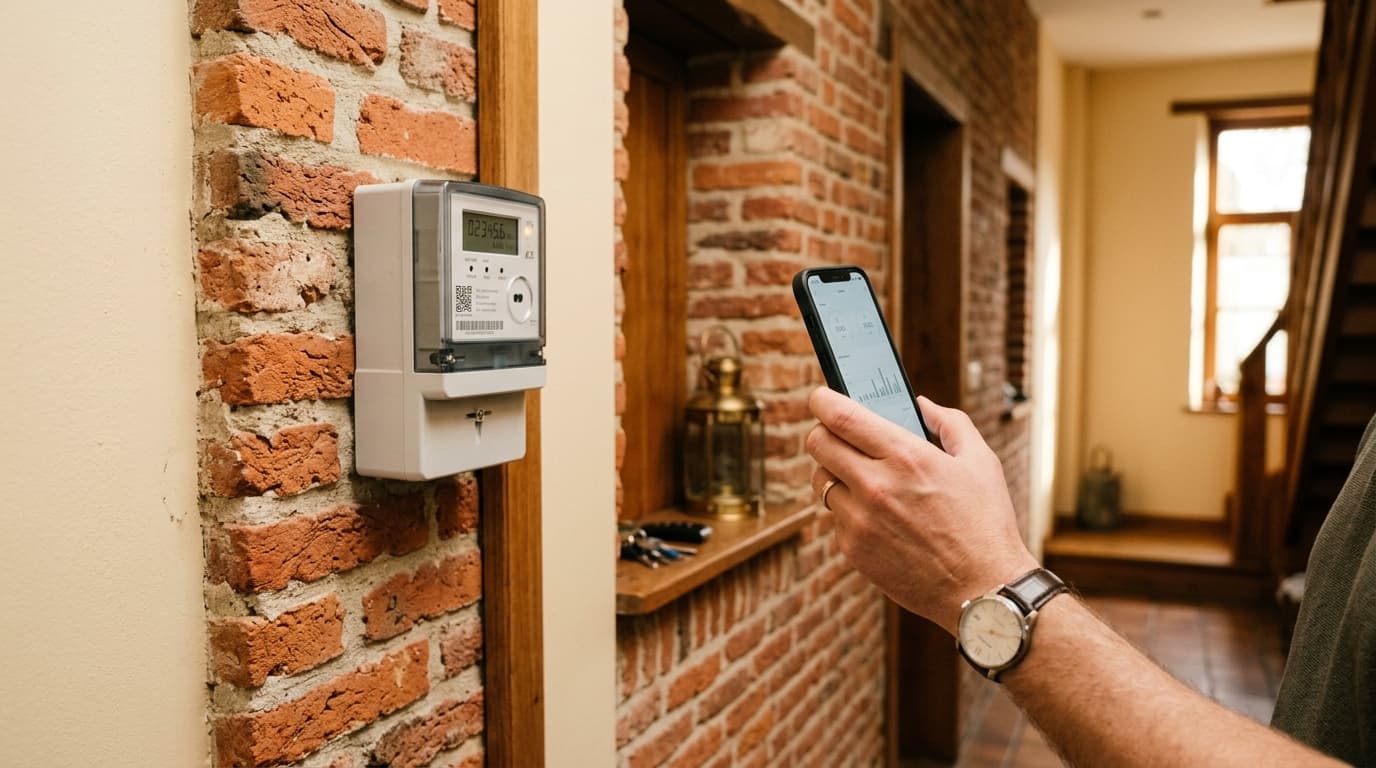
A budget meter (compteur à budget) is an electricity or gas meter that only delivers energy that has been paid for in advance. In Belgium, it no longer exists as a card device in Wallonia since 1 January 2026: it has become a function of the smart meter, called prepayment. It is presented as the alternative to disconnection. The Walloon regulator's figures tell a different story.
What is a budget meter today?
The name stayed. The object is gone.
For twenty years, the budget meter was a box into which you slid a card, blue for electricity, yellow for gas, topped up in a newsagent's or at an office of the distribution network operator (GRD in French, the company that owns the local grid and that you cannot choose). The CWaPE, the Walloon energy regulator, recorded the end of that system in a notice dated 13 May 2025: network operators no longer support card meters since 1 January 2026. ORES and RESA replaced theirs free of charge with smart meters whose prepayment function is switched on remotely. AIEG, AIESH and REW had already finished.
The principle has not moved. You pay in a sum, the meter draws it down as you consume, and it stops when the balance reaches zero. ORES offers three ways to top up, according to its brochure dated July 2026:
- The online portal, available day and night from a phone or a computer.
- A postal transfer, capped at 250 euros per operation, for which bpost charges 4.10 euros.
- Payment terminals in customer offices, in most CPAS (public social welfare centres) and at partner shops.
The contract does not change. In Wallonia, the household in principle keeps its supplier, whether Engie, Luminus or another, and its price per kilowatt-hour. Only the moment of payment shifts: before, no longer after.
59,294 prepayment meters in Wallonia, 73,545 in Flanders
Both regulators publish their figures once a year. Here they are side by side, which neither of them does.
| Situation at end of 2025 | Wallonia | Flanders | Brussels |
|---|---|---|---|
| Electricity, active prepayment meters | 59,294 (3.5% of residential customers) | 73,545 (2.5% of households) | 0 |
| Gas, active prepayment meters | 23,668 (3.3%) | 48,842 | 0 |
| Who supplies the prepayment household | Its usual supplier, in principle | Fluvius, after the supplier terminates | Not applicable |
| Minimum protection for electricity | 10 amps for protected customers | OCMW support case by case | Disconnection only by decision of the justice of the peace |
| Protected winter period | 1 November to 31 March | 1 December to 1 April | 1 October to 31 March |
Sources: the CWaPE annual report on public service obligations in 2025, published on 3 July 2026, Statistiek Vlaanderen, updated on 18 June 2026, and the Test-Achats file of 5 May 2025 for the winter periods.
Added together, that makes 132,839 Belgian homes paying for their electricity before using it, and 72,510 for gas. None in Brussels: the capital never installed budget meters, and the reform voted in 2022 even abolished the 2,300 watt power limiter that stood in for them. A Brussels household in payment default can apply for protected customer status (client protégé), and its contract can only be ended before the justice of the peace.
In Wallonia, 98.8% of electricity prepayment meters were already smart meters at the end of 2025, and 96.3% for gas. The card meter is a memory. Our guide to the digital meter explains what else that device measures and transmits.

Three households in ten cut themselves off
Here is the thesis. Prepayment is described everywhere as the tool that avoids disconnection, and the consumer association Test-Achats sums up the Walloon situation in one line: the power can no longer even be cut. Legally that is accurate. No supplier has a meter shut off for an unpaid bill any more. But disconnection has not disappeared. It has changed hands.
The CWaPE report states that 71.8% of electricity prepayment customers experienced no self-disconnection in 2025. The regulator presents the figure that way round. Turn it over: 28.2% found themselves in the dark at least once because the balance had run out. For gas, the share rises to 30%. Applied to the active stock, that is roughly 16,700 households for electricity and 7,100 for gas, calculated on the year-end figures.
Nobody decided to cut these households off. No letter, no technician, no committee. The meter stopped.
Prepayment did not abolish disconnection. It abolished the person who used to decide it.
The scheme is also growing. Wallonia recorded 18,332 activations for electricity in 2025, 1.2% more than in 2024, and 5,752 for gas. In Flanders, both stocks rose over the year, and so did full disconnections: 1,943 for electricity and 1,608 for gas, an increase that Statistiek Vlaanderen attributes mainly to top-up blocks applied to customers in debt.
What is the 15 euro emergency credit worth?
When the balance hits zero, the meter does not stop straight away. It starts drawing on an emergency credit, set at 15 euros for electricity and 15 euros for gas in the ORES brochure of July 2026. That sum is an advance: it is deducted from the next top-up.
How long do fifteen euros last? The answer depends entirely on the energy. The calculation below uses the average all-in Walloon prices recorded on 16 September 2026, namely 0.4496 euro per kWh of electricity and 0.1407 euro per kWh of gas, and a typical household using 3,500 kWh of electricity and 17,000 kWh of gas a year.
| Electricity | Gas, annual average | Gas, heating season | |
|---|---|---|---|
| Energy bought with 15 euros | 33 kWh | 107 kWh | 107 kWh |
| Consumption per day | 9.6 kWh | 46.6 kWh | 79 kWh |
| How long the emergency credit lasts | 3.5 days | 2.3 days | 32 hours |
| Top-up needed per week | 30 euros | 46 euros | 78 euros |
The heating season is an assumption: 70% of gas consumption concentrated in the five months from November to March. Your home will differ.
The gap is plain. The same amount covers half a week of electricity and barely more than a day of heating in January, while the weekly top-up needed for both energies reaches 108 euros in midwinter.
Non-disconnection periods soften the mechanism without erasing it. ORES does not let a meter stop between 4 pm and 8 am the next day, nor from Friday 4 pm to Monday 8 am, nor on a public holiday. The energy used during those hours is still owed. A January weekend without credit lasts 64 hours, during which our typical household burns about 210 kWh of gas and 26 kWh of electricity, close to 41 euros on top of emergency credits already used up: on Monday at 8 am, several tens of euros must therefore be paid in before the first cent goes towards heating, and it is precisely the household that did not have 20 euros on Friday that has to find three times as much three days later.
The serious objection: no debt, no bailiff
The case for prepayment is solid and deserves to be taken seriously.
A struggling household that stays on ordinary billing piles up unpaid advance payments, then an annual settlement, then reminder fees, then a debt collection file. The debt grows quietly and ends up with a bailiff. Prepayment blocks that machinery. You only use what you have paid for, you see your balance every day, and the smart meter sends a text message when it runs low. Seven customers in ten do get through the year without a single interruption.
For a protected customer, protection goes further for electricity: when the emergency credit is used up, supply does not stop, it is throttled to 10 amps, about 2,300 watts. Enough to run a fridge, the lights and one appliance at a time. At the end of 2025, 7.4% of Walloon protected customers were on prepayment for electricity.
The nuance fits in one sentence: prepayment protects against debt, not against the cold.
Gas budget meter: winter changes everything
Gas has no limiter. A boiler runs or it does not, and no device can deliver a little gas the way 10 amps of electricity are delivered. Once the balance and the emergency credit are spent, heating and hot water stop, protected customer or not.
The two regions concerned have therefore bolted winter support onto the system.
In Wallonia, it goes through the CPAS and the local energy committee. The CWaPE report says a great deal about its real reach: 482 customers received it in 2025, against 1,669 in 2023, for a stock of 23,668 gas meters on prepayment. Two per cent.
In Flanders, the mechanism is called the minimum supply of natural gas. It is aimed at Fluvius customers who pay by prepayment on a digital meter and heat with gas or with a hybrid heat pump. Between 1 November and 31 March, the OCMW (the Flemish public social welfare centre) loads an amount onto the meter every fourteen days, either at the household's request or after a report from the network operator, which sends the OCMWs a weekly list of customers at risk of losing their heating. The amounts for winter 2026-2027 are due to be published in October 2026.
In both cases, the support does not arrive by itself. You have to ask for it, and before the first frost.

How do you get off prepayment?
By clearing the debt that triggered it, then asking for the function to be deactivated. With a smart meter, that is done remotely, with no technician visit. The supplier remains free to request it again at the next payment default.
Better not to go in at all. The Walloon procedure leaves several windows, set out by Test-Achats: fifteen days to pay the bill, ten days after the reminder, fifteen more after the formal notice, and prepayment can only be requested if no agreement has been reached within thirty days. A payment plan negotiated during that time stops everything. Installation is free for a protected customer; for everyone else, published amounts differ from one source to the next, and only the network operator can confirm them.
Three levers weigh more than the meter itself. The social tariff first, because it lowers the price of every prepaid kilowatt-hour and many people entitled to it do not have it. A recalculated advance payment next, when the difficulty comes from an overestimated monthly instalment and not from consumption. And the contract, finally: a Walloon household on prepayment pays its supplier's price, and the gap between two offers shows up in every top-up. Our ranking of energy suppliers compares annual costs for gas and electricity together.
Sources and assumptions. Number of prepayment meters, activations, self-disconnections, protected customers and winter support in Wallonia: CWaPE, annual report on the performance of public service obligations 2025, published on 3 July 2026. End of card meters: CWaPE, notice of 13 May 2025. Emergency credit, non-disconnection periods and top-up methods: ORES brochure on paying for energy before using it, July 2026 edition; the rules of other network operators may differ. Flemish figures: Statistiek Vlaanderen, 18 June 2026. Minimum gas supply: vlaanderen.be, page consulted on 4 October 2026. Payment default procedure and winter periods: Test-Achats, 5 May 2025. Abolition of the power limiter in Brussels: reform presented to the Brussels Parliament in March 2022. Average all-in Walloon prices: Selectra comparison site, page updated on 16 September 2026; variable tariffs are re-indexed every month, so redo the calculation with your own price. Typical household: 3,500 kWh of electricity and 17,000 kWh of gas a year. No affiliate links.
Contrats & tarifs comparator
Compare all contrats & tarifs side by side.
Compare now →
Frequently asked questions
Camille suit le marché belge de l'énergie depuis une dizaine d'années. Elle a d'abord travaillé côté gestion de contrats B2B, puis est passée à l'analyse indépendante : elle éplucha les grilles tarifaires de Mega, Bolt, Engie, Luminus, TotalEnergies, Eneco ou Ecopower, recoupe chaque prix avec le CREG Scan, la CWaPE, le VREG et Brugel, et refait les calculs de facture à la main quand un fournisseur communique un chiffre trop rond. Sa conviction : la plupart des ménages belges ne changent jamais de fournisseur et paient chaque année quelques centaines d'euros de trop — pas par paresse, mais parce que les offres sont volontairement illisibles. Ici, elle traduit les conditions tarifaires en euros par an, et dit clairement quand une « promo » n'en est pas une.