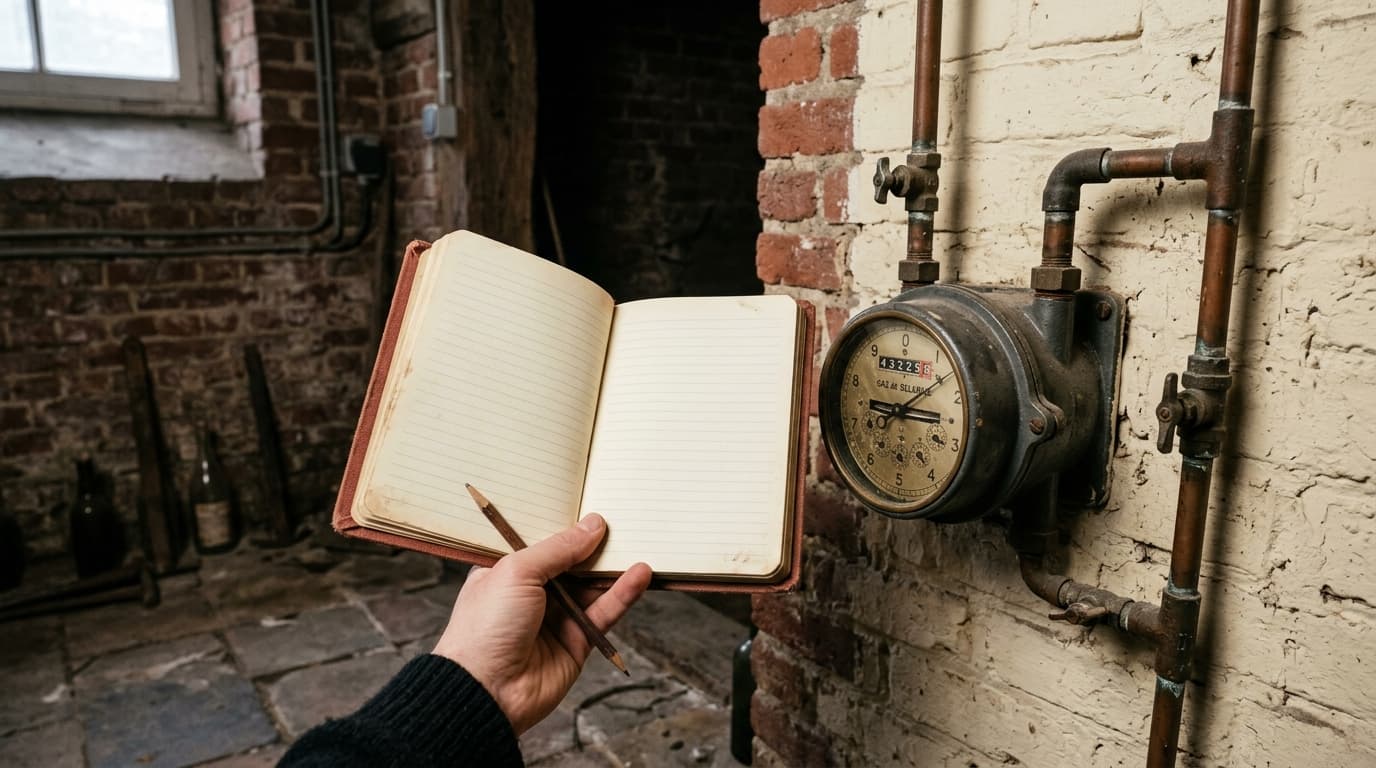
Meter readings are the business of your distribution system operator, not your supplier. ORES, RESA, Sibelga and Fluvius read gas and electricity meters once a year, each on its own schedule. Miss the window and the reading will be estimated: your bill will follow that estimate, right or wrong, until the next actual reading.
Four operators, four schedules
The question looks simple. It is not, because Belgium has handed metering to its distribution system operators (DSOs, known as GRD in French), the regulated companies that run the local grid, and each one organises it in its own way.
For each of them, we read their own documentation: the ORES brochure "Comment relever votre compteur", Sibelga's meter reading calendar, the Vlaanderen.be page on Fluvius, and the RESA page summarised by Callmepower. Here is what comes out of it.
| Operator | Region | Meter reader visit | Self-reading requested | Deadline to reply |
|---|---|---|---|---|
| ORES | Wallonia (about 200 municipalities) | Every other year | The other year, by letter or email | Reading month on the bill, no general deadline published |
| RESA | Liège area | At least once a year | By invitation letter, 10-digit code | Not published |
| Sibelga | Brussels (19 municipalities) | Every year, month fixed by municipality | Letter after two missed visits | Not published by Sibelga |
| Fluvius | Flanders | At least every four years | Other years, by reading card | 10 working days after receipt |
What they share fits in one line. The reading happens once a year, digital meters aside.
The differences lie elsewhere: in how often someone physically comes round, which varies fourfold between Sibelga and Fluvius, and in how clear the deadline is. Only Fluvius publishes one, short and precise. That detail matters when you leave for three weeks of holiday at the wrong moment.
When does the meter reader come to your municipality?
In Brussels, the answer is public. Sibelga posts its meter reading calendar by postcode: Forest and part of Anderlecht in January, Ixelles in September, Uccle in November, Saint-Gilles in December. In October, it is the turn of Haren, Laeken, Neder-Over-Heembeek and the second part of Anderlecht. Visits are not announced, only the month is, and Sibelga considers that a meter reader who rings outside the month scheduled for your street should make you suspicious. If you are out, there will be a second visit, then a letter explaining how to read and submit the figures yourself.
In Wallonia, ORES does not post a general calendar. Your reading month is printed on your annual statement and can be checked online. A meter reader who finds nobody home leaves a card with the date of the next visit; you can fill it in and display it where they will see it.
In Flanders, readings are spread over the whole year, except the summer months, according to the Vlaanderen.be page.
Fluvius must send a reader at least every four years to a conventional meter, and every two years only in cases judged to be at risk, such as annual consumption that swings sharply or repeated corrections in the past.
Reading a gas or electricity meter
You only record the digits before the decimal point. That rule is shared by ORES, RESA and Fluvius, and it prevents half of all mistakes.
On a mechanical gas meter, the reading is in cubic metres, five digits at most before the decimal point at Fluvius; the decimals, often on a red background, are not written down. On a simple electricity meter, you read a single figure in kWh, up to eight digits at Fluvius. A dual-rate meter shows two: day, marked by a sun, an "I" or a "1", and night, marked by a moon, a "II" or a "2". The ORES brochure points out that in Wallonia the night rate runs from 22:00 to 07:00 on weekdays and all weekend, except in seven municipalities that switch from 21:00 to 06:00.
Electronic meters scroll through their registers, seven to eight seconds each. Code 1.8.1 is daytime consumption, 1.8.2 night-time; 2.8.1 and 2.8.2 only concern households that feed production back into the grid. On an ORES budget (prepayment) meter, the total electronic reading in kWh appears on the sixth press of the blue Informations button, day on the seventh, night on the ninth; on the gas side, the sixth press of the grey arrow shows the electronic reading in m³. These meters are covered in detail in our article on the budget meter.
Before any reading, compare the meter number with the one on the letter. In a block of flats, two neighbouring meters are easily confused.
Submitting your reading: each operator's channels
At ORES, readings are entered on ores.be, under "Mon relevé d'index", with the eight-digit reference number from the letter and the last four digits of the meter; the Indexphone line answers on 078/15.70.01 and customer service on 078/15.78.01, option 3 for readings. RESA asks for the unique ten-digit code from its invitation, or the EAN code (the 18-digit identifier of your connection point) and the meter number. Sibelga directs you to its mixer.sibelga.be portal. Fluvius accepts the card by post, by phone or on its website.
Some suppliers also offer a reading form in their customer area. Handy for adjusting a monthly advance, but the figure that feeds the annual bill is the one the DSO has validated.
Always keep proof: acknowledgement of receipt, confirmation number, a dated photo of the dial.
What happens if you submit nothing?
The operator estimates, and it is required to. ORES says so in its brochure: without a reading, an estimate goes to your supplier, as the law requires. In Wallonia, the electricity technical regulation even sets the deadline, quoted in a decision by the CWaPE (the Walloon energy regulator) of 18 December 2025: without validated data, estimated data must be sent no later than the 20th working day of the month following the reading month.
The estimate is not pulled out of thin air. Sibelga's rules approved by Brugel on 28 April 2025 describe the method: the last actual reading is extrapolated using the annual volume, consumption profiles and a climate correction factor. They also require Sibelga to notify the user after two consecutive estimates, and to take specific action after three.
The trouble is that the estimate replays your past. A colder winter, working from home becoming the norm, one more person in the household, a new electric car plugged in in the garage: none of that enters the calculation, and the gap builds up silently until the next actual reading.
41,030 kWh of gas on a single bill
Case R2025-096 at Brugel's disputes service shows how far the gap can go. A Brussels household has its meter physically read on 28 February 2020, then estimated two years running, on 12 March 2021 and 15 March 2022. The reader only returns on 22 February 2023, and the bill of 24 March 2023 then assigns about 3,810 kWh of electricity and 41,030 kWh of gas to the period from 15 March 2022 to 21 February 2023 alone, more than twice the gas consumption of a typical household squeezed into less than a year because the two previous estimates had underestimated what was actually flowing through the meter. At 10 c€/kWh all in, that gas would come to about 4,100 euros.
The complaint was upheld.
Brugel, the Brussels energy regulator, ordered Sibelga to correct the estimated readings of 2021 and 2022 and to revise the bill, spreading consumption over the three annual periods. The household did not pay for less gas. It paid at the right time, at the right year's prices.
How much does an estimated reading cost?
The calculation below starts from a gas-heated household on the standard profile used by the CREG (the federal energy regulator), 17,000 kWh of gas and 3,500 kWh of electricity a year, whose actual consumption is 15% higher than the estimate assumed. These are our calculations, to be replaced with your own figures.
| Situation | Energy gap | Catch-up at 10 c€/kWh of gas | Catch-up at 12 c€/kWh of gas |
|---|---|---|---|
| Gas, one estimate 15% too low | 2,550 kWh | 255 € | 306 € |
| Gas, two consecutive estimates | 5,100 kWh | 510 € | 612 € |
| Gas, misreading by 100 m³ | 1,160 kWh (at 11.6 kWh/m³) | 116 € | 139 € |
| Electricity, two estimates 15% too low | 1,050 kWh | 338 € in Flanders (32.22 c€) | 397 € in Wallonia (37.83 c€) |
For electricity, prices are the CREG all-in tariff for the third quarter of 2026, detailed in our article on the price per kWh. For gas, 10 c€/kWh all in is the assumption used in our previous articles, 12 c€ the high variant; the 11.6 kWh/m³ factor is the reference value for high-calorific gas, explained in our guide to converting m³ to kWh.
The catch-up is not a penalty. It is energy you really used, billed in one go. But it lands on an annual settlement bill already weighed down by winter, and the next advance payment rises straight after: our guide to lowering your advance payments explains how to readjust it. The opposite mistake exists too: an estimate that is too high has you lend money for a year, interest-free.
Correcting a wrong reading: the clock is short
In Brussels, the rule is written down. The 2025 rules limit corrections to two annual consumption periods, and to five in two specific cases: when the user failed their obligations and the bill was in their favour, or when Sibelga failed its own to the user's detriment. Users can dispute for two years. If the actual reading you submit is dated within ten working days of the disputed one, Sibelga replaces it; beyond that, it corrects by interpolation.
Wallonia and Flanders follow the same logic, under their own technical regulations: complaint to the supplier, which takes it to the DSO, then the federal Energy Ombudsman, then the disputes service of the regional regulator, the CWaPE or the VREG. Cases are won with dated evidence.
Before entering or disputing a reading, check these points:
- the meter number matches the one on the letter, card or bill;
- you only wrote down the digits before the decimal point;
- on a dual-rate meter, day and night are not swapped;
- the gas reading is in m³, the electricity reading in kWh, and you have not mixed them up;
- a dated photo of the dial is saved;
- the acknowledgement of receipt or confirmation number is noted.
The digital meter ends meter reading
A communicating meter sends its readings to the DSO every day, and the annual reading goes to the supplier with no action needed. No more cards or estimates, as long as the device keeps communicating. According to Callmepower, about 80% of Flemish households had one by the end of 2025, with a target of 100% by mid-2029; Sibelga started its rollout in October 2023, while ORES and RESA are catching up. Our article on the digital meter covers each region's schedule and rights.
Two caveats. The communicating gas meter transmits through the communicating electricity meter, without which it sends nothing. And in Flanders, refusing remote transmission brings back the annual manual reading and shuts the door on dynamic contracts.
An accurate reading, then an accurate contract
The actual reading gives your exact consumption, in kWh. It is the only figure that lets you compare two offers fairly: enter it in the energy supplier ranking, which reasons in total annual cost, gas and electricity included. To go through each line of the statement afterwards, follow our guide to understanding your energy bill.

Sources. ORES, brochure "Comment relever votre compteur", consulted on 17 October 2026 (reader every other year, digits before the decimal point, codes 1.8.1 and 1.8.2, budget and communicating meters, estimate required by law, Indexphone 078/15.70.01). Sibelga, "Meter reading calendar", consulted on 17 October 2026. Vlaanderen.be, "Meterstand doorgeven aan netbeheerder Fluvius", consulted on 17 October 2026 (10 working days, visit at least every four years, 8 and 5 digits). Brugel, decision 323 of 28 April 2025 approving Sibelga's rules on validating, estimating and correcting metering data. Brugel, disputes service, decision R2025-096. CWaPE, decision CD-25I18-CWaPE-1195 of 18 December 2025 (article V.70 of the electricity technical regulation). Callmepower, "Qu'est-ce que le relevé de compteur ?", updated on 16 July 2026, and RESA page (digital meter rollout, RESA channels). CREG, average all-in electricity price for the third quarter of 2026. Catch-up amounts are our own calculations; the gas price of 10 c€/kWh is an assumption, and variable tariffs move every month.
Camille
Contrats & tarifs comparator
Compare all contrats & tarifs side by side.
Compare now →
Frequently asked questions
Camille suit le marché belge de l'énergie depuis une dizaine d'années. Elle a d'abord travaillé côté gestion de contrats B2B, puis est passée à l'analyse indépendante : elle éplucha les grilles tarifaires de Mega, Bolt, Engie, Luminus, TotalEnergies, Eneco ou Ecopower, recoupe chaque prix avec le CREG Scan, la CWaPE, le VREG et Brugel, et refait les calculs de facture à la main quand un fournisseur communique un chiffre trop rond. Sa conviction : la plupart des ménages belges ne changent jamais de fournisseur et paient chaque année quelques centaines d'euros de trop — pas par paresse, mais parce que les offres sont volontairement illisibles. Ici, elle traduit les conditions tarifaires en euros par an, et dit clairement quand une « promo » n'en est pas une.