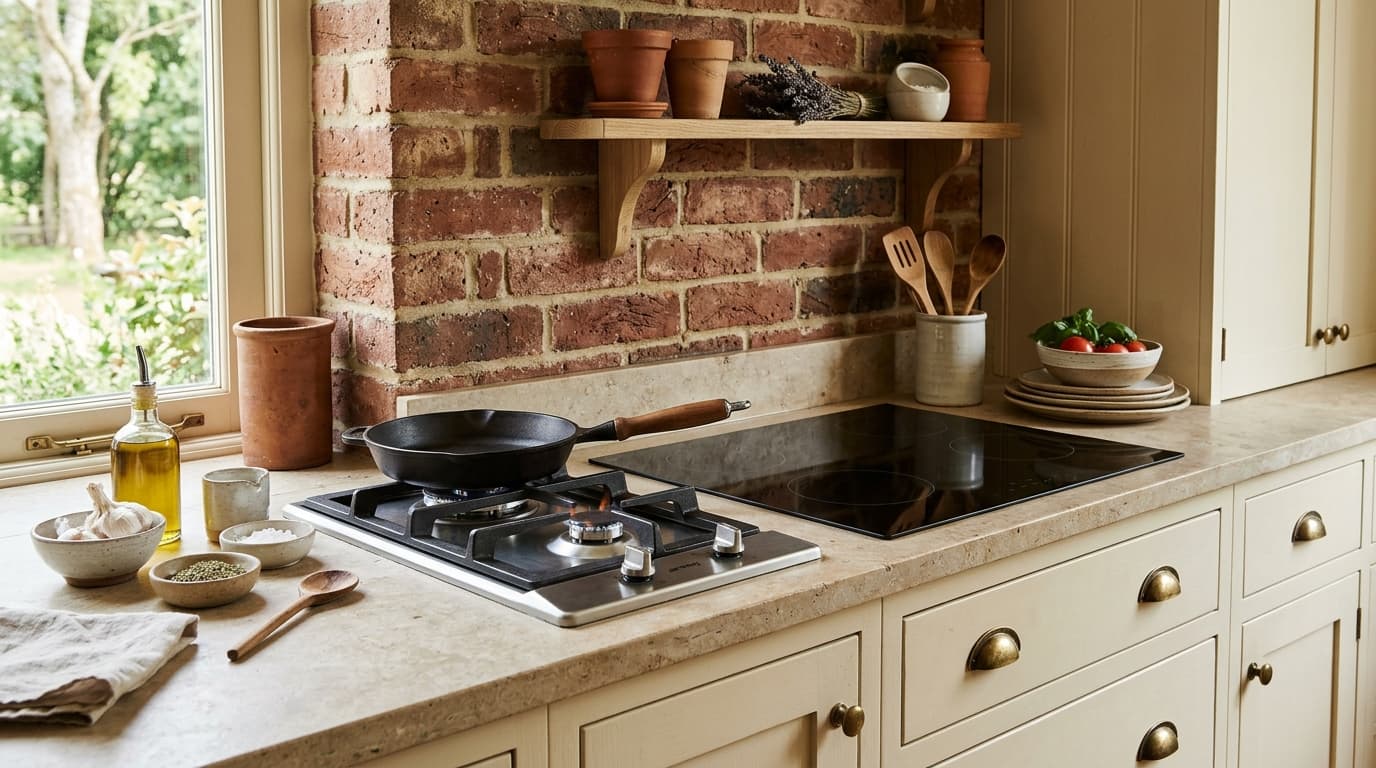
Induction or gas hob: if your boiler runs on gas, keep the flame, it costs 34 to 47 euros less a year. If gas is only used for cooking, induction wins by 57 to 66 euros a year, because the meter's fixed charges weigh more than the gas burned. The hob matters little. The meter decides.
The comparisons you find online ask the question the wrong way round. They compare efficiencies, 90% for induction, 60% for gas, multiply by a price per kWh, and conclude that the gap is a few euros a year. The arithmetic is right and the conclusion wrong, because it forgets the line on the bill that has nothing to do with cooking: the standing charge.
The gas meter costs more than the flame
That is the thesis of this article, and it fits in one table.
A household that cooks every day, without excess, needs about 200 kWh of useful heat a year at the bottom of its pans. At the 60% efficiency used by ADEME, the French energy agency, a gas hob has to burn 333 kWh of gas to deliver it; an induction hob, at 90%, draws 222 kWh of electricity; a ceramic hob, at 75%, about 267 kWh. We priced all three with current Belgian rates: the Eneco Gaz Naturel Flex tariff card of September 2026 for gas, the 2026 gas distribution tariff summary of the CWaPE, the Walloon energy regulator, for ORES, the 2026 gas grid of Sibelga for Brussels, and the CREG rate for the fourth quarter of 2026 for electricity. The CREG is the federal energy regulator.
| Annual cost, cooking only, VAT included | Wallonia (ORES) | Brussels (Sibelga) | Flanders (Fluvius Antwerpen) |
|---|---|---|---|
| Gas burned (333 kWh) | €44 | €35 | €38 |
| Fixed gas meter charges (supplier + network) | €97 | €106 | €100 |
| Total to keep a gas hob | €141 | €141 | €137 |
| Share of fixed charges in that total | 69% | 75% | 73% |
| Induction hob (222 kWh of electricity) | €84 | €82 | €72 |
| Ceramic hob (267 kWh of electricity) | €101 | €98 | €86 |
| Saving if you switch to induction and close the meter | €57 | €59 | €66 |
Three euros out of four on the gas line go to charges that never move, whether you boil an egg or simmer a stew.
These fixed charges combine two items that the bill separates poorly. First the supplier's standing charge, 65 euros a year including VAT at Eneco, an amount that varies from one offer to the next. Then the fixed network term, set by the distribution system operator (DSO, the local grid company you cannot choose) and identical for every supplier: 31.91 euros at ORES, 34.59 at RESA, 15.68 euros plus 18.92 euros for meter reading at Fluvius Antwerpen, 15.90 euros plus 24.95 euros for metering at Sibelga. Our guide to understanding an energy bill shows where to find them line by line.
How much does a hob use, on gas and on induction?
Less than you might think, in both cases. Selectra estimates that an induction hob used for three quarters of an hour a day on two zones takes about 210 kWh a year, a gas hob between 150 and 300 kWh for an hour a day at moderate power, and up to 1,200 to 1,600 kWh for intensive cooking on three or four burners. For a Belgian home that commonly uses 3,500 kWh of electricity and, if it heats with gas, 15,000 to 20,000 kWh of gas, cooking weighs a few percent.
Efficiency explains the gap in kilowatt hours. Induction heats the bottom of the pan directly through a magnetic field; gas heats the surrounding air as much as the pan. A ceramic hob sits in between, since its element must first heat the glass.
But a kilowatt hour of gas is far cheaper. At 13.31 cents all in in Wallonia against 37.79 cents for electricity, the flame delivers its useful heat at about 22 cents per kWh, induction at 42 cents. On variable cost, gas wins. That is the serious objection to our thesis, and it deserves its own section.
If the boiler runs on gas, should you still switch to induction?
No, not for the bill.
If gas already heats the house or the water, the meter stays open anyway, and its fixed charges are due whatever you do with your cooker. Only the gas burned then counts: 35 to 44 euros a year, against 72 to 84 euros of electricity for induction. The gas hob is the cheapest of the three, 34 to 47 euros a year ahead depending on the region. Replacing a gas hob in good condition with induction, in that case, costs money every year on top of the price of the appliance.
The choice then becomes a cooking and practical one. A flame can be adjusted by eye and takes any pan. Induction reacts just as fast, wipes clean in one go, switches itself off without a pan and leaves no naked flame in a kitchen where children come and go, but it needs cookware with a magnetic base.
Above 750 kWh of gas a year, the flame takes back the lead
Our thesis has a limit, and it can be quantified. The more you cook, the bigger the gas burned, and the more the fixed charges are diluted in a total where cheap gas kilowatt hours end up winning. We calculated the break-even point, the gas consumption above which keeping a gas meter for cooking alone costs as much as cooking on induction: 815 kWh a year in Wallonia, 756 kWh in Brussels, 974 kWh in Flanders. Above that, the gas hob remains cheaper, meter included. A family that cooks a lot, on three or four burners for an hour and a half a day, reaches 1,200 kWh, and it then saves 23 euros a year in Flanders, 46 euros in Wallonia and 62 euros in Brussels by staying on gas. To see where you stand, look at the annual gas consumption on your last annual settlement bill: if the boiler is electric or runs on heating oil and the gas line shows less than 750 kWh, most of what you pay for gas is the right to have a meter.
€57 to €66
annual saving by switching to induction, gas used for cooking only
750 to 975 kWh
gas threshold above which the flame becomes cheaper again
€34 to €47
annual lead of gas if the boiler runs on gas
Can the Flemish capacity tariff wipe out the saving?
Partly, yes. Since 2023, Fluvius has charged part of the electricity network on your monthly power peak, measured per quarter hour by the digital meter: this is the capacity tariff. According to Ecopower's tariff card of July 2026, it costs from 49.05 euros (Fluvius Limburg) to 57.10 euros (Fluvius West) per kilowatt per year. An induction hob drawing 2 to 3 kW at dinner time, while the dishwasher and the oven are running, can raise that peak. Just one extra kilowatt on the average of your monthly peaks, and the 66 euros saved in Flanders melt down to about ten euros. There is a way round it: cook without starting the big appliances at the same time, which recent hobs make easier with an adjustable power limit. The mechanism is explained in our article on gas or electric heating, where the heat pump raises the same problem on a larger scale.
The capacity tariff is a Flemish feature. Brussels and Wallonia do not charge households for their monthly peak, and the saving calculated above stays whole there.
Closing the gas meter: the procedure and its cost
No closure, no saving.
Terminating your gas contract is not enough, because an open meter with no supplier ends up in a regularisation procedure at the DSO, then in a closure at its initiative. The clean way is to ask the DSO yourself to close it. In Brussels it is free at Sibelga, gas included, under the 2025 to 2029 grid approved by Brugel, the Brussels regulator. In Wallonia and Flanders, the non-periodic tariff grids we were able to consult only detail electricity, where closing on site costs 128.33 euros excluding VAT at ORES and RESA and 87.82 euros at Fluvius in 2026; ask the DSO for the gas amount before starting, as it may differ. Tariffs and lead times are detailed in our article on opening and closing a meter.
Before signing anything, five checkpoints:
- No other gas appliance in the home: no backup boiler, water heater, stove or gas tumble dryer.
- Your annual gas consumption on the last settlement bill, to compare with the 750 to 975 kWh threshold.
- The state of your pans: if a magnet sticks to the base, they work on induction; if not, budget for replacements.
- The electrical power available: a 7.4 kW induction hob often needs a dedicated circuit and, on a weak single-phase connection, an electrician to check the fuse box.
- Your ten-year plan: reopening a meter costs 106 to 198 euros including VAT depending on the region according to the 2026 grids, gas included in Brussels, and putting gas back into service after works requires a certificate of conformity.
The payback is quick to work out. An entry-level induction hob starts at around 300 euros according to the price survey published by SeLoger in May 2026. With 57 to 66 euros saved a year, it pays for itself in 4.6 years in Flanders before any capacity effect, 5.1 years in Brussels and 5.2 years in Wallonia, not counting closure fees where they apply.
Mixed gas and induction hob: a compromise that costs?
For the bill, yes. A mixed hob, two gas burners and two induction zones, is much searched for and reassures those who hesitate. But it keeps the gas meter open. If gas is only used for cooking, you pay the 97 to 106 euros of fixed charges for a few dozen kilowatt hours burned on a Sunday wok, and you lose most of the saving calculated above. If the boiler runs on gas, the mixed hob costs nothing more, and it makes sense.
Kitchen air, the argument the bill does not show
A gas flame produces nitrogen dioxide. In January 2023, a study by CLASP and the European Public Health Alliance, with simulations by the Dutch institute TNO, estimated that more than 700,000 children in the European Union had asthma symptoms linked to gas cooking, about 12% of cases, and that the WHO daily guideline of 25 µg/m³ was exceeded five days out of seven in the simulated kitchens of Western Europe. These estimates rest on models and have been debated in the scientific community. At the very least they point to a simple rule: a cooker hood that vents outside, on for the whole cooking time, and a window ajar. A carbon monoxide detector remains useful in any home with a gas appliance, and the periodic servicing of the boiler, if there is one, remains mandatory.
In part of the country, the conversion from low-calorific to high-calorific gas also requires old cooking appliances to be checked. And in Brussels as in Flanders, connecting new buildings to gas is already banned: the question there mostly concerns existing homes.
All these figures move. The gas price of a variable contract is re-indexed every month, the standing charge changes from one supplier to another, and the gap between the lowest and highest standing charge on the market is sometimes enough to shift the threshold. Before touching the kitchen, compare the total annual cost of your contract, fixed charges included, in our energy supplier ranking.
Sources. Gas energy price (7.76 c€/kWh), standing charge (€65/year), Fluvius network terms, transport (0.165 c€/kWh) and excise duty (1.0929 c€/kWh), 6% VAT included: Eneco Gaz Naturel Flex tariff card, valid from 1 to 30 September 2026. Fixed and proportional T1 terms of ORES (€31.91/year, 4.289 c€/kWh) and RESA (€34.59/year, 4.639 c€/kWh) including VAT: CWaPE, 2026 gas distribution tariff summary. Sibelga T1 (€15.00/year, 1.482 c€/kWh, YMR metering €23.54/year, excluding VAT, 6% VAT added by us): 2026 gas distribution tariff grid. Electricity: CREG rate for the fourth quarter of 2026, 37.79 c€/kWh in Wallonia, 36.88 in Brussels, 32.25 in Flanders. Fluvius capacity tariff: Ecopower tariff card of July 2026. Cooking efficiencies (induction 90%, ceramic 75%, gas 60%): ADEME, quoted by Selectra, hob consumption guides updated in May and June 2026. Need of 200 useful kWh and induction hob price: SeLoger, 12 May 2026. Closing and opening fees: 2026 non-periodic tariff grids of Brugel, the CWaPE and the VREG (the Flemish regulator), checked on 23 October 2026. Air quality: CLASP, EPHA and TNO, press release of 9 January 2023. The Eneco energy price is used as a reference in all three regions, Brussels included, and the Fluvius "meter reading" column is read as an annual amount; costs, thresholds and payback periods are our own estimates, made on 26 October 2026. No affiliate links, no appliance tested.
Camille
Contrats & tarifs comparator
Compare all contrats & tarifs side by side.
Compare now →
Frequently asked questions
Camille suit le marché belge de l'énergie depuis une dizaine d'années. Elle a d'abord travaillé côté gestion de contrats B2B, puis est passée à l'analyse indépendante : elle éplucha les grilles tarifaires de Mega, Bolt, Engie, Luminus, TotalEnergies, Eneco ou Ecopower, recoupe chaque prix avec le CREG Scan, la CWaPE, le VREG et Brugel, et refait les calculs de facture à la main quand un fournisseur communique un chiffre trop rond. Sa conviction : la plupart des ménages belges ne changent jamais de fournisseur et paient chaque année quelques centaines d'euros de trop — pas par paresse, mais parce que les offres sont volontairement illisibles. Ici, elle traduit les conditions tarifaires en euros par an, et dit clairement quand une « promo » n'en est pas une.