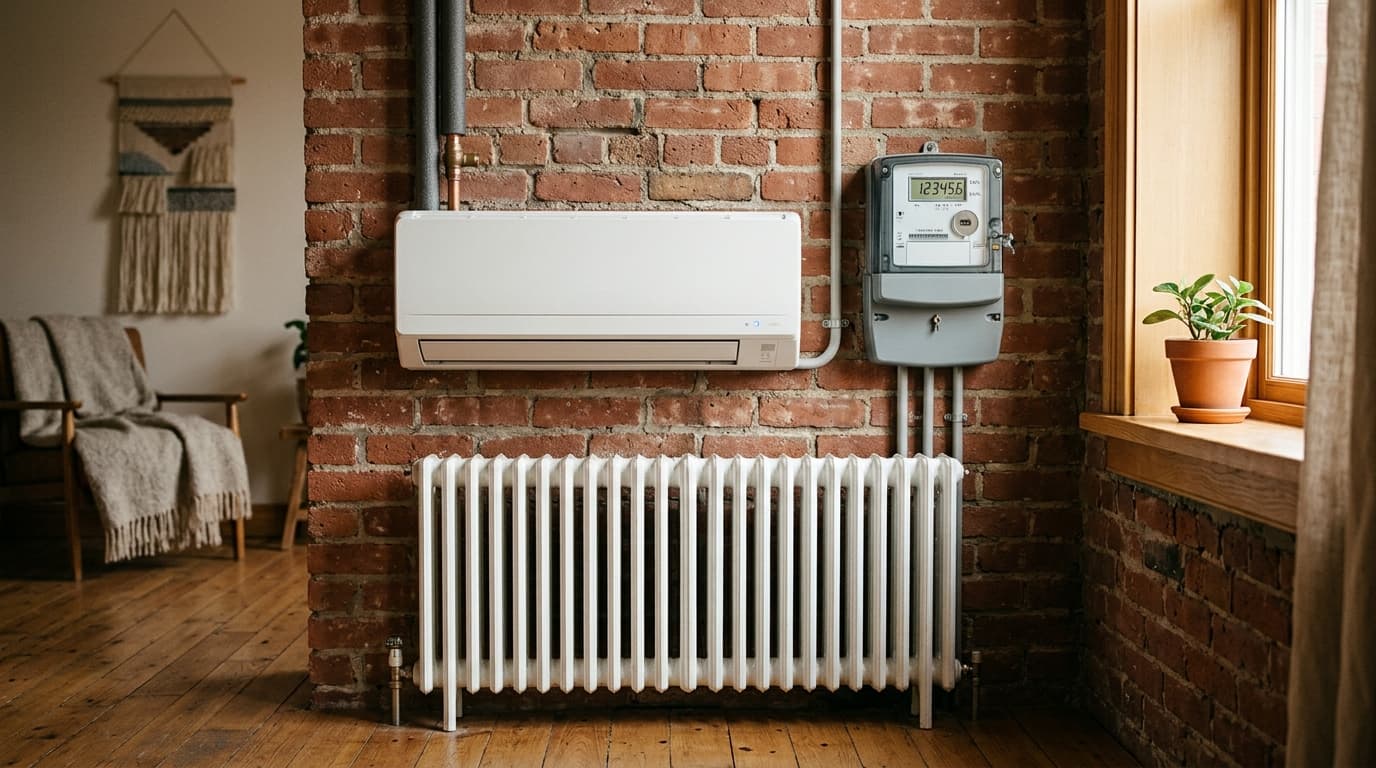
Wallonia's IMPACT tariff and the Flemish capacity tariff are presented as electricity reforms. Above all, they are heating reforms. They do not add a cent to your gas bill, but they move the balance point between a boiler and a heat pump, and not in the same direction depending on how you heat your home.
IMPACT tariff: three network prices by time of day, optional since 2026
Since 1 January 2026, a Walloon household can ask its supplier for the IMPACT tariff. The network tariff, meaning the part of the bill that pays the distribution system operator (DSO, the company that runs the local grid, such as ORES or RESA, which you cannot choose), is no longer a single price: it changes with the time of day, every day of the week, weekends included. You need a digital meter whose communication function is switched on and a connection capacity of 56 kVA or less, according to the press release from the CWaPE, the Walloon energy regulator, dated 3 November 2025. The choice is reversible.
The three slots, as detailed by Test-Achats:
| IMPACT slot | Hours (every day) | ORES network | RESA network | All-in kWh, ORES |
|---|---|---|---|---|
| ECO | 1am to 7am and 11am to 5pm (12 h) | 5.09 c€ | 4.99 c€ | 33.61 c€ |
| MEDIUM | 7am to 11am and 10pm to 1am (7 h) | 10.83 c€ | 10.05 c€ | 39.35 c€ |
| PIC (peak) | 5pm to 10pm (5 h) | 16.57 c€ | 15.11 c€ | 45.09 c€ |
| Single rate (for comparison) | 24 h | 11.98 c€ | 11.06 c€ | 40.50 c€ |
Distribution network tariffs and energy price: Eneco Soleil & Vent Flex rate card valid from 1 to 30 September 2026, 6% VAT included according to the card. The all-in figure adds up energy (17.61 c€), distribution, transmission (2.74 c€), Walloon green certificates (3.22 c€), excise duties (4.876 c€) and the connection levy (0.075 c€), excluding the annual fixed fee.
On the network line alone, the PIC slot costs 3.3 times the ECO slot. On the price you actually pay per kWh, the gap falls to 34%. Energy, taxes and green certificates do not change with the hour and dilute the signal.
How does the capacity tariff work in Flanders?
Flanders took the other road back in January 2023: billing capacity rather than time.
Each month, the digital meter keeps your busiest quarter of an hour. Fluvius, the Flemish DSO, bills the average of these twelve monthly peaks, with a floor of 2.5 kW, multiplied by a price per kW per year. In September 2026, that price ranges from €51.99 (Fluvius Limburg) to €60.53 (Fluvius West); it is €57.45 at Fluvius IMEWO, the Ghent area. In return, the network price per kWh drops sharply: 5.54 c€ at IMEWO with a digital meter, against 11.98 c€ on the single rate at ORES. Test-Achats points out that protected customers on the social tariff are exempt and quotes an average peak of 4.26 kW per household, or about €240 a year.
The time of day no longer matters. Only simultaneity does: a hob, an oven and a car charging at the same moment set the peak for the month.
Why do these two reforms leave your gas bill alone?
Because gas has neither time slots nor a capacity tariff, in Wallonia or in Flanders.
Its network tariff remains a single price per kWh, plus an annual fixed charge that depends on the consumption band. On the September 2026 Eneco Gaz Naturel Flex rate card, a household that heats with gas (band of 5,001 to 150,000 kWh) pays 2.21 c€ per kWh of distribution at ORES and 1.02 c€ at Fluvius IMEWO, plus €140.93 and €98.81 of fixed charges. Gas distribution therefore costs twice as much per kWh in Wallonia as in Ghent, a gap that is rarely highlighted.
A gas boiler also uses a little electricity, for the circulation pump and the electronics. A few dozen watts.
That is far too little to weigh on a peak or to justify changing time slot.
Is the IMPACT tariff worth it with a heat pump?
Yes, and this is where the Walloon reform really changes the choice between energies, even for households that shift almost nothing.
We took a gas household using 17,000 kWh a year, the reference profile used by comparison tools, with a condensing boiler running at 90% efficiency. Its heat demand comes to 15,300 kWh. An air-to-water heat pump with a seasonal coefficient of performance (SCOP) of 3.5 covers it with 4,371 kWh of electricity; with an SCOP of 2.8, more realistic on existing radiators, it needs 5,464.
| Heating mode (September 2026) | Wallonia, ORES | Flanders, Fluvius IMEWO |
|---|---|---|
| Gas, 17,000 kWh, fixed charges included | €2,105 | €1,878 |
| Heat pump SCOP 3.5, single rate | €1,770 | €1,291 + capacity tariff |
| Heat pump SCOP 3.5, IMPACT without shifting anything | €1,647 | not applicable |
| Heat pump SCOP 3.5, IMPACT with scheduling (70% in ECO) | €1,557 | not applicable |
| Heat pump SCOP 3.5, with capacity tariff | not applicable | €1,339 to €1,377 |
| Heat pump SCOP 2.8, IMPACT without shifting anything | €2,059 | not applicable |
| Heat pump SCOP 2.8, with capacity tariff | not applicable | €1,700 |
Our calculations of 2 November 2026, based on the Eneco Flex gas and electricity rate cards for September 2026. Gas: energy 7.67 c€, distribution, Fluxys transmission 0.165 c€ and federal excise of 1.09 to 1.18 c€ depending on the band, giving 11.17 c€ per kWh in Wallonia and 9.97 c€ in Flanders, plus the €65 fixed fee and the network's fixed charges. Electricity in Flanders: 29.54 c€ per kWh excluding the capacity tariff (the card shows no separate transmission charge for Fluvius). The heat pump cost assumes the gas meter is closed; it excludes purchase and installation.
The most telling result sits in the "without shifting anything" line. A heat pump runs day and night, and half the hours of the day fall in the ECO slot: even without scheduling and with steady consumption over 24 hours, its average kWh comes to 37.68 c€, against 40.50 c€ on the single rate. With 70% of consumption in ECO, thanks to a hot water tank heated in the afternoon and a house preheated before 5pm, the average kWh falls to 35.62 c€. The saving over the single rate then reaches €213 a year, and over gas €548.
In Flanders, a heat pump's peak costs €48 to €86 a year
The usual fear is that the capacity tariff punishes heat pumps. The figures say otherwise. A compressor that adds 2 kW to the peak during the five cold months raises the annual average by 0.83 kW, or €48 a year at €57.45 per kW at IMEWO. If the 6 kW backup heater kicks in during the two coldest months, the bill rises to €86. On an electric heating bill of about €1,300, that is an extra 4 to 7%. The real danger is not the compressor, it is the electric backup heater starting at the same time as the oven on a January evening, and that peak weighs on the average for twelve months.
On high-temperature radiators, the advantage melts away
The serious objection comes from the existing heating system. A heat pump connected to radiators sized for a boiler has to produce water at 55 or 60 °C, and its seasonal efficiency drops. With an SCOP of 2.8, our Walloon calculation gives €2,059 on the IMPACT tariff, against €2,105 for gas: a €46 difference per year, before even paying off an installation that costs thousands of euros. In Flanders, the same heat pump stays €178 cheaper than gas, because a kWh of electricity costs 11 c€ less than in Wallonia thanks to a low network price per kWh and lighter green certificates. The IMPACT tariff improves the heat pump; it does not rescue a poorly sized installation. The hybrid solution, which keeps the boiler for the coldest days, exists precisely for this case, and our article on the hybrid gas heat pump runs the numbers.
Brussels waits for 2028 and 2030
No IMPACT tariff and no capacity tariff in Brussels in 2026. Sibelga, the Brussels DSO, keeps its off-peak hours from 10pm to 7am on weekdays and all weekend.
The timetable is set. In its decision of 8 July 2026, Brugel plans a capacity tariff in euros per kVA of available capacity from 1 January 2028, with a minimum of 2.3 kVA under discussion, then a three-slot tariff from 1 January 2030: peak from 5pm to 10pm, day from 7am to 5pm, night from 10pm to 7am. The three slots will only apply to remotely read smart meters. The social tariff, which is all-in, will not be affected. For a Brussels resident weighing a boiler against a heat pump, today's calculation is therefore still the one in our article on gas or electric heating, to be redone in 2028.
Who should ask for the IMPACT tariff?
Households that use a lot and can shift. Test-Achats puts the distribution cost of an average household using 3,408 kWh at €384 on the single rate, €327 on the dual rate and €309 on IMPACT without changing anything, and that of a household with an electric car (7,380 kWh) at €493 on IMPACT used well, against €813 on the single rate.
Winning profiles and traps, based on the figures above:
- Heat pump or electric car: almost certainly a winner, even without fine scheduling.
- Programmable electric water heater: a winner if it heats between 11am and 5pm or after 1am.
- Gas heating with low electricity use: a modest gain, to compare with the new dual rate, whose off-peak hours already cover 62.5% of the week.
- Electric cooking and appliances between 5pm and 10pm: a trap, the peak slot is the most expensive of all options.
- Prosumer with a meter that runs backwards: Test-Achats advises against the IMPACT tariff for now, as no suitable offer exists.
- Digital meter without communication: the tariff is unavailable until the function is switched on by the DSO.
You request the tariff from your supplier, who must offer it. Eneco shows it on its rate card, as does TotalEnergies on a dedicated card. Febeg has been challenging this obligation before the Constitutional Court since the end of June 2026, which changes nothing for households as long as no ruling is handed down. For the difference between the new dual rate and the single rate, see our article on the dual-rate or single-rate meter, and to switch on the communication function, the one on the digital meter.
The network tariff is imposed by your DSO; the energy price, on the other hand, varies from one supplier to another, and it weighs the most in the all-in kWh. Compare the annual cost of gas and electricity offers in our energy supplier ranking. Any work on a boiler, a heat pump or an electrical panel is a job for an accredited professional.
Sources. IMPACT tariff, eligibility and new dual rate: CWaPE, press release of 3 November 2025. IMPACT time slots and distribution simulations: Test-Achats, report of 25 November 2025 updated on 11 June 2026. How the capacity tariff works, 4.26 kW average peak and exemption of protected customers: Test-Achats, 5 June 2025. Network tariffs, capacity tariff by network area and energy prices: Eneco Soleil & Vent Flex and Eneco Gaz Naturel Flex rate cards, valid from 1 to 30 September 2026. Brussels tariff structure: Brugel, decision 390 of 8 July 2026. Febeg action: Belga dispatch of 30 July 2026. The annual costs by heating mode are our own calculations of 2 November 2026, on explicit assumptions (90% boiler efficiency, SCOP of 3.5 and 2.8, hourly split of consumption). Variable rates are re-indexed every month: redo the maths with your own rate card. No affiliate links.
Camille
Électricité comparator
Compare all électricité side by side.
Compare now →
Frequently asked questions
Camille suit le marché belge de l'énergie depuis une dizaine d'années. Elle a d'abord travaillé côté gestion de contrats B2B, puis est passée à l'analyse indépendante : elle éplucha les grilles tarifaires de Mega, Bolt, Engie, Luminus, TotalEnergies, Eneco ou Ecopower, recoupe chaque prix avec le CREG Scan, la CWaPE, le VREG et Brugel, et refait les calculs de facture à la main quand un fournisseur communique un chiffre trop rond. Sa conviction : la plupart des ménages belges ne changent jamais de fournisseur et paient chaque année quelques centaines d'euros de trop — pas par paresse, mais parce que les offres sont volontairement illisibles. Ici, elle traduit les conditions tarifaires en euros par an, et dit clairement quand une « promo » n'en est pas une.